JMP platforms and statistical methods
Graph Builder:
Mosaic plot, comparative dot plots and box plots
Distribution:
Bar charts, summary statistics, inference for population proportion
Reliability:
Life distribution (Weibull)
Objective
Use statistical reliability modeling methods for censored data to describe and compare the performance of a bone plate made of different materials.
Problem statement
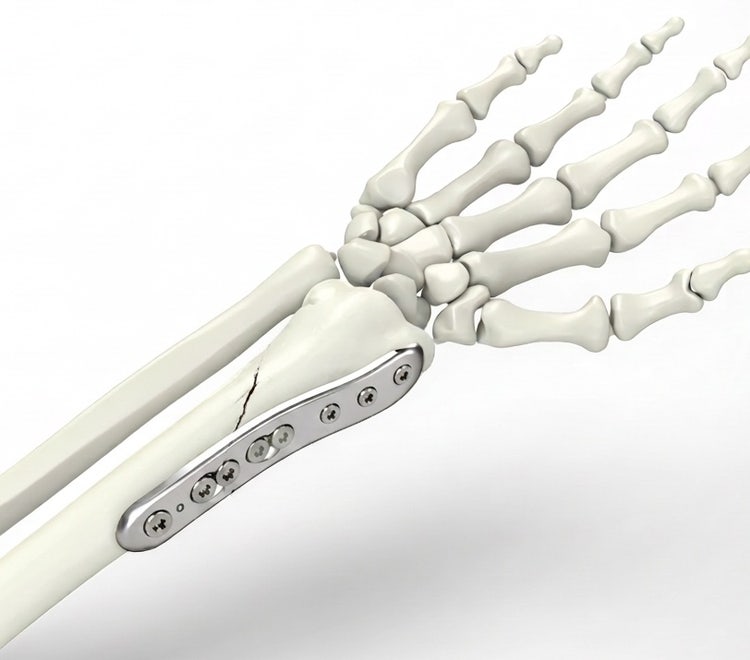
Surgeons often use bone plates and screws to provide the necessary mechanical support to facilitate proper healing of a bone fracture.
Manufacturers of these plates and screws are required to subject their products to frequent testing to validate their durability. These tests are also part of R&D efforts as scientists and engineers work on structural changes and materials to improve upon the performance and durability of their products.
One such test procedure, known as flexure testing, applies a repetitive pulsating force onto the specimen; the number of cycles to produce an undesired amount of deformation of the specimen is observed. The force used for the testing is much greater than what would be experienced in real usage to accelerate failure.
The engineering team is working on two new formulations designed to reinforce the base material. As the team is still early in the development stage, an initial sample of 20 specimens of both the XR and XT reinforcement material has been made in the product development lab. These specimens, along with a sample of 25 base specimens, were tested. The tests were stopped after 5,000 cycles, even if the undesired deformation had not occurred.