JMP platforms and statistical methods
Distribution:
Histogram, box plot, summary statistics
Graph Builder:
Comparative dot plots and box plots;
time series plot of means and standard deviations;
location heat map
Objective
Analyze data for a semiconductor planarization process, using graphical analyses and summary statistics, to compare the performance of chemical slurry products from different suppliers to identifying the supplier that can produce the most consistent wafer thickness.
Problem statement
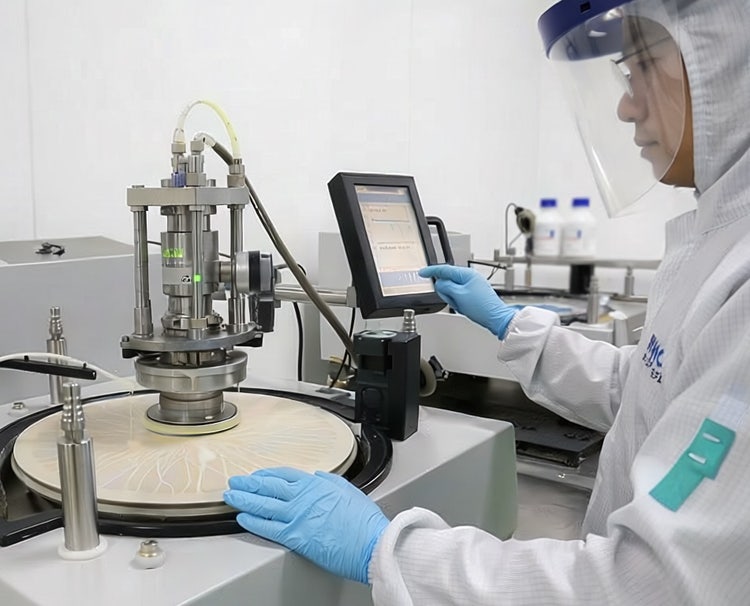
Chemical mechanical planarization (CMP) is a critical process in semiconductor manufacturing used to achieve precise and flat surfaces on silicon wafers. It is crucial for ensuring that subsequent layers of materials in the integrated circuit manufacturing process adhere properly and function correctly.
CMP involves the use of a chemical slurry, which typically contains abrasive particles suspended in a liquid solution. Simultaneously, a mechanical force is applied through a rotating polishing pad. The combination of chemical action and mechanical abrasion allows for removal of material resulting in a thin film on the wafer's surface.
Ideally, the resulting surface will be perfectly uniform across the wafer, and all wafers going through this process will have a thin film surface thickness that meet specifications.
Engineers in one such wafer manufacturing facility have been conducting a comparative analysis of slurries from four different supplies to decide which would be the best to use. One part of this study was to use each slurry in a 50-wafer production run. The resulting thickness of the film was measured on 21 different locations on each wafer. The specification for this process is a uniform film thickness of 750 +/- 15 nanometers.