The ultimate guide to functional data analysis for scientists and engineers
Preparing functional data for analysis

Why prepare functional data before analysis?
Functional data – such as temperature curves, absorbance spectra, or sensor signals – are continuous by nature and often noisy, misaligned, or irregularly sampled. Without proper preparation, your subsequent analyses may misinterpret noise or timing differences as meaningful structure. Preprocessing ensures that the data you're working with is clean and aligned, thus revealing true patterns and trends rather than artifacts and random variation.
Three key preprocessing steps in functional data analysis (FDA)
1. Cleaning to improve data quality
Cleaning functional data is an essential step to ensure that the curves or signals you're analyzing are accurate, reliable, and meaningful. Since functional data are collected over continuous domains, they can be affected by various sources of noise. This noise can be problematic in all data types but is amplified with the complexity of functional data’s structure.
Cleaning involves removing outliers, correcting measurement errors, or filtering signals to improve quality while enhancing the accuracy and reliability of functional data by addressing:
- Outlier detection: Identifying and removing abnormal points or curves caused by sensor errors or rare events.
- Error correction: Filtering to remove areas of data with known measurement issues.
By addressing these issues, you can significantly enhance the quality, accuracy, and reliability of your functional data, which in turn leads to more valid comparisons and robust models.
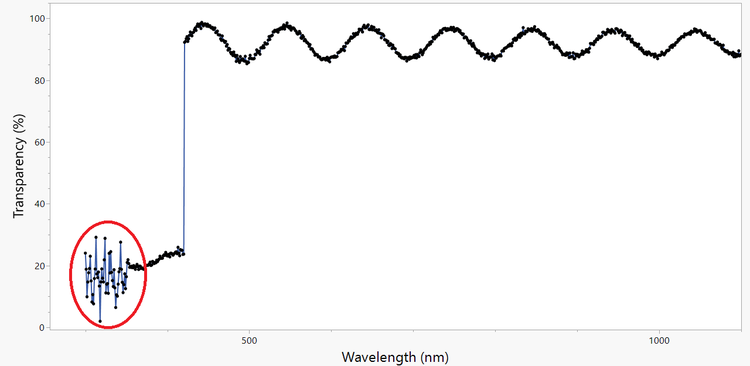
Noisy spectroscopy data to be removed to ensure a meaningful analysis.
2. Alignment to match key features
Even when curves share the same structure, their key features might be shifted or misaligned along the time or space axis. Row alignment ensures that key features are synchronized across samples, enabling more meaningful comparisons.
Without alignment, the variation caused by timing differences or phase shifts can mask the true differences in shape or amplitude that FDA is meant to capture.
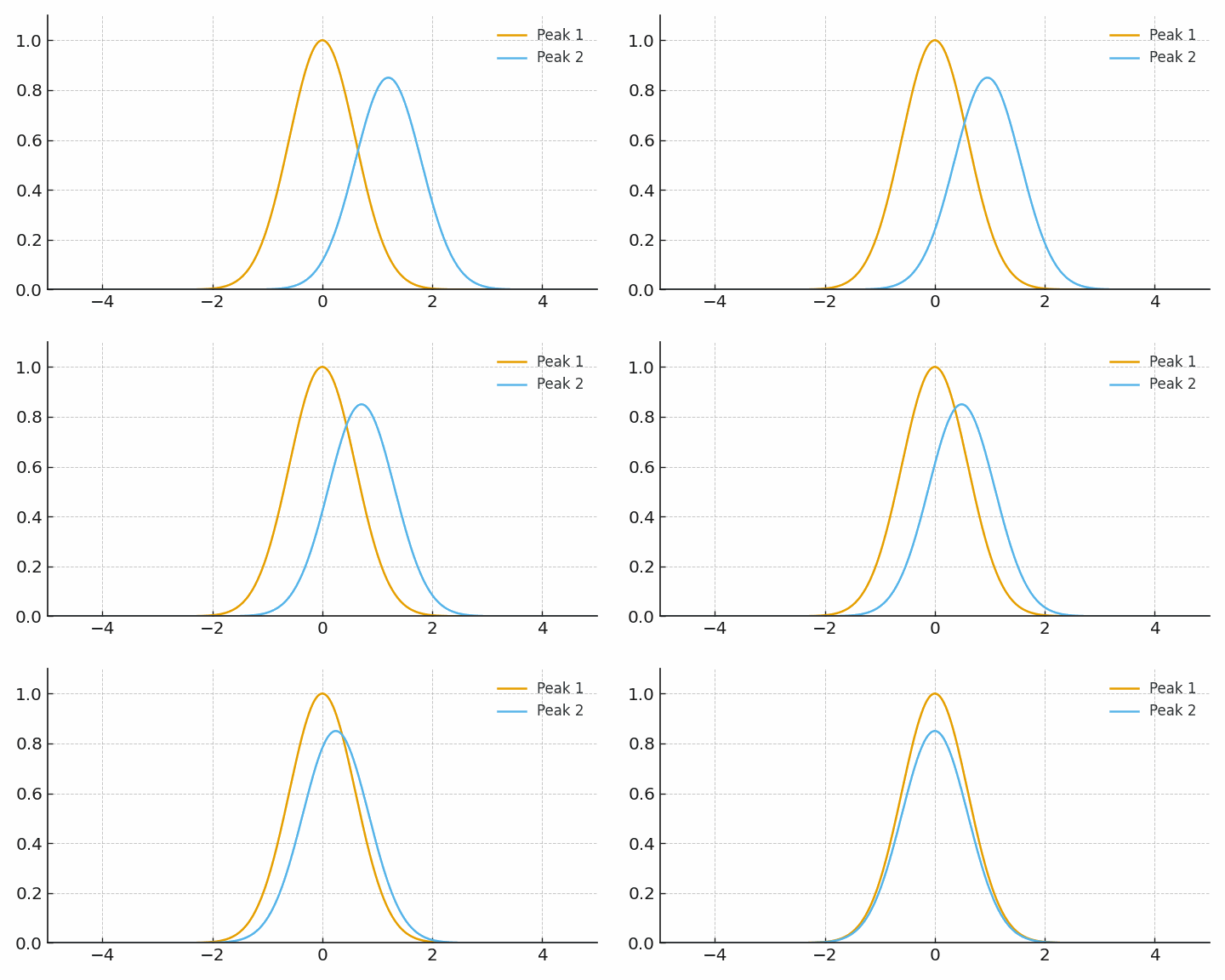
Aligning the maxima of curves can enable more meaningful comparisons.
Aligning maxima or minima: One simple method is to align curves by shifting them so that a common feature like the maximum or minimum point is synchronized. This is useful when all curves are expected to share a dominant peak or dip, such as:
- Aligning absorbance peaks in spectral data.
- Aligning reaction rate maxima in chemical process curves.
- Aligning growth spurts in biological growth data.
This method is fast and interpretable, but assumes the key feature is consistent and clearly defined across samples.
Dynamic time warping (DTW): Dynamic time warping is a more advanced and flexible alignment method. It allows stretching or compressing of the curve along the X axis so that similar shapes align. It works by:
- Computing point-by-point differences between two curves.
- Finding an axis adjustment that minimizes the difference between two curves.
DTW is ideal for curves with variable timing, such as:
- Biological signals (e.g., ECG, EMG).
- Sensor data from machines under different loads.
- Batch processes where timing varies but process stages are similar.
Why DTW matters: By effectively aligning curves despite variations in their timing, DTW allows the analysis to focus on the genuine differences between shapes, rather than being misled by phase differences.
In short, row alignment ensures that curves are compared fairly, revealing true shape-based variation rather than artifacts of when events happen. It's a key preprocessing step for meaningful functional analysis across many domains.
3. Preprocessing spectral data
Raw spectral data – such as UV-Vis, NIR, and Raman measurements – are excellent candidates for FDA analysis. However, these data sets often contain noise caused by factors like instrument sensitivity, environmental conditions, or sample impurities. Therefore, signal preprocessing is crucial for preparing this data for analysis.
Several techniques are commonly employed to enhance the quality of spectral data. Before utilizing FDA, it is often useful to apply signal processing to ensure the data is ready for analysis. Spectral data represent functional forms that can benefit from these signal processing techniques.
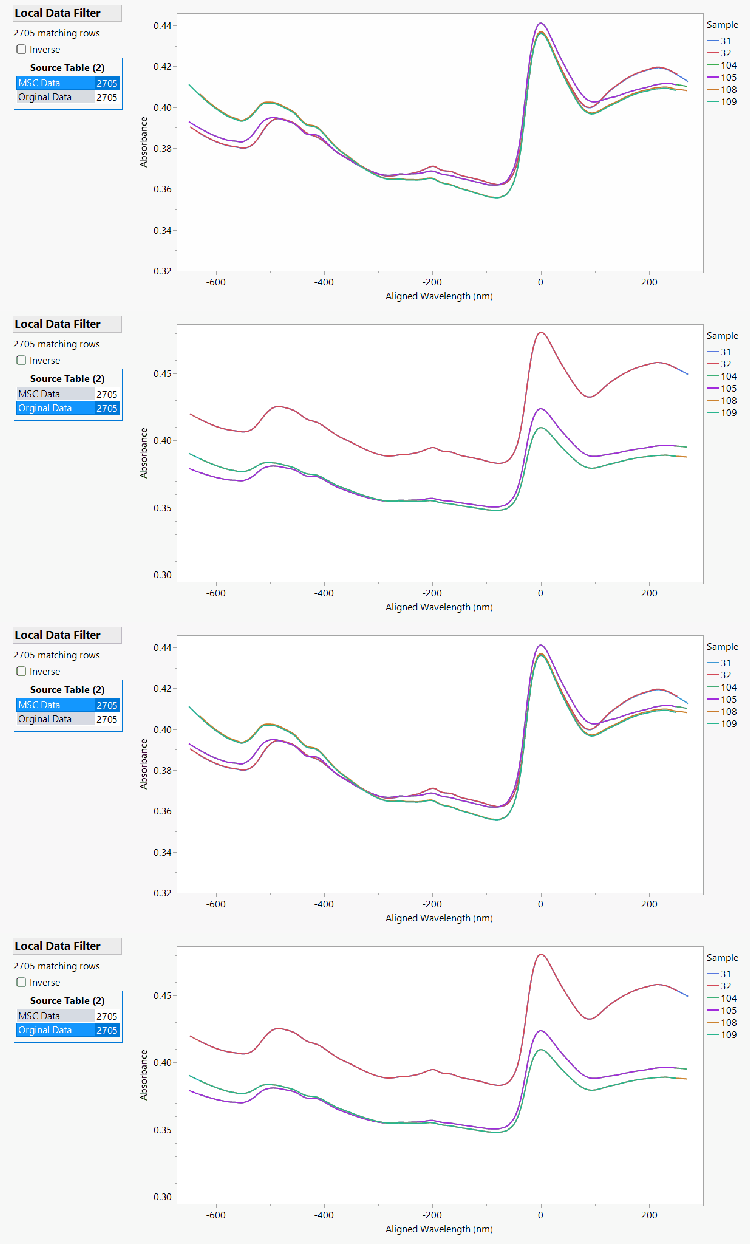
Multiplicative scatter correction adjusts for texture and density differences to improve spectral model accuracy.
- Standard normal variate (SNV): Normalizes intensity to reduce scatter caused by differences in sample particle size or path length. It works by centering and scaling each spectrum individually.
- Multiplicative scatter correction (MSC): Adjusts spectra for light-scattering effects in solid or powdered samples. Each spectrum is regressed against a reference spectrum (often the average) and corrected by adjusting slope and intercept to match the reference. MSC is especially helpful when comparing samples with different surface textures or densities, and it improves the accuracy of classification or regression models built on the spectra.
- Derivative transformation: Enables us to highlight areas of change or inflection points in the data. One popular method of derivative transformation is the Savitzky-Golay method, which allows for smoothing spectral data while highlighting important features by taking the derivative of the data. It reduces high-frequency noise while maintaining the integrity of the underlying signal – crucial for detecting subtle spectral shifts or peak shapes.
- Baseline correction: Many spectra contain a background signal (baseline drift) unrelated to the sample’s chemical properties. Techniques like polynomial fitting or wavelet-based baseline correction are used to remove this unwanted background so the real peaks stand out.
Summary
Proper preparation through smoothing, cleaning, aligning, and targeting transforms raw functional data into a powerful source of insight. These steps ensure that FDA models highlight the real, meaningful structure in your data, improving both interpretation and predictive performance.
Frequently asked questions about preparing functional data for analysis
What qualifies as functional data?
What if curves are measured at different points?
Why is cleaning the data important?
How do I prepare spectral data?
To reduce baseline shifts and scattering effects, apply spectral preprocessing techniques, such as:
- Standard normal variate (SNV)
- Multiplicative scatter correction (MSC)
- Savitzky-Golay filtering