The ultimate guide to functional data analysis for scientists and engineers
Understanding functional principal component analysis (FPCA)

What is functional principal component analysis?
Functional principal component analysis is a statistical technique for finding structure in dynamic data that vary continuously. Instead of treating each measurement as an isolated point, FPCA represents each observation as a curve or function. In FPCA:
- Each set of observations is fit to a function to capture the shape of the data.
- The goal is to identify a small number of functional principal components (FPCs) that capture the variation across the entire set of these functions.
- Each function can be represented as a weighted sum (FPC score) of these shape components plus a mean function.
Why is FPCA important for analyzing dynamic data?
Many types of modern data are inherently dynamic. This type of dynamic data is highly autocorrelated: adjacent points in a curve are not independent. Process curves in manufacturing, environmental measurement across time, and spectral data all exhibit smooth, correlated variation.
This data can vary in shape, not just level; subtle curve differences are missed when analyzing only a few key time points.
Ignoring the functional nature of the data can lead to:
- Losing information that's contained in the data structure.
- Overfitting noise rather than capturing smooth trends.
- Misinterpreting variability.
How is FPCA different from standard PCA?
FPCA builds directly on ideas familiar from standard principal component analysis (PCA). Standard PCA summarizes variation in multivariate data by identifying linear combinations of variables, principal components, that capture the greatest variance. These components are defined by vectors.
FPCA extends this idea to autocorrelated dynamic data where observations are fit to a smooth function rather than a vector. FPCA finds principal functions that represent the main modes of variation across curves.
I used PCA to identify differences in an X-ray diffraction spectroscopy study. It performed well with evenly spaced spectra and when variation was captured by few principal components. However, PCA was less effective in high-pressure liquid chromatography (HPLC) when data included distortions and misaligned peaks. These peak offsets and distortions often obscured true underlying patterns.
FPCA could have made data interpretation much easier in that HPLC study. Unlike traditional PCA, FPCA is better suited for handling functional data, such as spectra, especially when peak alignment and shape differences matter. FPCA would have simplified the analysis by directly capturing these shape variations.
To summarize, just like PCA, FPCA:
- Reduces dimensionality.
- Summarizes variability.
- Enhances interpretability.
But it does so while preserving the continuous structure and shape of the functional data, thus improving the interpretability and flexibility of the functional data.
Key benefits of fitting functions to data in FPCA
In fields such as manufacturing, medicine, and environmental monitoring, fitting smooth functions to data reveals subtle process dynamics and improves predictive performance in applications where shape matters more than single-point summaries.
By expressing data as smooth functions, this approach:
Captures full dynamics
Rather than summarizing with a few points (e.g., max or mean), the entire shape of the data is preserved.
Enables functional modeling
Once reduced, the scores can be used in common analysis techniques, such as regression.
Reduces dimensionality
Complex curves are distilled into a few FPCs to capture variation.
Reduces impact of noise
Smoothing is built into the framework, improving robustness to noise and missing values.
Improves interpretability
FPCs often correspond to meaningful shape features.
How to perform FPCA
Performing FPCA involves representing functional data in a smooth, manageable form and then analyzing variation across those functions.
Fitting basis functions to the data
Dynamic data are continuous and often high-dimensional, requiring a manageable representation for analysis. For FPCA, a basis function such as splines, Fourier series, or wavelets fits to the observed data, representing each data set as a smooth curve. FPCA models each curve, enabling clearer, interpretable analysis that reveals data's true structure.
Choosing which basis function to use depends primarily on the characteristics of the data and the goals of the analysis: the smoothness or structure of the data, whether the curves are periodic or not, and the balance between computational cost and flexibility. Common choices include:
- B-splines: Great for capturing local variation and modeling non-periodic, irregular curves. Ideal with simple curves that have sharp bends or vary in specific regions.
- P-spline: A spline that has a penalty applied to its coefficients, resulting in a smoother and more robust fit to data.
- Fourier: Best suited for smooth and periodic data (e.g., seasonal trends, cyclic signals). Basis functions are sinusoids, capturing global variation.
- Wavelets: Excellent for multiscale analysis, they capture both smooth trends and localized spikes. Useful in signals with abrupt changes or noise, and often used with spectral data.
Interpreting results in FPCA
The starting point for interpreting FPCA results is the mean function, which represents the average curve across all sets of observations. Once the mean function is known, FPCA looks at all the ways the individual curves deviate from that average.
These deviations are summarized as shape functions, which are distinct patterns that capture the main ways the curves differ from the mean shape. Interpreting shape functions involves understanding the shape change each component introduces relative to the mean function.
Each shape function represents a distinct "shape mode." For example:
- Shape Function 1 might reflect an overall vertical shift (level).
- Shape Function 2 might reflect a widening or narrowing of the curve.
- Shape Function 3 might reflect timing shifts of peaks.
These deviations help reveal which kinds of variation are present across the sets of observations and whether differences are mostly in level, shape, or timing.
The FPC scores measure how strongly each curve expresses these shape functions. Positive and negative scores indicate the direction and magnitude of deviation from the mean shape. These scores are analogous to PCA scores and can be used in standard analysis techniques, such as clustering or regression.
This interpretation helps identify not just how much functional observations differ from one another, and in what way, making it possible to separate changes in shape.
A scree score plot enables clearer visualizations
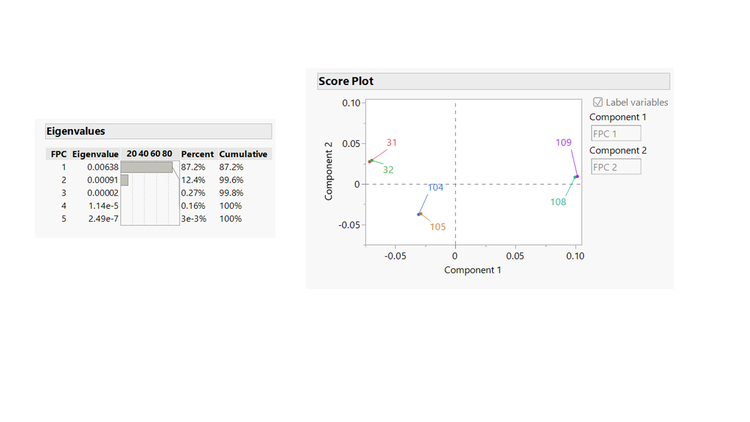
This image shows the scree plot and score plot from an FPCA analysis. The scree plot provides a Pareto-style view of the functional principal components, indicating the percentage of variance each component explains. The score plot highlights how closely related the batches are to one another, making it easy to visualize similarities and groupings.
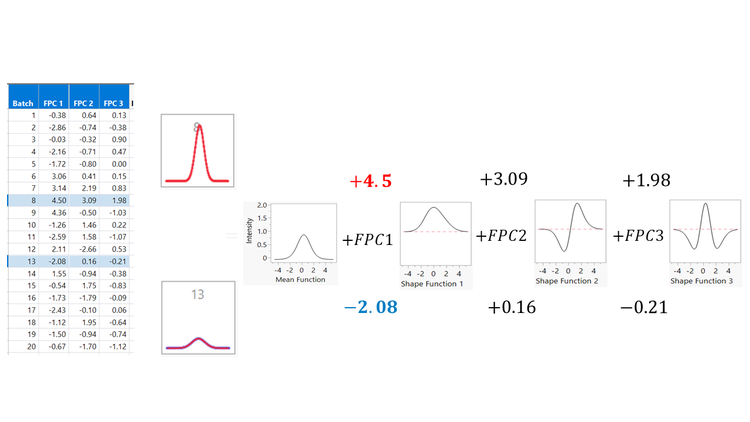
Visualizing FPCs: Mean ± score × shape component
A powerful way to interpret functional principal components is through visual comparison. By plotting the mean function together with different FPC scores for each shape component, you can see how that component alters the overall curve shape.
These plots make it easy to visualize:
- What it means to have a high or low score on a given FPC.
- How the curve's shape changes as you move along that component.
- Which regions of the curve are most impacted by the different FPC scores.
Seeing these effects directly makes FPCs more intuitive and interpretable, showing how each mode of variation influences the function’s shape.
This visual reconstruction also has practical analytical benefits:
- Noise filtering: Using only a few dominant FPCs retains major shape variation while removing minor noise.
- Dimensionality reduction: You can represent each shape made up of hundreds of data points with just a few FPC scores.
- Comparative modeling: You can model or cluster curves based on their FPC scores, which reflect core shape differences.
Visually, you can compare:
- The original data vs. the reconstructed curve using a few FPCs.
- How including more FPCs improves the fit or overfits the data.
- How well a few shape patterns explain most of the variation in the data.
Through these visual comparisons, FPCA reveals how curves differ and helps interpret the underlying structure of complex, dynamic systems at a glance.
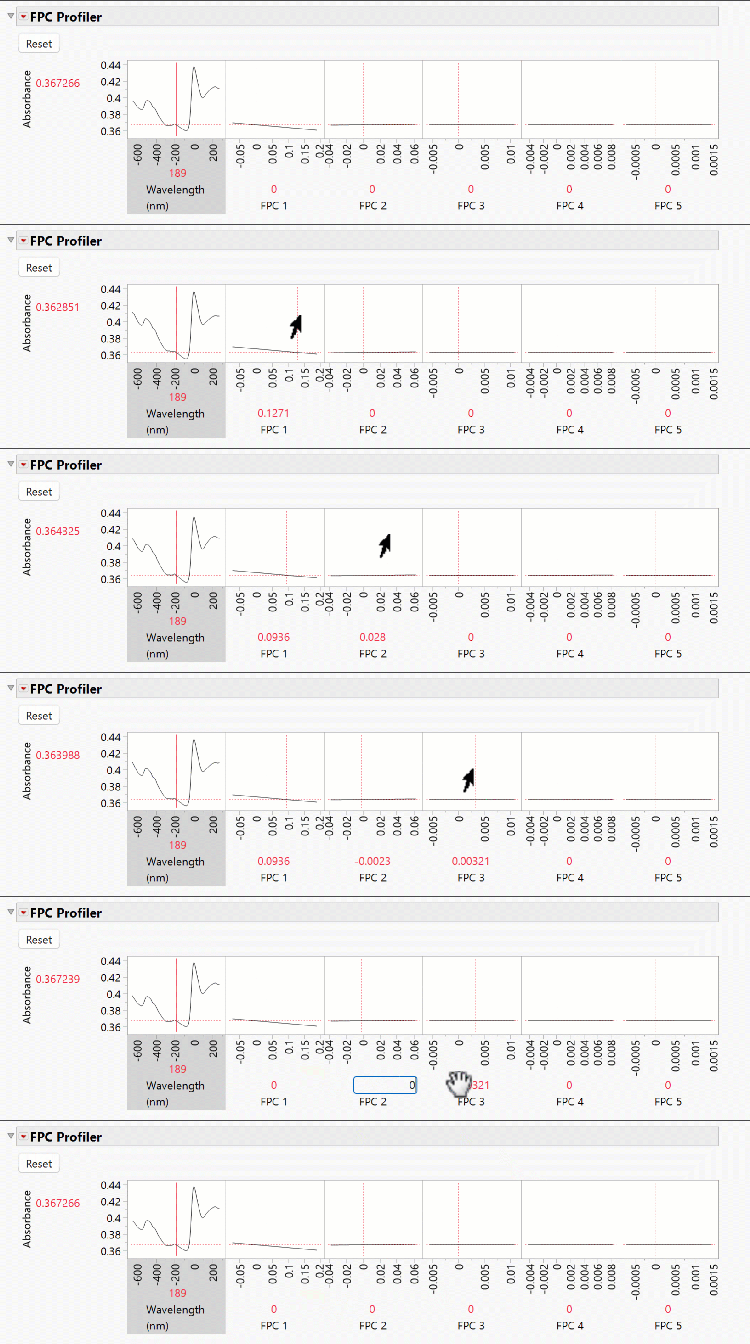
The FPC Profiler allows for dynamic component comparisons
This image depicts the FPC Profiler. Adjusting each component’s slider shows how the functional shape changes as the corresponding FPC scores are varied.
Which components tell the real story?
Once you’ve visualized how each component affects the curve’s shape, the next question is which ones really matter. Depending on the complexity of your dynamic data, you will need a different number of functional components to describe most of the variation in your data. The scree plot shows how much variance each component explains and helps you see where the returns start to diminish..
The goal is to capture the main shape patterns without including components that mostly reflect noise or small local features. In many cases, the first few FPCs tell most of the story, giving you a compact, interpretable summary of the dominant sources of variation that you can use for modeling, clustering, or prediction.
The applications and benefits of FPCA
FPCA provides powerful tools for simplifying and analyzing complex curve data. By reducing a large set of data to a function and describing the variation in functions with a small set of FPC scores, FPCA enables a range of applications:
- Clustering and classification: Group similar curves based on shape patterns captured by FPC scores.
- Functional regression: Use FPC scores as predictors or responses to model relationships between curves and other variables.
- Outlier detection: Identify curves with unusual shapes by detecting extreme FPC scores.
Overall, FPCA transforms complex functional data into insights while preserving key shape information. Across domains such as manufacturing, biotechnology, and spectroscopy, FPCA helps researchers and engineers uncover hidden structure, compare process behaviors, and draw clearer conclusions from complex, time-varying data.
Frequently asked questions about functional principal component analysis
What is FPCA?
How does FPCA differ from standard PCA?
Why use FPCA instead of analyzing raw functional data?
What are FPC scores and why are they important?
How many functional components should be kept?
What types of basis functions are commonly used?
Common choices include:
- B- and P-splines for smooth curves.
- Fourier basis for periodic data.
- Wavelets for data with sharp features.
Is it necessary to preprocess data before FPCA?
It depends on how clean the data set is. Often, you will need to apply some preprocessing. These steps may include:
- Cleaning to remove noise that is not relevant to the signal.
- Alignment (registration) to handle shifts in curves.
- Spectral preprocessing to adjust for baseline irregularities or perform data smoothing.
What are common applications of FPCA?
- Spectroscopy: Analyze and compare spectral shapes.
- Biotechnology: Study growth/decay curves.
- Manufacturing: Monitor process profiles over time.