How to reduce process variation and improve manufacturing quality
A systematic approach to understanding, reducing, and controlling process variation
Why process variation matters
Manufacturing teams are under constant pressure to improve quality while maintaining throughput, reducing waste, and controlling costs. Yet even well-established processes can produce inconsistent results. Outputs drift off target, variability increases, and defects begin to appear.
The consequences can be significant: scrap and rework increase, troubleshooting consumes valuable engineering time, schedules slip, and customers receive products that fail to meet expectations.
The challenge is that process variation is not always obvious or easy to diagnose. Without a clear understanding of what is driving variability, teams may struggle to stabilize processes or sustain improvements over time.
Reducing process variation is harder than it looks
All processes vary — but not all variation means the same thing
Every manufacturing process contains some level of natural variation. Raw materials fluctuate slightly, equipment performance changes over time, and environmental conditions shift. Some variation is expected and unavoidable.
The challenge is determining whether observed variation reflects normal process behavior or whether it signals a meaningful change that requires investigation.
This distinction is often described as:
- Common cause variation — The natural variability built into a stable process.
- Special cause variation — Unexpected variation caused by a specific change, disruption, or failure in the process.
In practice, distinguishing between the two is not always straightforward. Teams may react to normal fluctuations as though they are serious problems, or overlook meaningful process shifts until defects or failures become visible downstream.
The true drivers of variation are rarely obvious
Modern manufacturing processes rarely depend on a single variable. Product quality may be affected by differences in raw materials, machine settings, environmental conditions, operator practices, equipment status, and many other factors.
These variables often interact in ways that make diagnosing the underlying causes of variation extremely difficult. Combine that with the sheer volume of data modern processes generate and it's no wonder that identifying the factors that truly matter to quality and process performance can be so difficult.
Common approaches (and where they fall short)
Why traditional methods become difficult to sustain as processes grow more complex
Many teams try to reduce process variation using methods that may work in simple situations but become difficult to sustain as processes grow more complex:
-
Trial-and-error and one-factor-at-a-time testing
Trial-and-error and one-factor-at-a-time testing are intuitive starting points: change a setting, observe the result, and repeat. They may deliver short-term improvements, but they are often slow, difficult to reproduce, and prone to overlooking interactions between variables.
-
Spreadsheet-based analysis
Spreadsheets are widely used for process analysis, but they can make it difficult to identify patterns in large or multivariate data sets. They can also make analyses difficult to reproduce, maintain, and share across teams.
-
Reactive quality control
Many organizations focus on inspecting products after defects occur rather than monitoring process behavior over time. This reactive approach may identify problems too late to prevent scrap, rework, or process instability.
A systematic approach
Understand what drives variation and how to control it
Reducing process variation requires more than isolated troubleshooting or reactive adjustments. Effective quality improvement depends on understanding how a process behaves over time, identifying the factors that contribute most to variability, and establishing stable operating conditions that can be maintained consistently.
A more systematic approach combines statistical methods, process monitoring, and data-driven experimentation to help teams make better decisions and improve process performance with greater confidence.
Distinguish normal variation from meaningful process shifts
Ensure the measurement system is reliable
Assess whether the process is capable
Identify and reduce the sources of variation
Optimize and stabilize the process over time
How JMP helps
Move from reactive troubleshooting to systematic quality improvement
JMP combines interactive statistical analysis, visualization, and process improvement tools in a single environment, helping manufacturing teams make better decisions with greater confidence.
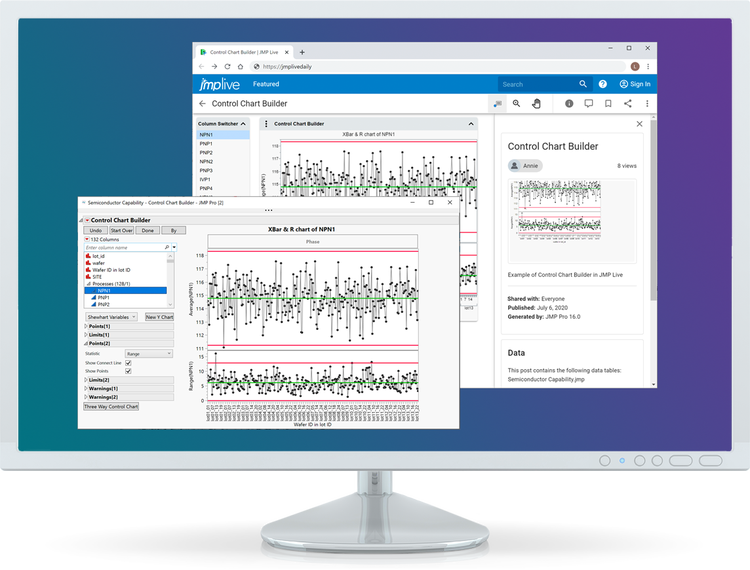
Detect process shifts earlier
Know when your process changes — before problems escalate.
Evaluate process capability
See how well your process meets specifications.
Identify the sources of variation that matter
Prioritize the factors most associated with quality outcomes.
Reduce variability through designed experiments
Identify key drivers and optimize process settings.