Digital transformation in chemical R&D: Why technology alone isn't enough
Leaders from Evonik, BASF, and JMP discuss AI in the chemical industry, high-throughput experimentation, data infrastructure, and the workforce changes needed to scale innovation.
Katie Stone
June 23, 2026
8 min. read
If your day-to-day work includes catalyst or process R&D in a chemical company, you have probably seen significant budget invested in AI, data platforms, and digital tools, yet many R&D and manufacturing teams still struggle to improve productivity at scale.
In a recent webinar hosted by Wiley, leaders from Evonik, BASF, and JMP discussed why this is the case. Their conclusion: successful digital transformation depends less on AI models themselves and more on how organizations connect people, workflows, experimentation, and data.
This post highlights key moments from the discussion and short video clips from the webinar, along with a bit of good news.
The most valuable catalysts in your company aren’t in your reactors; they’re your scientists and engineers. - Florian Vogt, JMP
Learn
- Why many AI initiatives in chemical R&D fail to deliver productivity gains.
- How Evonik approaches AI adoption and change management.
- How BASF accelerates catalyst innovation with high-throughput experimentation.
- Why analytics adoption depends on empowering scientists and engineers.
- What chemical companies need to scale data-driven decision making.
Why digital transformation often falls short in chemical R&D
Henrik Hahn has spent a decade driving digital transformation at Evonik, and he opened the discussion by naming what many leaders feel but rarely say plainly: most AI initiatives stall before delivering real business value. He calls this the “productivity paradox” of digitalization and GenAI.
Digitalization vs. true digital transformation
In his view, the limiting factor is not access to AI, it is the ability to use it effectively. Digitalization and digital transformation, he argues, are not the same thing.
- Digitalization is the groundwork: introducing digital tools, improving processes, helping people work more effectively.
- Digital transformation is the bigger story: implementing a cultural and organizational shift in how the company operates and creates value.
Hahn's “digital formula” captures what needs to come together for AI to actually deliver, in the form of user interaction, interconnectedness, and intelligent use of data.
Crucially, he warns against two traps that are increasingly common in AI:
- The “rush to AI” driven by fear of missing out and deploying tools without the necessary groundwork, strategy, or change management.
- The “shiny object syndrome” of chasing each new AI buzzword without a clear use case, which can burn resources and create technostress.
On the technology side, Evonik pursues a hybrid strategy with powerful off‑the‑shelf tools, specialized solutions, and domain‑specific variations. On the human side, it invests in data literacy, AI literacy, and change management so people can actually use these tools confidently and responsibly.
The message to chemical R&D leaders: If you want AI to pay off, start with people, processes, and data. AI is powerful, but its true potential relies on trained humans guiding the way.
Inside BASF: High‑throughput experimentation, data infrastructure, and 3D‑printed catalysts
While Hahn focused on strategy and culture, Wolfram Stichert from BASF zoomed into the technical front line with digitalization in catalyst research and development.
For BASF, the stakes are enormous. Catalysis touches around 90% of commercially produced chemical products, and it’s central to the global energy transition. The International Energy Agency estimates that roughly half of the emissions reductions needed by 2050 will come from technologies that are not commercially available today, which is a direct call to speed up process and materials innovation.
How BASF uses high-throughput experimentation and AI in catalyst R&D
Stichert outlined how BASF is attacking this speed challenge with a combination of automation, data science, AI, and high‑throughput experimentation. Through its subsidiary HTE, BASF runs high‑throughput platforms that cover the full cycle.
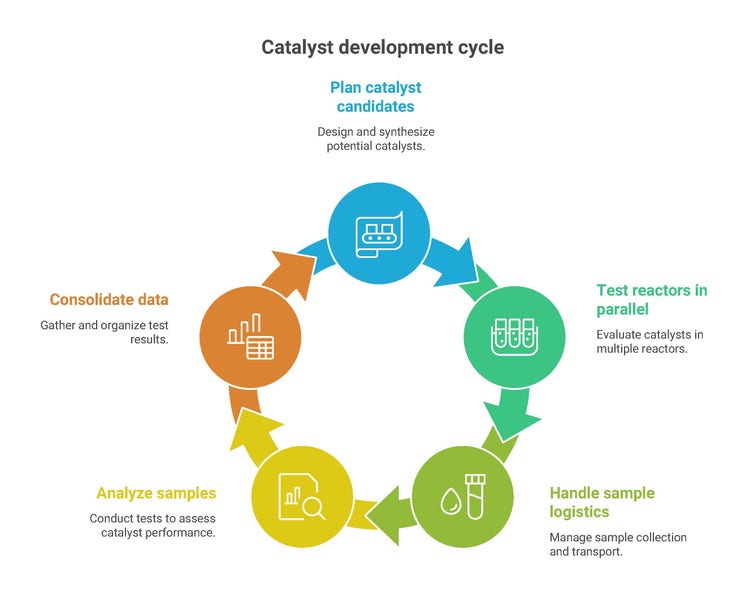
The critical insight: The cycle is only as fast as its slowest step. True acceleration comes from orchestrating the entire loop from synthesis, testing, data management, and learning, so that bottlenecks are systematically identified and removed.
Stichert also stressed that modernization in catalyst R&D isn’t only about throughput; it’s also about creating high‑quality, machine‑understandable data.
BASF uses dedicated software to automate experiments, creating a single point of truth for downstream statistics, design of experiments, and AI. By centralizing data in a scientific data warehouse, it is easily able to store, manage, and analyze data from various sources, allowing for integration and retrieval with ease. As a result, digitalization becomes a bridge rather than a barrier.
One of the most striking examples he shared is BASF’s patented X3D technology. With 3D‑printed catalysts, BASF can design intricate structures that achieve specific flow, pressure drop, and heat and mass transfer characteristics, optimized for each process.
Combined with simulation capabilities, this approach gives BASF a degree of freedom that competitors without X3D cannot easily replicate. It's a vivid demonstration of how combining digital design with advanced manufacturing can unlock entirely new performance possibilities.
The power of many: Scaling data-driven decision making in chemical manufacturing
If Evonik and BASF illustrated the “what” and “how” of digital transformation in catalyst R&D, Florian Vogt from JMP focused on the “who.”
Why analytics adoption stalls in chemical organizations
Vogt framed the challenge simply: scaling data-driven decision making requires activating the entire organization, not just a central analytics team.
In his work with chemical companies, Vogt hears the same complaint from plant engineers again and again, “We’re drowning in data, but urging for insight.” Digitalization has delivered massive data volumes, but the people who are closest to products and processes often lack accessible tools and the confidence to work with data quickly.
In this segment, Vogt describes the challenge of moving from isolated analytics breakthroughs to enterprisewide momentum in chemical manufacturing.
The result is pockets of excellence, where smart teams are running successful experiments while their wins stay local. Analytics experts and data scientists play an important role, but they cannot scale to every product decision, every troubleshooting episode, every process optimization.
Vogt’s answer is what he calls the “power of many.” To truly scale data‑driven decision making, companies need more scientists and engineers, not just specialists, who think statistically, design efficient experiments, and explore data interactively.
He points to pharma’s Quality by Design framework as a powerful precedent. Regulators and industry encouraged systematic use of design of experiments (DOE) for process development. That single requirement acted like the “brain signal” in his running analogy. It pushed thousands of scientists and engineers to learn and apply statistical methods, building confidence and a common language around data.
Vogt sees several levers that chemical companies can use to create a similar effect:
- Provide accessible, unified tools for most daily analytical tasks, without forcing scientists and engineers to become programmers.
- Standardize and embed methods like DOE into everyday workflows.
- Invest in practical, context‑specific training that fits real work, not abstract theory.
- Send a clear signal from leadership: “We want you to use the data, we trust you, and we will support you.”
When organizations do this, the benefits compound. Fewer, smarter experiments mean more high‑quality data that flows directly into manufacturing for faster root‑cause analysis, more effective statistical process control, and better-quality reporting. Companies see reduced downtime, less waste and rework, and shorter time‑to‑market.
Vogt illustrated this payoff with examples from multiple companies. At Vishay, deploying JMP cut data preparation time by 83 percent, freeing scientists and engineers to focus on innovation instead of wrangling spreadsheets. At BASF Antwerp, interactive analytics tools embedded in root‑cause workflows help process managers use data without needing to code, avoiding “data graveyards.” And initiatives like an Industrial Analytics Academy formalize training so that the “many” develop analytics skills in a structured, scalable way.
The throughline: Digitalization brings data and big tech brings algorithms, but only leadership can mobilize the workforce to turn those assets into decisions and value.
What AI transformation in catalyst R&D actually requires
Taken together, the perspectives from Evonik, BASF, and JMP paint a coherent picture of what it will take to realize AI’s promise in catalyst R&D.
- Strategically: Companies must move beyond AI‑driven pilots to a digital formula that aligns users, connectivity, and data.
- Technically: Build robust experimentation and data infrastructure, including high‑throughput platforms and 3D‑printed catalysts to accelerate discovery.
- Culturally: Activate the many by equipping scientists and engineers throughout the organization to use data confidently and consistently.
It matters because catalysis sits at the center of the industry’s contribution to climate and energy goals. Without faster, smarter catalyst innovation, the technologies needed for net‑zero will not arrive at the pace or scale required.
The good news is that the path forward is becoming clearer. AI doesn’t need to replace human expertise; it needs to augment it. Digital tools don’t need to overwhelm people; they need to be integrated into workflows in ways that feel accessible and useful. And data doesn’t need to drown teams; it needs to be structured, shared, and used by the many, not the few.
Are you responsible for R&D, digital transformation, process engineering, or data strategy in the chemical industry?This post and its few short clips only scratch the surface of how three leaders are turning buzzwords into real change.
See how Johnson Matthey successfully utilizes digital chemistry and design of experimentation to speed innovation.