A history of ICH guidelines: Inside the regulatory revolution that reshaped pharmaceutical development
Enjoy this deep dive into the regulatory revolution behind ICH guidelines, Quality by Design, ALCOA+, statistical expectations, and the shift to data-driven pharmaceutical quality.
Chandra Ramnarayanan
December 16, 2025
8 min. read

Ben Franklin once said there are only two certainties in life: death and taxes. The pharmaceutical industry also has two certainties: guidelines and regulations.
Before the 2000s, pharmaceutical regulation was built around the idea of “harmonization.” In practice, that meant trying to align expectations across three dominant regions, each with its own way of doing things. Companies had to repeat tests, rewrite reports, and reformat the same data to meet slightly different requirements in different places. When global trade expanded under the WTO, more countries joined the supply chain, and the friction multiplied. What had once been a manageable inconvenience became an overwhelming burden.
At the same time, the products themselves were evolving. The industry moved from straightforward small-molecule drugs to biologics and advanced therapies. Science was moving fast, and manufacturing had to keep pace. Regulators had to adapt or risk falling behind.
The International Council for Harmonisation emerged as the vehicle for this shift. What followed was a decades-long transformation from fragmented oversight to a more integrated and science-driven global system. That transformation played out in four major phases that reshaped the foundation of pharmaceutical development.
1. From static reports to real-time, lifecycle analytics
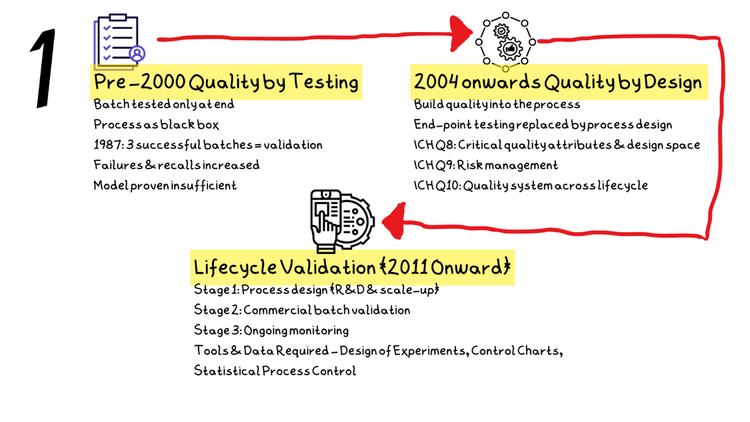
At the start of the 2000s, the approach to pharmaceutical quality was simple and reactive. You made a batch, tested it at the end, and hoped it passed. This mindset was built around the concept of Quality by Testing. The manufacturing process was often treated like a black box. There was no requirement to fully understand how it worked as long as the results were good.
Validation was based on a guideline from 1987 that said if you could produce three successful batches in a row, your process was validated. It was a comforting idea, but one based more on tradition than science. When failures and recalls became more frequent, it was clear this model wasn’t good enough.
From Quality by Testing to Quality by Design (QbD)
In 2004, the FDA introduced a new vision. It called for quality to be built into the process from the beginning. Quality by Design became the new standard. This shift meant companies had to stop relying on end-point testing and start building processes that could consistently deliver quality outcomes.
ICH laid the foundation with three key guidelines. ICH Q8 introduced terms like critical quality attributes and design space, emphasizing a deep understanding of what makes a product safe and effective. ICH Q9 brought risk management into the daily workflow, encouraging companies to assess and control risk systematically. ICH Q10 created a comprehensive quality system that linked all of this across the product lifecycle.
A new model for process validation
In 2011, the FDA replaced the old three-batch model with a three-stage validation process. Stage one focused on process design, using R&D and scale-up data. Stage two was about proving that the process could reliably produce commercial batches. Stage three required ongoing monitoring to ensure the process stayed in control.
This change required more than philosophy. It demanded data, and it demanded tools to make sense of that data. Design of experiments became essential for understanding process variability. Control charts and other statistical process control tools became the backbone of ongoing verification. Quality had moved from the lab bench into the data stream.
2. Beyond harmonization: A connected framework
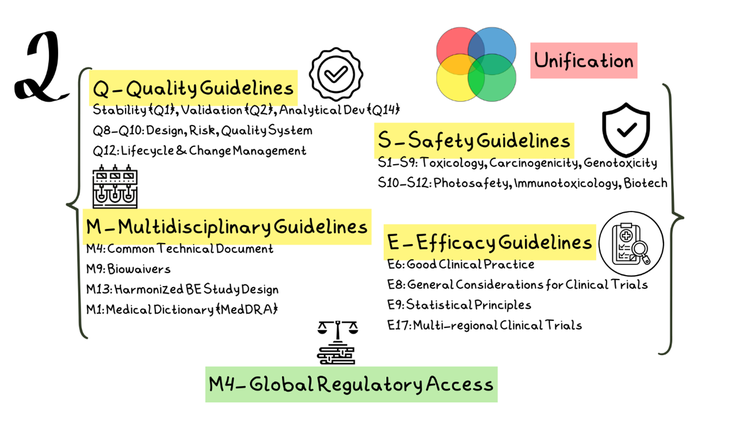
The first wave of ICH guidelines helped countries speak the same regulatory language. The next wave went further, aiming to create a connected system where each piece supports the others.
A cornerstone of this entire system was the ICH Q1 series on stability testing. Before Q1, companies faced a nightmare of different stability requirements for different climates and regions. The Q1 guidelines (from Q1A to Q1E) integrated this chaos into a single, harmonized approach. They not only defined what conditions to test (e.g., long-term, accelerated) but also provided the statistical framework for how to evaluate the data (Q1E) and how to use efficient, risk-based statistical designs like bracketing and matrixing (Q1D) to reduce unnecessary testing. This harmonized approach to a product's lifecycle and shelf-life was a critical foundation for the connected system that followed.
Expanding the regulatory ecosystem: Q12, Q14, and the updated Q2
This system-thinking continued as ICH Q12 linked development science with regulatory logistics. It introduced the idea of Established Conditions (ECs), which are the elements of a manufacturing process that must remain fixed to ensure product quality. By identifying which conditions are truly critical, companies could gain more flexibility to improve and adapt non-critical aspects of their process without needing to file constant updates. This was a strategic shift that reduced friction and encouraged innovation.
Analytical testing also matured. ICH Q14 created a framework for developing robust analytical methods using risk and science, while the updated Q2 guideline established how to validate those methods so they meet their intended purpose. Together, these guidelines brought testing into the same lifecycle mindset already used in manufacturing.
Clinical transformation: ICH E6(R3) and the shift to risk-based trials
Clinical trials saw a parallel transformation. ICH E6(R3), completely overhauled in its third revision, moved away from a rigid checklist approach and adopted a flexible, risk-based model. This allowed the use of modern trial designs and digital tools, making it easier to focus on what truly matters: patient safety and data integrity.
Eliminating regional inefficiencies: The ICH M guidelines
The ICH M guidelines tackled long-standing regional inefficiencies in drug development. M9 harmonized rules for when companies can waive bioequivalence studies, reducing unnecessary trials. M13 created a unified standard for designing and analyzing bioequivalence studies, solving the problem of conflicting regional rules. These changes made global development faster and more cost-effective.
Across all areas, the direction was clear. ICH was building not just individual guidelines but a comprehensive system. When companies could show they understood their products deeply and managed them responsibly, regulators gave them room to operate with more autonomy.
3. Compliance by default: When statistics became mandatory
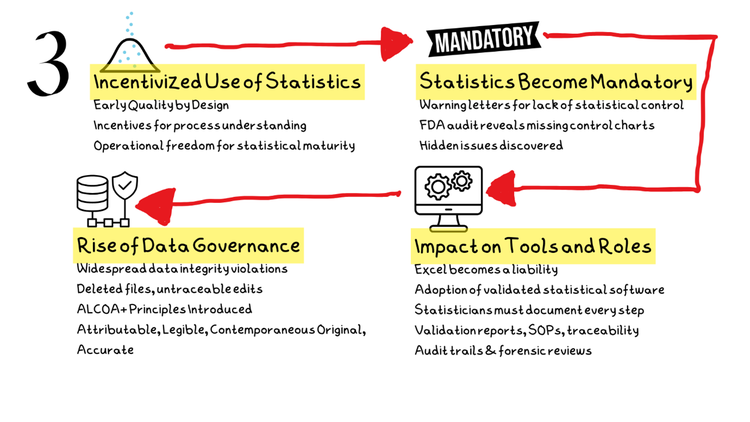
In the early days of Quality by Design, regulators used incentives to encourage better statistical practices. Companies that invested in process understanding got more freedom to operate. But it didn’t take long for those practices to become mandatory.
Regulators began issuing warning letters not just for product defects, but for failing to use the statistical tools that could have prevented those defects.
Regulators began issuing warning letters not just for product defects, but for failing to use the statistical tools that could have prevented those defects. In one case, the FDA faulted a company for not creating control charts. When inspectors asked them to generate the charts during an audit, the data revealed hidden issues that had gone undetected for months.
The origins of ALCOA+: The case for stronger data governance
This kind of failure pointed to a deeper problem: a lack of data governance. Around the same time, regulators noticed a steep rise in data integrity violations. These ranged from deleted files and manipulated results to untraceable changes and missing audit trails. To respond, the FDA, EMA, and MHRA introduced a clear framework called ALCOA+, a set of expectations for how data must be managed.
Under ALCOA+, data must be attributable, meaning it is clear who created or modified it and when. It must be legible and human-readable, so results are understandable. It must be contemporaneous, meaning recorded at the time of the activity. It must be original, with raw records preserved. It must be accurate and reflect the actual work performed. The additional "plus" principles say data must be complete, with nothing hidden or deleted; consistent, with logical and chronological order; enduring, stored securely and durably; and available, ready for inspection or audit at any time.
Moving beyond Excel: New expectations for statistical practice
This created a massive shift in how companies handled data. Shared passwords were no longer acceptable. Microsoft Excel, once the go-to tool for many statistical tasks, became a liability. It was never built for regulated environments and lacked the controls needed to ensure data integrity. Companies began phasing it out in favor of validated statistical software.
Statisticians were now expected to document every step. Validation reports, traceability matrices, and standard operating procedures became mandatory. Audit trails had to be reviewed by trained professionals, adding forensic review to the statistician’s job description. The role of statistics had officially crossed the line from helpful to essential.
4. The end of the silo: A data-driven culture takes hold
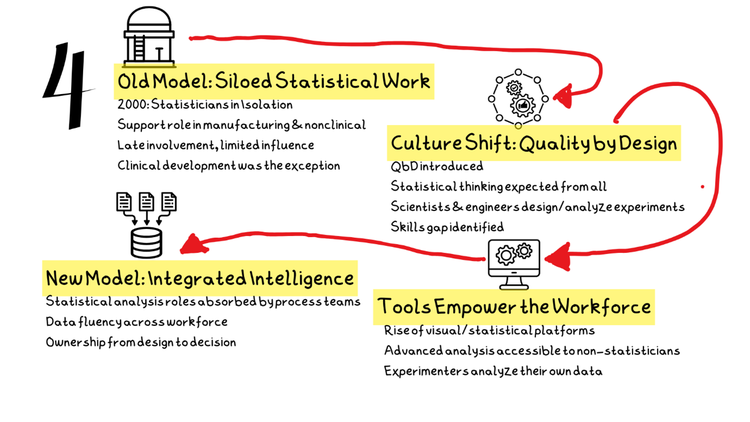
Perhaps the most profound change was not in policy or technology, but in people. The demand for data-driven decisions reached a tipping point that redefined who does statistical work and how it's done.
The most profound change was in people. Statistical analysis was no longer something done by a separate team. It became a hands-on activity practiced by the people closest to the process.
In 2000, statisticians in manufacturing or nonclinical development often worked in isolation. They supported process scientists and reviewed data, but they were rarely central to the action. Their influence was strongest in clinical development, where statistical planning had long been essential. But in product development and manufacturing, they were mostly brought in late and worked behind the scenes.
QbD and the rise of statistical thinking for everyone
Quality by Design changed that dynamic overnight. The core message of QbD was that everyone involved in development and manufacturing needed to think statistically. The expectation was clear: scientists and engineers had to design, execute, and interpret complex experiments. The skills once confined to a small group of specialists were now required across the technical workforce.
That shift exposed a serious skills gap. Many chemists, formulators, and engineers had never been trained in statistical thinking. This gap created strong demand for software tools that made advanced analysis accessible to non-statisticians. Visual platforms like JMP became essential, offering a way to run multivariate experiments and explore data without needing to write code or understand programming languages.
A new culture of hands-on analysis
This was more than a convenience. It marked the birth of a new culture. Statistical analysis was no longer something done by a separate team. It became a hands-on activity practiced by the people closest to the process. The specialist still existed, but the center of gravity had shifted.
Today, the person running the experiment is often the same person analyzing the data, drawing the insights, and making the decisions. The statistician is no longer a late-stage gatekeeper. They are a partner in the process, or in many cases, their role has been absorbed by the process team itself.
Over 25 years, the pharmaceutical industry has moved from isolated expertise to integrated intelligence. The defining feature of this new era is not just better tools or tighter rules, but a workforce fluent in data, capable of owning the process from start to finish.
Modernize your analytical methods with DOE
See how DOE supports the enhanced ICH Q14 approach in our on-demand webinar. You’ll learn about the latest regulatory expectations along with practical strategies you can apply immediately.