Making biostatistics click: Bringing data to life through interactive learning – no coding required
Teach and learn biostatistics faster—with interactive, no-code tools that make data analysis clear, visual, and fun.
Byron Wingerd
October 7, 2025
4 min. read
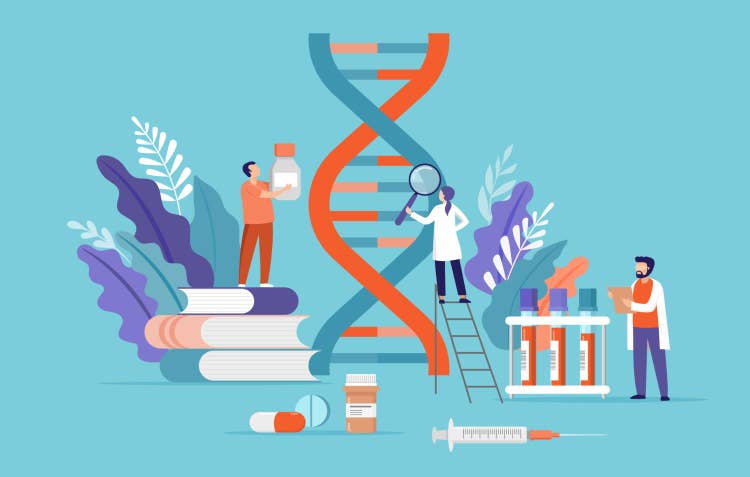
Biostatistics is the often-overlooked force driving breakthroughs in medicine—from tailoring cancer treatments to improving drug safety through patterns in complex data. Yet mastering biostatistics often means learning to code first, which can get in the way of understanding the statistics themselves.
No code, no problem
Biostatistics applies statistical methods to data in the biological sciences, specifically in medicine and public health. Biostatisticians combine statistical expertise with a deep understanding of the biological and medical context of the data they work with. This dual knowledge allows them to design effective studies, account for biological factors and biases, and interpret results within clinical or public health frameworks.
For many scientists, biostatistics class is their introduction to programming in R, SAS, or Python. If you teach one of these courses, you know that transitioning students from a basic working knowledge of Excel to mastering statistical programming and its strict syntax is often the biggest challenge. The focus on coding often overshadows understanding, interpreting, and applying statistics, turning it into an exercise of finding and adapting code snippets – or, with the rise AI platforms, a "prompt and pray" approach. That’s where JMP comes in.
Too often, biostatistics instructors view JMP’s biggest advantage—the fact that it doesn't require learning a programming language—as a shortcoming, since many believe that analysis without coding is somehow inferior to using JMP’s intuitive point-and-click applications. But honestly, why learn to fish if fresh salmon is readily available at the grocery store? The result it the same, but you’ve saved so much time and effort. This idea is also true for JMP, since its graphical user interface relies on the same underlying code base as programming does in an interpreted language to perform any analysis. Additionally, while open-source packages benefit from community-driven development and updates, software like JMP undergoes stringent quality control and provides robust numerical accuracy validation.
Course assignments often provide clean data sets that make finding the "right" answer easy, but in the real world, data is messy, filled with formatting issues, entry errors, missing data, and dubious outliers. Using a tool like JMP helps students and scientists alike quickly understand a data set through easy data visualization and menu-driven manipulation with live previews. By spending less time on data cleaning, experts jump straight to efficient analysis and modeling, thus putting their domain expertise to work quickly to discover what the data is saying.
During the analysis and modeling stages, JMP’s graphical user interface offers simple dialogs to select variables and analysis types. Results and visualizations appear instantly, making data exploration feel conversational rather than command-driven. A streamlined workflow allows you to focus on statistical thinking instead of coding. You can quickly generate descriptive statistics, contingency tables, survival analyses, and regression models—no complex coding required—making the experience truly game-changing.
I recently took a biostatistics course as a refresher, and JMP was perfect. It let me dive into the core concepts without getting bogged down by coding. I could focus on interpreting results, understanding assumptions, and drawing conclusions – which is exactly what the course was meant to reinforce. If you're teaching or taking a biostatistics course, a tool like JMP is worth serious consideration. It lowers the barrier to entry, speeds up the learning curve, and makes statistical analysis feel less like a chore and more like a discovery process. While I felt a little like I was cheating, what I really felt was relief that working with biostatistical data could be so easy.
Essentials for to learn and teach biostatistics
JMP offers additional resources to help biostatistics instructors and students -- including books, videos, and case studies. Check them out here!
Learn more: Additional options to get started
For anyone looking to teach biostatistics using JMP, the textbooks below are a great place to start. They bridge theory with hands-on application, helping students, professors, and researchers strengthen their statistical understanding while learning to analyze real-world data effectively.
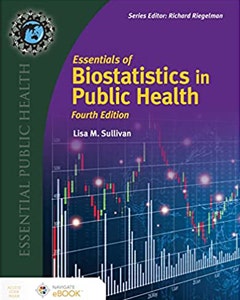
Essentials of Biostatistics for Public Health, 4th Edition, Lisa M. Sullivan, Jones & Bartlett Learning
This approachable text helps students learn to apply and interpret biostatistics in public health using real examples from the author’s own clinical experiences, including the renowned Framingham Heart Study. With relevant examples, it emphasizes practical application over computation. The fourth edition is updated to include cases based on COVID-19 and a new chapter on careers in biostatistics; it also includes a JMP workbook and free access to the JMP Student Edition for hands-on learning.
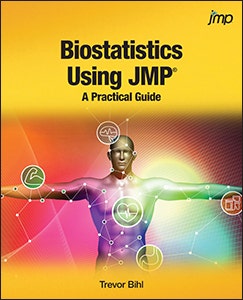
Biostatistics Using JMP®: A Practical Guide, Trevor Bihl, SAS Institute
This comprehensive guide provides step-by-step instruction on solving biostatistical problems directly in JMP. Written for university students, professors, biological/biomedical experimenters, laboratory managers, and research scientists, this text provides a practical approach to using JMP to handle your data and solve your biostatistical problems.
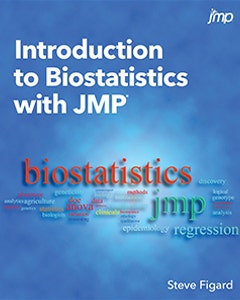
Introduction to Biostatistics with JMP®, Steve Figard, O’Reilly Media
Perfect for beginners, this introductory text helps undergraduate students in biological sciences understand how to use JMP to analyze experimental data. Once they become confident that they are using the right analysis, students then learn how to apply that analysis to specific tests for real-world scenarios in their future work.