Career paths for data-loving scientists and engineers: Lessons from those who stayed and those who pivoted
Part 1: Those who stayed: Expanding your impact without changing careers
Wendy Tseng
August 11, 2026
8 min. read

The conversation that started it all
Two years after starting my first job as an engineer, I knew I wanted to do something different. Initially, it was interesting to be a part of getting a product to market. But after the first product launch, I started to notice how much of the job consisted of paperwork and processes that were uninspiring.
The aspects of the job I loved were those that involved data analysis: analyzing test method validation data, performing root cause analysis on failures, and quantifying process variation for critical dimensions. I saw statistics as a process for learning and making sound decisions and, as a result, a way to make an impact as a young engineer.
What kept resurfacing was a pivotal experience from a year-long internship experience working alongside a biostatistician and retinal surgeon. The retinal surgeon was the principal investigator in a study to evaluate a drug implant to treat an inflammatory retinal disease. He developed the hypotheses and understood the disease progression, but it was the biostatistician who interpreted the data because she had the statistical expertise. Witnessing their conversations about the science and what statements could be made using the data and statistics sparked something inside of me.
This experience revealed two things very clearly:
- Statistical knowledge is powerful.
- Strong collaboration between domain experts and statisticians accelerates learning.
I knew I wanted to do more of what I liked and much less of what I didn’t like. So, I started a part-time master’s degree program in applied statistics. I wasn’t 100% sure that I wanted to change careers, but I knew I had to take the first step by getting formal education. Also, I thought, whether I decided to pursue a career change or not, the coursework would help me as an engineer. Getting a degree part-time allowed me to learn more about statistics while spending more time as an engineer.
Eventually, I did fully commit to making a career change from engineer to statistician. But looking back, I didn’t know there were alternative paths.
Now, after decades of working in different industries as a statistician, I have realized that making the formal career switch is just one of the many career paths for a “data person.”
I’ve met several scientists and engineers that have advanced their careers through applying data and statistics to their work – without switching career paths. They took the initiative to advance their knowledge in statistics and increased their impact in their organizations by applying that knowledge. They advanced innovation directly as technical experts and indirectly by advancing the statistical competency of their colleagues.
As scientists and engineers, they have stayed closer to the problems. They can identify more problems that can be solved with data, and they can make the decisions that directly impact the project.
Seeing this proximity to the problems and solutions has made me reflect on how I might have made a different decision two decades ago had I known that I could have evolved my work as an engineer rather than completely pivoting away.
I wanted to know – how have other scientists and engineers who’ve had similar life-changing moments with data and statistics navigated this in their careers? Why have some technical experts chosen to stay and others chosen to pivot?
To explore this, I spoke to several scientists and engineers that were the data people in their organizations about their careers.
This two-part series shares what I learned from those conversations:
- Part 1: Those who stayed
- Part 2: Those who pivoted
Conversations with those who stayed
Engineering was always at the heart
When I spoke with the data people who have stayed as scientists and engineers, it became evident that the pursuit of learning statistics was always about enhancing their work.
Chad Naegeli, now the Associate Director of Mechanical Engineering at Francis Medical, has known he wanted to be an engineer since he was a kid. At his core, he is motivated by building things.
Naegeli explains:
Imagine a Venn diagram. I like to design things, build things, and solve problems; I think statistics is right in the middle of all that. I didn’t see it as its own individual pursuit. The statistical tools made me a little bit more diverse than other people because I could solve problems that maybe other people couldn't, or I would approach solving a problem differently.
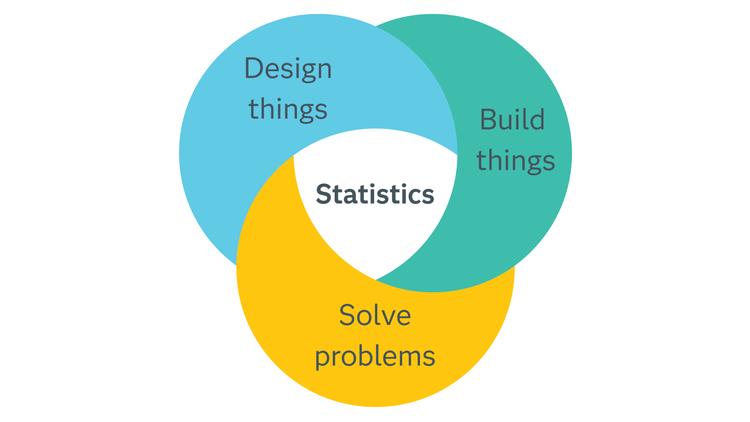
For Naegeli, statistics sits at the intersection of designing, building, and solving problems, helping him approach challenges in ways others might not.
These data people were motivated to learn statistics because it:
- Helped them solve science and engineering problems better.
- Gave them a seat at the table (because of the insights and contributions they were making).
- It was fun.
For many, their first aha moment with statistics was seeing how design of experiments (DOE) could be used to approach a problem. Very simply, as new scientists and engineers, they wanted to know: How do I do my job well?
DOE provided a structured, data-driven approach to problem solving. They found that they had immediate success with applying it and saw how it could help them do their jobs better and make meaningful contributions.
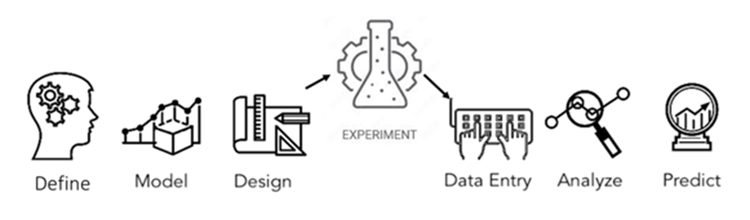
For many of the technical professionals we interviewed, DOE provided a structured process for problem solving early in their careers.
Matt Sanders, now a Distinguished Engineer at Medtronic, shared a story about a project he was given as a new engineer working with more experienced engineers. The project was supposed to be a slam dunk, an easy project for a junior engineer to cut their teeth on. Using DOE, however, he uncovered issues with the product that others had not seen before. Initially, the lead engineers were skeptical that the problem was real.
“And it was like, well, no, I've got the data. And I was able to not only use the DOE, but to use graphical analysis to show the latent issue with a custom heat map. And I thought that was the coolest thing ever – that I was actually able to drive value and decision making that were not anticipated from more experienced engineers and back it up with data. And it gave me, as a young engineer, a voice and put me on a level playing field,” says Sanders.
As an engineering intern, Naegeli recalls his manager at Seagate introducing him to DOE on his very first day. That same week, he was using DOE to improve yield on hard drives. Having never taken a course in statistics, it was thrilling to see an approach like DOE solving engineering problems.
Naegeli now manages a large team of engineers at a medical device start-up and tries to create an environment where that same sense of excitement and engagement can thrive. His team regularly meets to learn and share how DOE and statistics can be used to solve the challenges that arise when developing novel medical devices.
Recently, he had an engineer approach him at his desk, exclaiming “You have to come see this!” He then proceeded to talk about his findings from the DOE for 45 minutes straight.
Naegeli understands the enthusiasm:
It gets kind of contagious when you see people have successes. They just get so excited!
At the end of the day, for Naegeli and his engineers, the excitement is rooted in solving engineering problems. Statistics just happens to be a capability that supports it.
The role, reimagined
The data people who stayed found unique ways to evolve their roles, given their passion for science/engineering and expertise in using data and statistics to advance it. By simply looking at their titles, it is not obvious that they have reshaped their career paths. But the responsibilities they have and how they contribute are unique because of their knowledge of applying data and statistics.
Cara Happe, now a Research Scientist at Promega, has always had “scientist” as part of her title. However, over the past few years, she has evolved her role into one where she spends most of her time with data versus the lab. Currently, she is leading a project to develop data pipelines for analyzing a new assay for the team. As one of the scientists who needed to analyze the data, she has a clear vision of the deliverables from a data analysis perspective. She also serves as the go-to person for DOE and performing statistical analyses.
Her contributions as the data person started when she began programming in JMP Scripting Language (JSL) to automate a data pipeline. Her work in automation made it possible for other scientists to access and analyze the data. This led her to wonder what other tools in JMP could be helpful. And that is when she started exploring more statistical tools, including DOE.
Recently, she enrolled in a master’s in data analytics program at the University of Wisconsin, motivated by the belief that deeper statistical knowledge would help advance the science further.
Happe says:
I'm working through an analysis, and I would just feel like there's more I can pull out of this, but I just, I don't know what that is. I was just kind of noticing this theme over and over again. Oftentimes, it felt like our weakness when moving projects forward stemmed from our lack of stats: abilities, knowledge, everything.
Similarly, Sanders has held an engineering title throughout his 21-year career at Medtronic, but the way he has shaped and expanded the scope of his role is uniquely his own. Early in his career, he took every single statistical course available to him at Medtronic and through JMP. From there, he became a Project Engineer, leading an internal cross-functional team with ownership of strategy and tactical execution using DOE and statistical thinking. Later, Sanders became an internal consultant across multiple programs at Medtronic, supporting engineers in data analysis, experimental strategy, and design of experiments by coaching them through problem solving.
His heart has always been in engineering and that’s why he has stayed. He loves solving real-world problems, specifically as an engineer who knows statistics. With how he has evolved his roles, he has been in the driver’s seat in terms of being able to identify engineering problems that can be solved with statistics and by using storytelling with data.
Doing a 10 or 12 factor experiment that's custom designed with whole plots and split plots, constraints and covariates – you could never design one of those without understanding how something works.
To Sanders, being an engineer is how he can make the largest impact, especially when combined with his expertise in statistics.
Data as a multiplier
Becoming a data person doesn’t always require leaving your field. For the technical professionals I spoke with, statistics isn’t an alternative career, it is a multiplier. It makes them better engineers and scientists.
Sanders, Naegeli, and Happe remain close to the technical work that inspires them, while reshaping their roles and career paths in distinctive ways through their use of statistics.
Looking ahead: Up next in the series
In Part 2 of this series, I share what I learned from those who chose a different path – those who pivoted into dedicated data and statistical roles.