From data to decisions: How to present your data analysis to non-technical stakeholders
Learn how to communicate analytics results to stakeholders by linking data findings to KPIs, business value, and clear visualizations for better decision-making.
Levannia Lildhar
November 18, 2025
3 min. read

The communication challenge that every data scientist faces
As a data scientist, I’ve always thought of myself as a jack of all trades, with a box full of tools, each one suited for a specific modelling technique or task. However, one of those trades – communicating my results – needs a different set of tools. I’ve often been asked to explain my work and its results to a variety of individuals, from stakeholders to quality assurance, and sometimes, to colleagues who are just interested (which, by the way, is my favourite). Admittedly, I haven’t always been as effective as I had hoped. I once tried to explain my plan for a modelling monitoring program to the stakeholders of a project, and they asked me to come back with a ROI calculation.
I’m hoping that this article explains some of the lessons I’ve learned along the way. It is the first of two articles with a focus on communication. Here, I talk about the basics concepts of what to consider when communicating your results, and in Part Two, I get into the details and nitty gritty of it all. But my first piece of advice and what I consider to be the most important when communicating with anyone – but specifically your stakeholders – is consider your audience.
Know your audience: Speaking your stakeholders' language
On the surface, it seems like an easy enough task. But I’ve learned that this is actually one of the hardest things I have to do. It requires me to put aside what I think is cool and interesting about the work and focus on what will interest my stakeholders. But rest assured. Sometimes there is overlap, and if there isn’t, if you communicate the work effectively, you might be asked later to explain the cool things that you love. I think the key lies in the language that we use.
Connecting analytics results to key performance indicators (KPIs)
Ask yourself: what is important to my stakeholders? Are there key performance indicators, for example, that your stakeholders are working toward at your organization? Could your work help to address these KPIs? How can you translate your results into the metrics and indicators that your stakeholders speak? As an example, your stakeholders might not be interested in the model type that you used in your system, but they might be interested in its ability to increase yield. If you don’t know what is important to your stakeholders, I’d suggest you start with your team goals. Often these are tied to company and department targets that the business is trying to meet. They will likely list the KPIs that your stakeholders will be interested in.
How to show the business value and impacts of your work: Use metrics that matter to decision makers
This brings me to direct and indirect impacts. Often the impacts of your data science work might indirectly impact the metrics that are important to your stakeholders. It will be your job to find these connections and communicate these indirect impacts. It’s easy to understand how upgrading the machinery on a production line can increase the yield but it may be harder for some to understand that upgrading the models might do the same work. Use examples to explain the indirect impacts of your findings and, once again, communicate in the language of the metrics that matter to your audience.
Use data visualization to make complex data accessible
Finally, while considering your audience, try your best to keep it simple. Use consistent language when discussing your findings and use visualizations that are simple but impactful. (This will also be helpful as you build a data-literate organization). For example, if you’re putting together a presentation, spend some time on the figures. With each figure, I like to ask myself: What am I trying to communicate? How can I emphasize it in my visualizations? I spend some time discussing this in Part Two, but for now, remember that too many details can often muddle your message. So, it may not rocket science, but it is mission-critical to consider your audience and communicate your findings based on their needs.
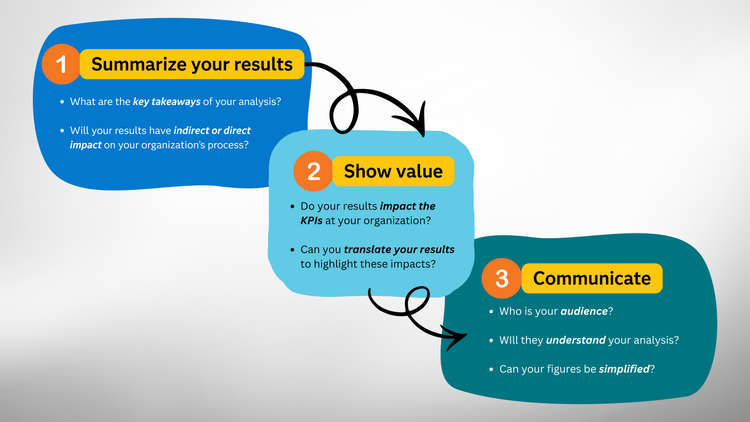
My three-step framework for communicating data findings to stakeholders.

Connect with me on LinkedIn