The integration imperative: Preserving analytical reasoning across JMP, Python, R, and beyond
How fragmented analytical workflows weaken decisions—and how to maintain context, from discovery to decision.
Kemal Oflus
May 12, 2026
7 min. read
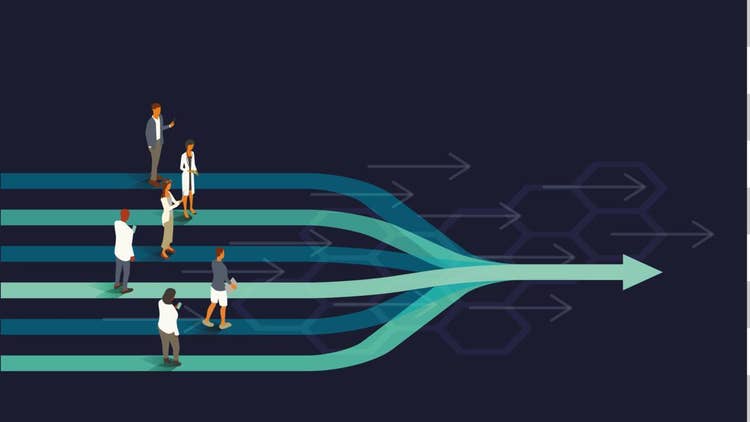
Organizations have an integration problem. Engineering and manufacturing teams are working with more data, more analytical environments — including tools such as JMP, Python, R, and cloud-based analytics platforms — and more modeling capability than at any point in history. At the same time, they are being asked to make sense of more complex systems under tighter timelines. In many organizations, that work spans engineering, quality, operations, data science, and leadership all at once. These groups often depend on the same data and analysis, but they do not use the results in the same way. Leadership needs speed and accessibility. Engineers and scientists need flexibility, scale, and technical depth. In that environment, integration becomes essential.
When more tools don't mean better decisions
Even with all of these tools available on demand, organizations still struggle to turn analysis into decisions that they can act on with confidence. Often, the problem is not a lack of technical skill. It is a fragmented analytical stack. Different tools are optimized for different needs—ease of use, technical depth, communication, or deployment—but they are not well connected, making it difficult to carry analysis and its underlying reasoning from one stage of the workflow to the next.
Connecting these silos without breaking the reasoning behind the work is the integration problem organizations keep running into. When the pieces are connected well, teams don't have to choose between ease of use and technical depth. Exploratory analysis, specialized modeling in Python or R, spreadsheet-based inputs, and broader deployment can coexist without losing the logic behind the result. In my experience, the challenge has never been deciding whether exploration should happen in JMP, whether specialized modeling should happen in Python or R, or whether results should be deployed more broadly. Most organizations already have those pieces. The harder problem is keeping the analytical thread intact as the work moves from one step to the next.
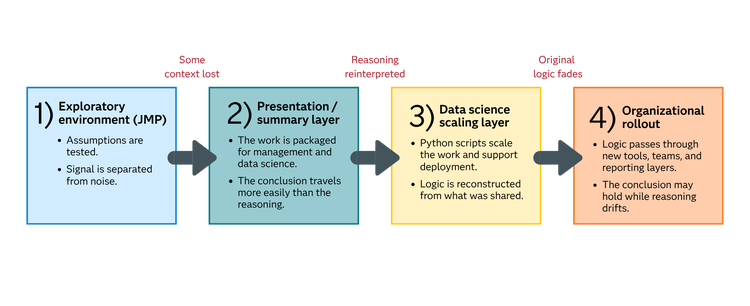
Where reasoning gets lost in the handoff
The point is not that the conclusion disappears at each handoff. In many cases, it survives. The problem is that the reasoning behind it becomes thinner as the work moves away from the point of exploration. By the time the result reaches management, data science, or broader deployment, the recommendation may still be directionally right, but the context that made it trustworthy has often been reduced, reinterpreted, or detached from the conditions under which it was first understood.
This breakdown usually is not dramatic. More often, it shows up in everyday handoffs. An interactive plot that once made curvature obvious turns into a static image in a slide deck. A modeling choice grounded in domain expertise later appears only as a KPI. A recommendation moves upward, but without the context that explains where it applies and where it does not.
A concrete example: What an interactive profiler shows that a PPT slide cannot
Let me make this concrete with a simple DOE example. Imagine an engineering team studying response in a coating process, using DOE in JMP to evaluate four factors, as shown below. At first glance, the result may suggest that at the low level of Factor 2, Factors 3 and 4 contribute little and Factor 1 dominates the response. But that reading does not hold across the design space. As Factor 3 moves, the structure of the problem changes. Factor 2 and Factor 4 begin to matter much more.
An interactive profiler makes that situation visible during exploration, which matters because it isn't just a statistical curiosity. It changes how engineers understand the process, where variation is acceptable, and which settings are worth adjusting on the manufacturing line.
I have seen this kind of issue many times with customers. In one case, I was helping a team involved in vaccine development model a cell-growth process. Based on the conditions they had tested, they concluded that increasing temperature would continue to improve growth. They implemented that change but did not get the result they expected. Temperature was not simply helping. Its effect peaked at a certain level because it interacted with another environmental variable. The result was costly, but it validated the larger point: when interaction structure is flattened or misunderstood, the conclusion may travel while the reasoning fails.
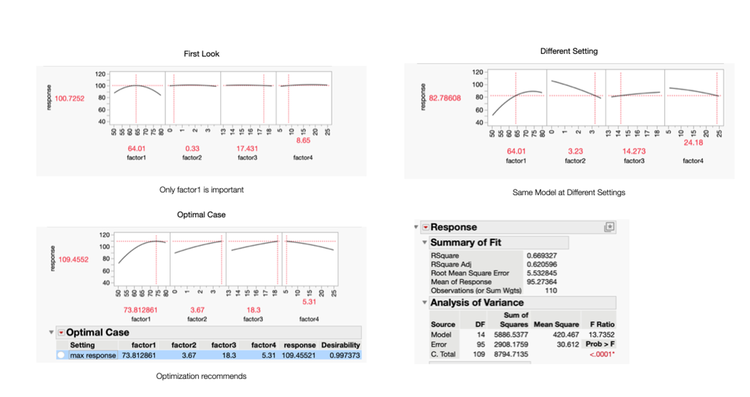
Exploration reveals interaction structure that can be flattened in a static summary.
From exploration to Python, without losing the thread
This is where integration becomes consequential. If the findings are pushed directly into PowerPoint or Excel for broader review, the interaction may survive only as a coefficient, a p-value, or a simplified summary. Slides and spreadsheets remain useful for distribution, annotation, and communication, but they rarely tell the same story as an interactive profiler, where users can ask what-if questions and see how the response changes across the design space. If the work then moves into Python, the data science team can scale it, simulate from it, or deploy it as part of a larger system.
Simple Python code generated by JMP
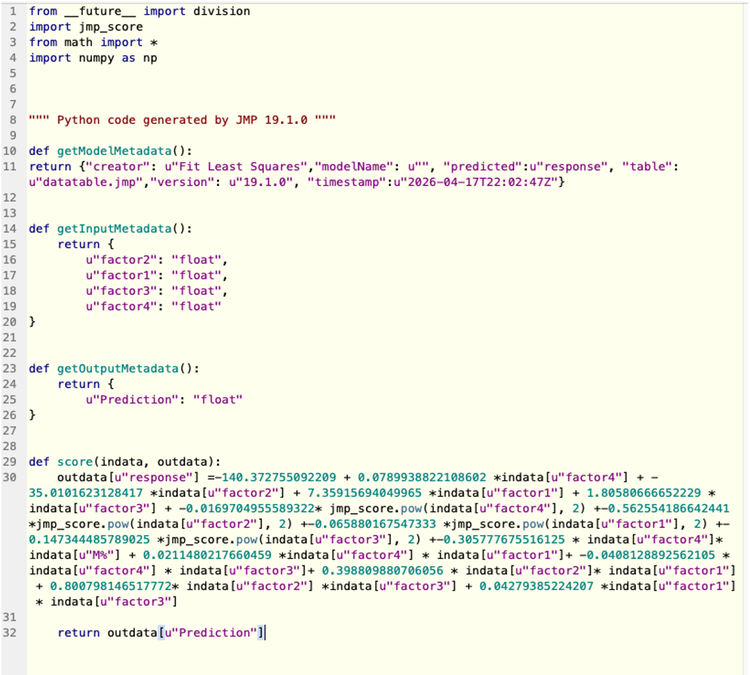
The work can be extended into Python without rebuilding the logic from scratch.
But if the exploratory context is not carried forward, the interactions that drove the original engineering insight can easily be treated as just another model term rather than as a meaningful feature of the process.
Keeping the analytical thread intact across tools
In a connected workflow, that loss is avoidable. The DOE is explored in JMP, where the interaction is first understood in process terms and checked against domain knowledge. The analysis can then be extended in Python or R from the same analytical context, so technical depth builds on exploratory understanding rather than replacing it. Results can still be shared in Excel or PowerPoint when those formats are more accessible, without allowing them to become the only surviving representation of the work.
Where cloud platforms are part of the organizational architecture, they can support data access, report regeneration, collaboration, and deployment without becoming the point where analytical meaning.
JMP Live extends that continuity into the communication layer. Engineers, managers, and operations leaders can interact with the findings directly and see not just the recommendation, but more of the interaction structure that makes it credible and actionable.
Actionable report
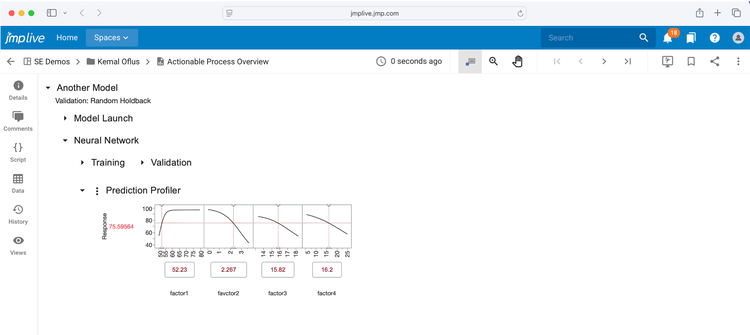
Interactive sharing on JMP Live.
This is where integration starts to show its organizational value. It determines whether ease of use and analytical depth reinforce each other or pull the workflow apart.
Why capable teams still struggle to drive action
Leaders usually experience this problem indirectly. They are not asking whether an interaction term was flattened in a presentation or whether a Python pipeline preserved the assumptions that shaped the original understanding. They ask why analytically capable teams still need repeated review meetings before action can be taken, why the same work has to be explained multiple times to different stakeholders, or why technically sound recommendations do not always arrive with enough clarity and significance to support decisive action.
In many cases, the issue is not weak analytics. It is weak integration. The stack may be powerful, but it still has to be connected sufficiently to preserve reasoning as work moves across tools, teams, and levels of the organization.
How weak integration slows organizational decisions
What organizations need, therefore, is not a single tool that does everything. They need an analytical architecture in which each environment does what it does best without severing the work from its original interpretation and value. Ease of use and analytical depth are not competing priorities. They complement each other, even if they are rarely balanced that way in practice.
This is where JMP plays a distinct role. Its strength lies not only in rapid exploration, but in anchoring the workflow at the point where the first reasoning begins to take shape. JMP can hand work directly into Python or R without losing the context that shaped the selection of factors, exclusions, assumptions, and interactions uncovered during exploration. It can coexist with other analytical tools rather than forcing organizations to replace them. It can also operate within broader cloud architectures without losing its role as the interpretive front end of the workflow.
JMP Live extends that continuity into the communication layer, which is often where analytical nuance disappears fastest. By publishing results in an interactive setting rather than reducing them to static slides, standalone worksheets, or new code, teams can give downstream audiences access to more of the reasoning behind the recommendation.
The broader implication is organizational. The effectiveness of analytics depends less on raw modeling horsepower than on whether the available tools are connected in a way that preserves understanding as work moves across teams, tools, and decisions. Organizations that get this right learn faster, act sooner, and adapt with greater precision. They spend less time in meetings translating, defending, and reconstructing work that was already done.
Making the integration imperative practical
The central challenge, then, is not choosing between JMP and Python, R, or Excel, or between local tools and cloud platforms. It is ensuring that each of these tools contributes to a workflow in which reasoning survives the journey from discovery to decision. The next step is to identify where that reasoning gets lost in your own workflow and connect the stack accordingly. In that effort, environments like JMP are most valuable not when they stand alone, but when they help anchor the work where interpretation first takes shape and keep that reasoning connected as the work moves outward. That is the integration imperative.
Learn from Pirelli how the consolidation of data workflows into a single, customized platform means process innovations are rolling out at lightning speed.