Speeding up heart science: how Boehringer Ingelheim are streamlining data analysis in the lab
A cardiovascular researcher at Boehringer Ingelheim describes how cutting through data complexity has given her something rare in modern science: time back at the bench.
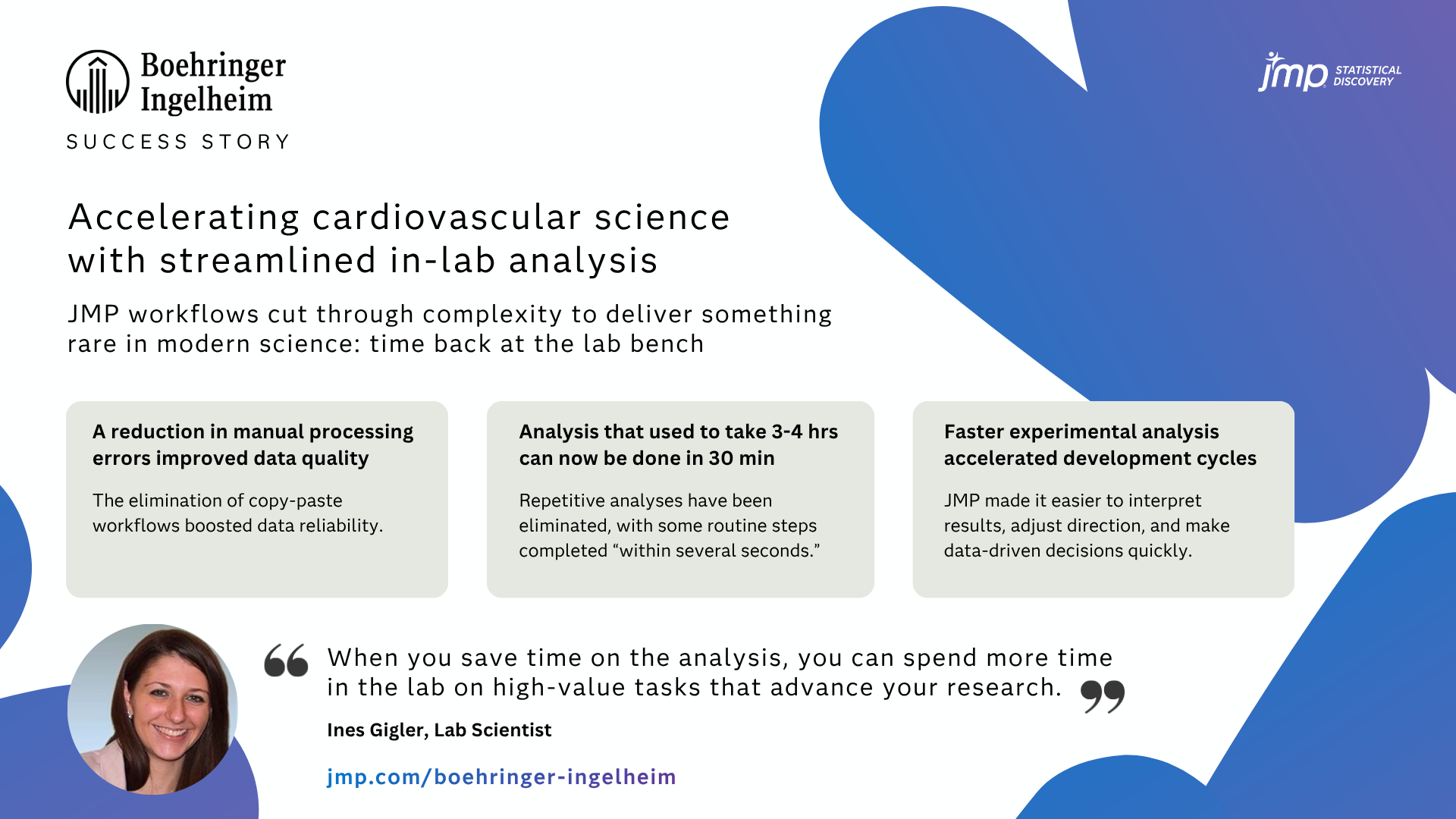
Ines Gigler uses JMP to simplify data integration, eliminate manual errors, and unlock deeper insights across cardiovascular experiments. By reducing analysis time from 3–4 hours to minutes, JMP enables more time in the lab and accelerates progress toward new therapies.

Ines Gigler
Lab Scientist, Boehringer Ingelheim
Despite decades of medical progress, cardiovascular diseases remain a stubborn challenge in the pharmaceutical research sector. Responsible for more than 30% of deaths each year, conditions such as cardiac arrest, heart attack, and arrhythmias place a heavy burden on public health systems. Finding new therapeutic targets for the potential treatment of cardiovascular disease is therefore not just a scientific ambition, but a pressing global priority. It is this work that must be tackled by laboratory researchers, such as Ines Gigler, a scientist at Boehringer Ingelheim.
The sheer number of variables influencing whether a patient will experience a cardiovascular event makes the search for new treatments “a very complex task for us” Gigler says. Nevertheless, the team’s goal is to evaluate potential treatments for a broad swath of heart conditions, requiring a high experimental volume.
Gigler runs a range of biological assays, generating cytometry data, impedance data, and images from fluorescence data. Each produces its own stream of outputs – CSV files, Excel sheets, or text files – which must then be manually copied and pasted into an analysis spreadsheet.
For standard setups such as 96-well plates, the process is repetitive and unforgiving. “You have to be really focused, and you have to do a lot of copying and pasting. This is a very critical step where a lot of errors can occur,” Gigler explains. It’s even worse, she explains, “if you notice you made a mistake with the copying and pasting, and you don’t know at what point the mistake was made, you have to start all over again.”
This status quo comes at a cost. For Gigler, the routine of assembling and preparing data can consume three to four hours at the bench, which is time that might otherwise be spent on the science itself. Frustrations in this potentially error-prone and task-heavy workflow pushed Gigler to search for an alternative. After conversations with statisticians at Boehringer Ingelheim, Gigler was led to try something they thought would be a lot simpler than continuing to use her current methods or exploring programming with tools such as R. With a new workflow based in JMP, which they suggested, Gigler could merge the data table with the analysis file automatically, eliminating the need for laborious and error-strewn copy-and-paste steps.
The impact was immediate. Tasks that once stretched across hours were reduced to around 30 minutes. Just as importantly, the process became more reliable. If the tables are aligned using JMP, Gigler says, she “can trust that it’s 100% correct.” In a field where both time and accuracy are in short supply, that shift is significant.
JMP has also opened the door to new experiments. In most biochemical systems, understanding how a treatment works means tracking its effects over time, which until recently was impractical. “We didn’t have the time to analyze each time point, so we just focused on specific time points from the literature. Often, they missed a time point,” Giger explains.
After switching to JMP, Gigler says she “can import the whole data set with all the time points, and then quickly check in Graph Builder which time point to analyze further.” She continues that using JMP “improves the quality of the data that [the team] is generating and the quality of the experiments they are running.” She notes that by having a more streamlined data analysis workflow and thus being able to interrogate more data for interesting trends, she “can now plan and conduct experiments more strategically.”
There is a persistent worry in some quarters that a more data-driven approach will pull scientists away from the bench in favor of more time spent behind the screen. Gigler’s experience is the opposite. At Boehringer Ingelheim, the adoption of JMP has allowed researchers to get back to the laboratory, freeing them up to run more focused experiments with less time spent on monotonous analytical workflows.
For Gigler, that shift matters. The time recovered is not simply a productivity gain but an opportunity to move closer to the goal that underpins the work: “providing help for patients of the future.” By cutting the hours required to analyze experimental data, Gigler and her team “spend even more time in the lab, doing more experiments for heart disease.” In a way, adopting a data-driven approach has allowed them to get back to the heart of their research: designing novel, impactful experiments to help tackle the world’s most dangerous health challenges.