Customer Story
Navigating the ethics of technology in modern healthcare
China Medical University gives future doctors the tools and mindset to use advanced analytics responsibly.

Challenge
China Medical University (CMU) in Taiwan set out to prepare future doctors for a healthcare world increasingly shaped by data-driven decision making. Assistant Professor Yang Tse-Yen saw a gap: many students lacked coding skills, yet needed to work with complex biomedical datasets and understand the ethical issues of privacy, bias, and human impact in digital health.
Solution
CMU’s master’s program in digital health integrates advanced analytics with ethics and hands-on practice. Using JMP’s low-code or no-code interface, students quickly clean and explore real-world biomedical data, visualize relationships interactively, and focus on interpreting results. Add-ins like LearnBot guide independent learning, freeing class time for critical discussions on privacy, bias, and patient well-being.
Results
Students with no coding background are now able to perform meaningful analyses early in the program, while interactive visualizations make complex concepts more engaging and memorable. Graduates leave equipped with both robust analytics skills and a strong ethical framework, ready to navigate the rapidly evolving healthcare landscape.
Predictive analytics and other data-driven technologies are changing the face of medicine – enabling earlier diagnoses, more personalized treatments, and better health outcomes. But with these capabilities come difficult questions: How do we ensure patient privacy? How do we identify and reduce bias in algorithms? And how can future healthcare professionals make use of advanced tools while keeping their focus on human well-being? China Medical University (CMU) in Taiwan is tackling these questions through a master’s program in digital health, combining advanced analytics training with a strong foundation in ethics and practical, hands-on application.
Balancing technical skills with ethical responsibility
Assistant Professor Yang Tse-Yen, co-founder of CMU’s digital healthcare programs, says higher education is barreling toward "automated analytics companion learning," where students would not just study from textbooks, they’d also learn alongside intelligent systems that help them make sense of increasingly complex and data-rich information. Courses such as biostatistics, epidemiology, bioinformatics – even machine learning – he says, will no longer be optional extras, but a core part of how future healthcare professionals are trained. As such, his goal is to help students prepare for a step change in the medical profession by getting comfortable working with data.
Alongside the technical know-how, he says it’s just as important to understand the human side of digital technology in healthcare. “When working with sensitive health data, it is essential to have a strong ethical compass,” he adds. Taking ethics, privacy, and the interface between humans and technology seriously, and knowing how to work across disciplines become paramount.
Why CMU Chose JMP®
The pressing nature of these ethical responsibilities means students and faculty simply cannot spend all their time coding. They need to balance technical execution with interpreting results, addressing privacy concerns, and considering the broader impact of their work. That's why CMU adopted JMP in its digital health program. With its low-code or no-code interface, JMP allows students to dive into substantive analytics quickly, so they can spend more time tackling the complexities of healthcare challenges rather than getting bogged down in programming details.
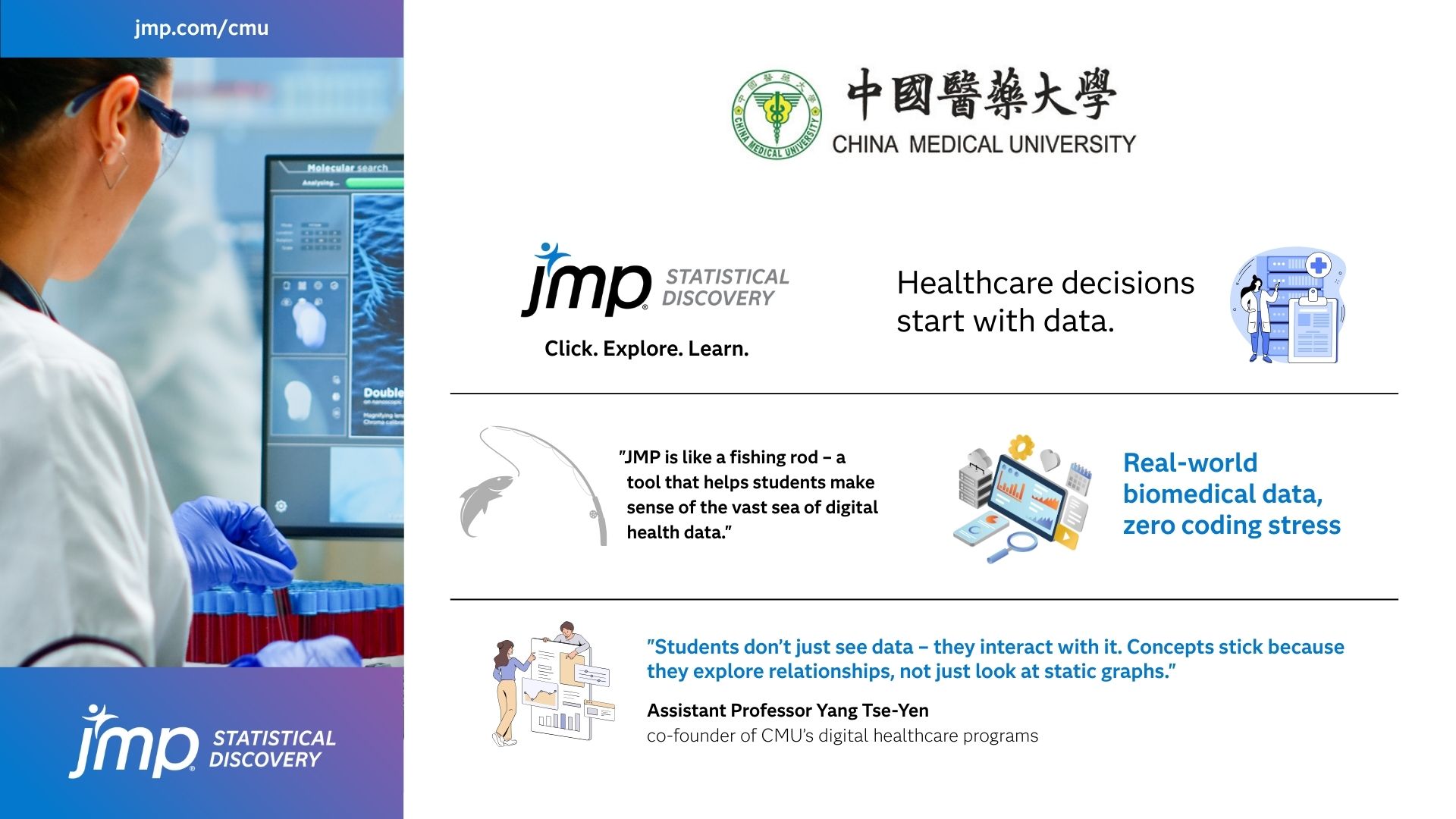
Many of Yang's students come from diverse backgrounds, which may not include coding experience. Hence, an accessible tool that allows students to break down complex concepts more easily and let them explore the data confidently is essential. Yang likens JMP to a fishing rod – a crucial instrument that helps his students make sense of the vast, often overwhelming sea of digital health data. Add-ins such as LearnBot from the JMP Marketplace also provide guided support, enabling students to delve into advanced analysis independently.
"JMP's strength lies in its highly interactive data visualization capabilities," Yang explains. "Students are not just looking at static outputs – they can click through graphs and see how changes in one variable affect another. This kind of learning approach is far more engaging and effective in making the concept stick."
He adds that the software also works well with the complexities of real-world biomedical data sets, which often involve missing values, multiple data sets, and the need for rigorous quality control checks. JMP's data manipulation features make it easier for students to prepare and clean disordered data before moving into analysis.
Building future-ready healthcare professionals
While JMP meets today’s needs, Yang is quick to point out that technology will continue to evolve. "What's cutting-edge today might be standard practice tomorrow." Hence, students must develop a mindset of lifelong learning and adaptability. They also need to spend time understanding the challenges faced by patients, clinicians, and the healthcare system.
Yang believes future healthcare professionals should be familiar with data privacy laws like Health Insurance Portability and Accountability Act (HIPAA) and General Data Protection Regulation (GDPR), and be aware of the biases in data and algorithms when working to build a digital health solution that is not only innovative but trustworthy. In his eyes, these are not merely technical skills, but professional values that will shape the future of healthcare.