How GE HealthCare is reducing costs with faster, smarter experimentation

GE HealthCare, a leader in high-technology medical devices, leverages JMP to streamline data analysis to improve decision speed, reduce manufacturing waste, and lower costs across complex, high-value manufacturing processes.

GE HealthCare

https://share.vidyard.com/watch/mUxiYc9f1dvsJu3xh5we1Z

Dale Human

Process, Quality, Reliability Engineer, GE HealthCare
Below is the video transcript.

I think at GE, and now GE HealthCare, we’ve been using data to make decisions for a long time. We’re generally a high-technology, low-volume kind of company. We don’t make a lot of things, but we make very high-technology things. We have a lot of process data.

We are trying to minimize costs, do as little testing as we need to do in order to make decisions on product development. Understanding the risks that we’re making based on the amount and quality of data that we have. We’re always solving problems, right? Everything is a problem. Whether it’s how do we increase market share, how do we reduce costs, all of those things. Once you have the data and you can start looking around, it helps if you can do that very quickly. And JMP has made it very easy for us.

I’m a Senior Architect Engineer at GE HealthCare. We’re a global medical device company. We design and manufacture the X-ray sources for medical systems. When you go get an X-ray or CAT scan, they’re using an X-ray source. And I work in the part of the business that designs and manufactures those sources. I’m not a statistician. We don’t need our engineers to be statisticians. We want to provide the tools that allow them to make very clean decisions.

We want to be able to do things as quickly as possible, as efficiently as possible. Reducing costs, driving down defects, reducing scrap – you know, things that all businesses are worried about.

A lot of it for health care is actually an efficiency of use. When a patient has to go for a CT scan, sometimes they have to hold their breath during the scan. You want to make the image as fast as possible so that they only have to hold their breath for one second or two seconds. You want them to get an answer as quickly as possible. You want that answer to provide a clear path for them and for their doctors and their care teams to figure out what are we going to be doing next. So you’re thinking about all of those things because you do understand the impact that it can have on someone.

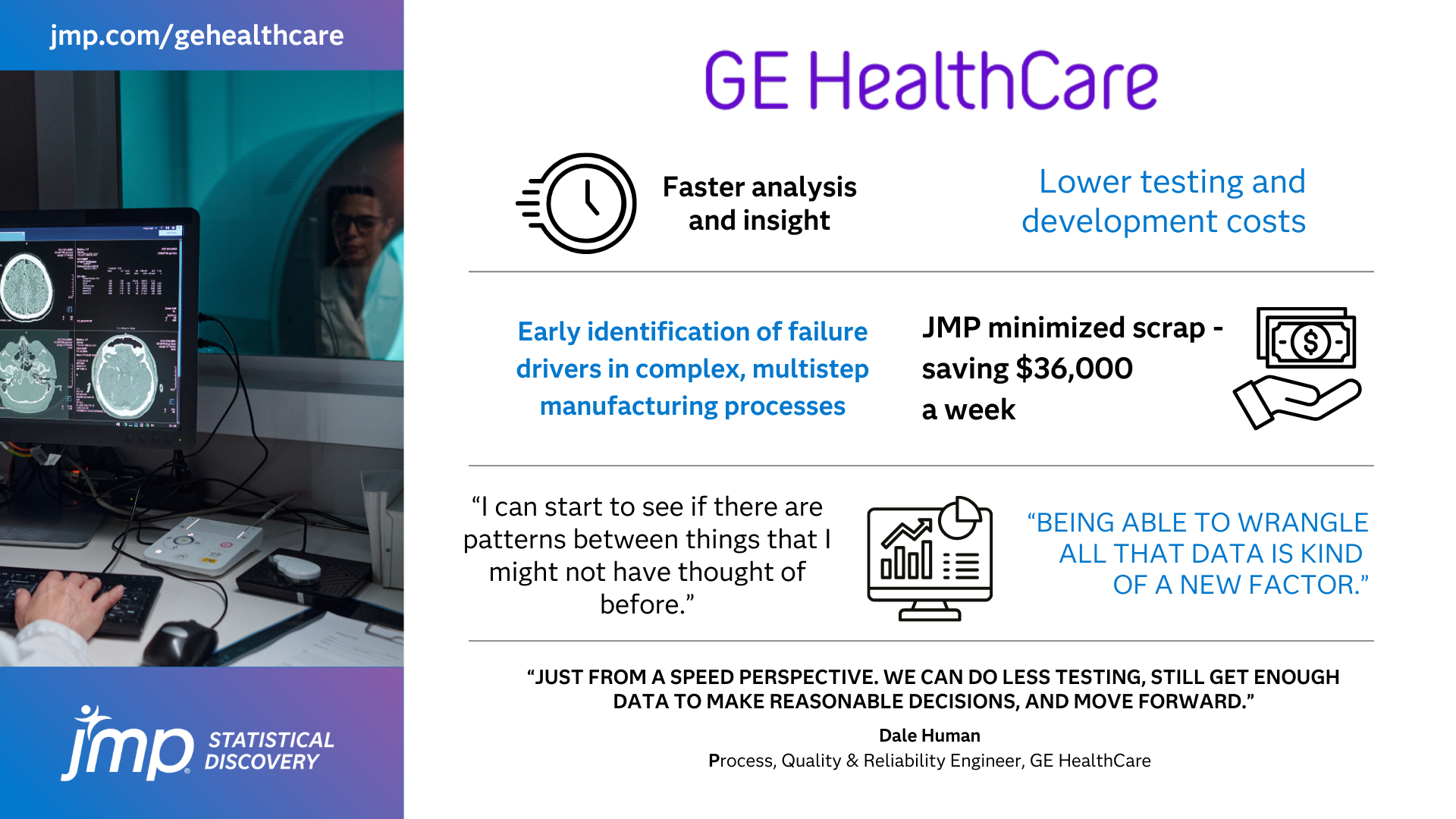
I mean, just in the time spent in doing exploratory analysis, JMP saves me time personally. That’s a little hard to quantify from a business perspective, I suppose. But it makes things much easier. We had a defect that had appeared on a particular component. It’s a fairly expensive component. It costs about $5,000 per unit, and we make 60 of these a week. And we had a defect come up, and we were having about a 20% failure rate. We were scrapping about $36,000 a week. I used JMP to help identify here’s the path that we can take to screen components so that we can minimize the parts that we have to throw away because they have a problem. So we put those off to the side, we worked with our vendors to make improvements on those parts over time.

When you’re dealing with a complex value stream in a manufacturing operation, for example, there are lots of process steps and, historically, we would go and gather data from each process step. And maybe you would find a relationship there that was important and was driving your problem, but you never knew if you had missed something. So maybe there’s this other factor that we haven’t been looking at. And with JMP, it becomes easier. I can gather all of that data, make simple graphs. I click on a button right in the data table, and I can start to see if there are patterns between things that I might not have thought of before.

I think that’s been one of the big benefits we’ve seen. Twenty years ago, data was hard to gather. So you’re dealing with small samples all the time. Nowadays, machines are just gathering gigabytes of data. We’re throwing them into databases of various types. So being able to wrangle all that data is kind of a new factor. And now I have to be able to connect all of those sources of data. So to me, that is one of the big benefits of JMP. To get engineers to want to use these kinds of tools is to make it very easy for them. Not a lot of steps to have to do a fairly detailed analysis. Just from a speed perspective, we can do less testing, still get enough data to make reasonable decisions, and move forward.

JSR, Jotun, Bosch, Adisseo: Success Story Infographic - 6

The results illustrated in this article are specific to the particular situations, business models, data input and computing environments described herein. Each JMP customer’s experience is unique, based on business and technical variables, and all statements must be considered nontypical. Actual savings, results and performance characteristics will vary depending on individual customer configurations and conditions. JMP does not guarantee or represent that every customer will achieve similar results. The only warranties for JMP products and services are those that are set forth in the express warranty statements in the written agreement for such products and services. Nothing herein should be construed as constituting an additional warranty. Customers have shared their successes with JMP as part of an agreed-upon contractual exchange or project success summarization following a successful implementation of JMP software.