Innovating fire-protective coatings: Jotun’s data-driven R&D
Jotun leverages JMP to optimize the development of advanced intumescent fire-protective coatings. By using design of experiments and dynamic data visualization, it improves formulation efficiency and reduces costly fire testing.

Jay Richardson
R&D Intumescent Chemist, Jotun
Below is the video transcript.
Jotun is a family-owned business. We have marine, protective, decorative, and powder coatings.
I'm an R&D chemist in the Intumescent Department, and the team I work in develops both cellulosic and hydrocarbon products for the infrastructure markets. These are used mainly on commercial property and places where steel exposure and architecture is of high importance.
An intumescent coating is a reactive coating and when exposed to fire it will swell up, up to 60 times the original dry film thickness to provide an insulative barrier to the substrate below.
I think our bread and butter, in terms of using JMP, is for design of experiments (DOE). DOE has helped us to efficiently optimize the formulations in order to reach our desired outcomes for fire test results, but it's also allowed us to optimize based on cost, based on other coating performance criteria.
As an R&D chemist, I'm not a statistician. It allows for an easier access to statistical tools and being able to apply statistical methods to something that I would never be able to do on my own.
In order to develop our products, we have to understand that the formulation changes we make are reflected in the results that we get. We expanded our capacity in the intumescent department from two smaller cube furnaces into two extra larger furnaces, which essentially quadrupled our testing capacity.
In the analysis we were doing, we had a positional component, as well as a temperature-time component. So in order to reduce the number of dimensions and get a better understanding, we can simplify by using Functional Data Explorer to reduce the number of dimensions within the analysis. And then we used this to simulate points into scatter plot 3D.
Using a dynamic visualization, it allows us to speak about our results in meetings and be able to show different trends to stakeholders and consumers when we need them. But also to give confidence in our development so that we understand when we develop our products, the changes that we make are based on formulation rather than being based on maybe some variation within the furnace.
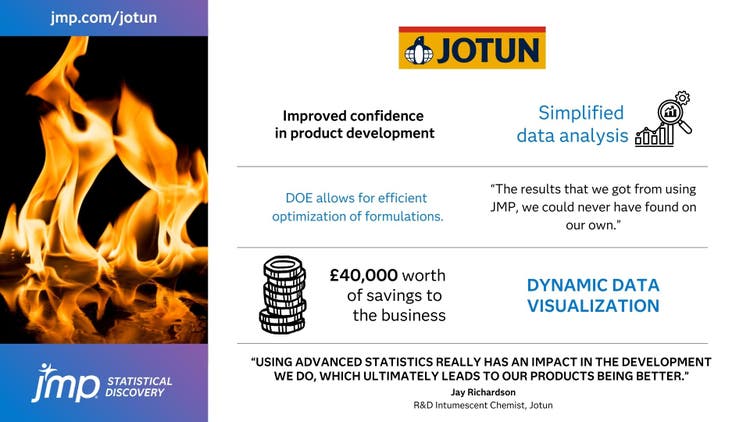
The cost of our fire tests are £5,000 start to finish. So it's quite easy to see, if you sort of backtrack in calculations in order to do our simulations, we simulated 10,000 data points. In a typical fire test, we'd have 20 thermocouples with 60 data points on them. The analysis that we've got from JMP with a reduction could equate to around £40,000 worth of savings to the business.
I can see in the future that there's going to be a greater awareness on data capture and data utilization, which comes from a foundation of understanding how to store data and best practice for data capture. Using advanced statistics really has an impact in the development we do, which ultimately leads to our products being better.
The results that we got from using JMP, we could never have found on our own. We can see the real value from using JMP in order to really understand the formulation space in more detail than one-factor-at-a-time type analysis.
It's really fulfilling to see that statistical analysis is leading to more optimization and deeper innovation within the fire-protective industry.