Streamlining quality control and ensuring reliability in semiconductor manufacturing

JSR Micro uses JMP Live to integrate data from multiple sources—production, quality control, and environmental systems—to improve analysis, catch anomalies early, and ensure the highest product quality for semiconductor manufacturing. This streamlined, automated approach has significantly increased efficiency and the reliability of the final product for the customer.

https://share.vidyard.com/watch/9RNnCCXa5yU8SNHCQCzVcp

Mathieu Vanden Bulcke

Director Quality, JSR Micro NV

Ruben Lenaerts

Quality Assurance Sr Specialist, JSR Micro NV
Below is the video transcript.

JSR Micro is the Belgian subsidiary of JSR Corporation. We are producing photoresist, a photochemical, photosensitive material that is used by the semiconductor industry. It's very critical that the quality of a product that we deliver are perfect so that it doesn't impair the reliability of the chips. We are making sure that we have systems in place to guarantee the quality of the final product is meeting the customer requirements.

JSR Micro, we are collecting and have access to a lot of data. The biggest challenge that we have is using this data, interconnecting this data, because most of this data are spread in different systems. And that's a big challenge. At the management level, there is a lot of support to use the data that we have. JMP Live fits in that context to make the best use of the data.

In production, we make a batch and during that batch, we have to sometimes adjust the recipe to get the functional parameters of that batch correct. But the data was in a different database than the analytical measurements. And now, what we worked on is that we merge those two things and that you can do analysis on everything that you have done in the past, which is something that, before we had JMP, took a lot of work.

Thanks to the capability of JMP to work with scripts we had a chance to start to automate processes which made it possible to have a more regular review of data.

JMP Live allow us to connect to all our different data sources; so production data, QC data, environmental data and gather all this information, this data, and play with that data, analyze it, and check correlations between those different sources. We can tune exactly the way we look at the data, in the way we want and the way we need. Missing data, or abnormal deviating data, if we do not catch it and it comes to our customers, it could impact thousands of chips. So, it would be very harmful for the customer, and also very harmful for our relationship with that customer.

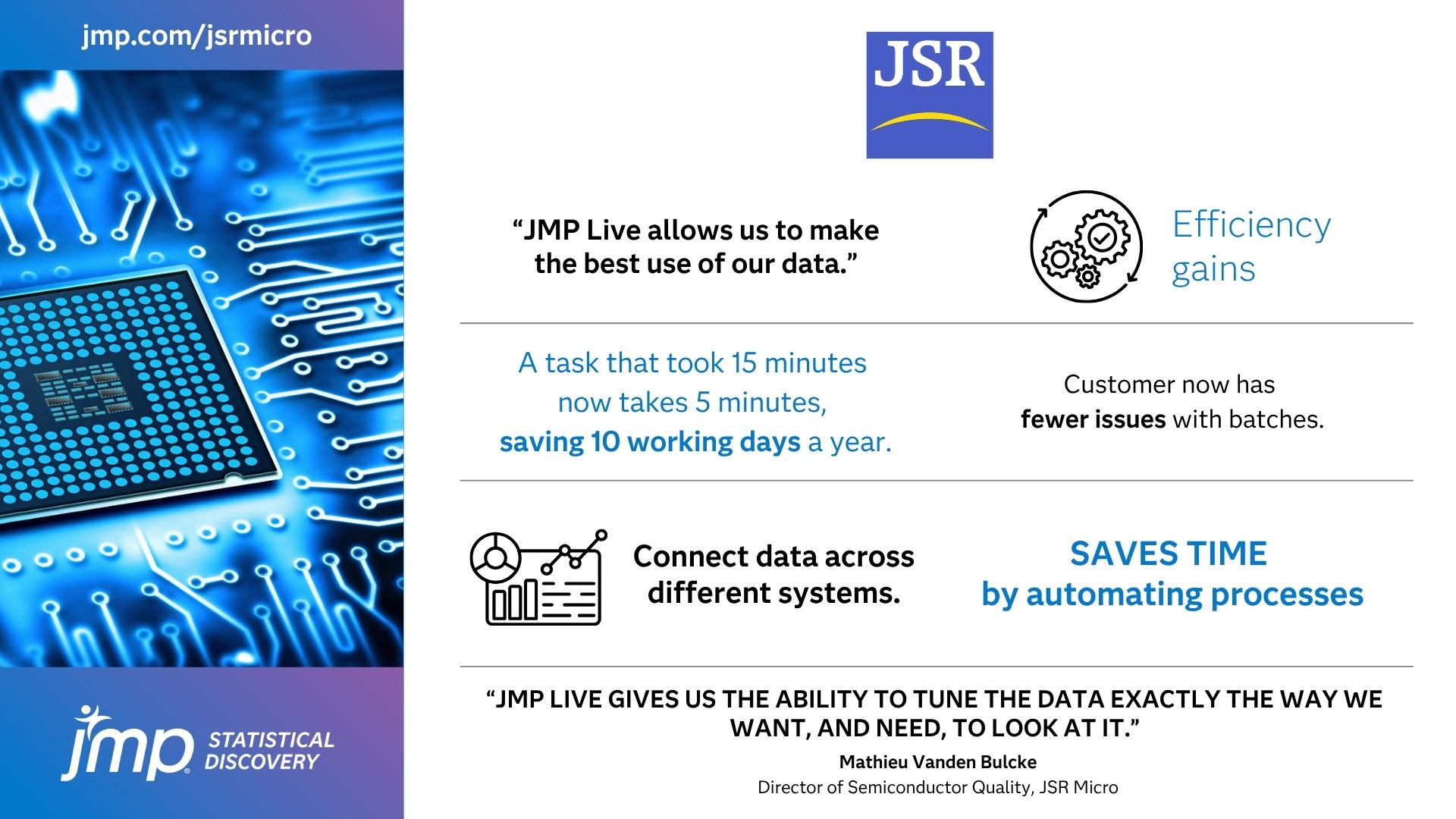
To quantify the value of the improvements, we now miss less. So our customer also gets less issues with the batches. Looking, for example, at these batch reports. It's something that took 15 minutes, and now it takes 5 minutes, which does not seem like that big of an improvement, but it is something that is done 10 times a day. So if you then look at how much time it saves in a year, then you end up at more than 10 working days of time saved.

With JMP Live, now we have a direct view on what is the data that is abnormal and needs focus. And we don't need to spend time looking at all the rest. So that's a huge gain in efficiency.

The results illustrated in this article are specific to the particular situations, business models, data input and computing environments described herein. Each JMP customer’s experience is unique, based on business and technical variables, and all statements must be considered nontypical. Actual savings, results and performance characteristics will vary depending on individual customer configurations and conditions. JMP does not guarantee or represent that every customer will achieve similar results. The only warranties for JMP products and services are those that are set forth in the express warranty statements in the written agreement for such products and services. Nothing herein should be construed as constituting an additional warranty. Customers have shared their successes with JMP as part of an agreed-upon contractual exchange or project success summarization following a successful implementation of JMP software.