Interpretable AI for Real Manufacturing Challenges
Drawing from real industry experience, Associate Professor Lee Jong-Seok at KAIST shows why AI must respect basic physical principles to be trusted on the factory floor.
Lee Jong-Seok
Associate Professor, Department of Industrial & Systems Engineering Process, KAIST
Below is the video transcript.
AI at this moment is not transparent enough.
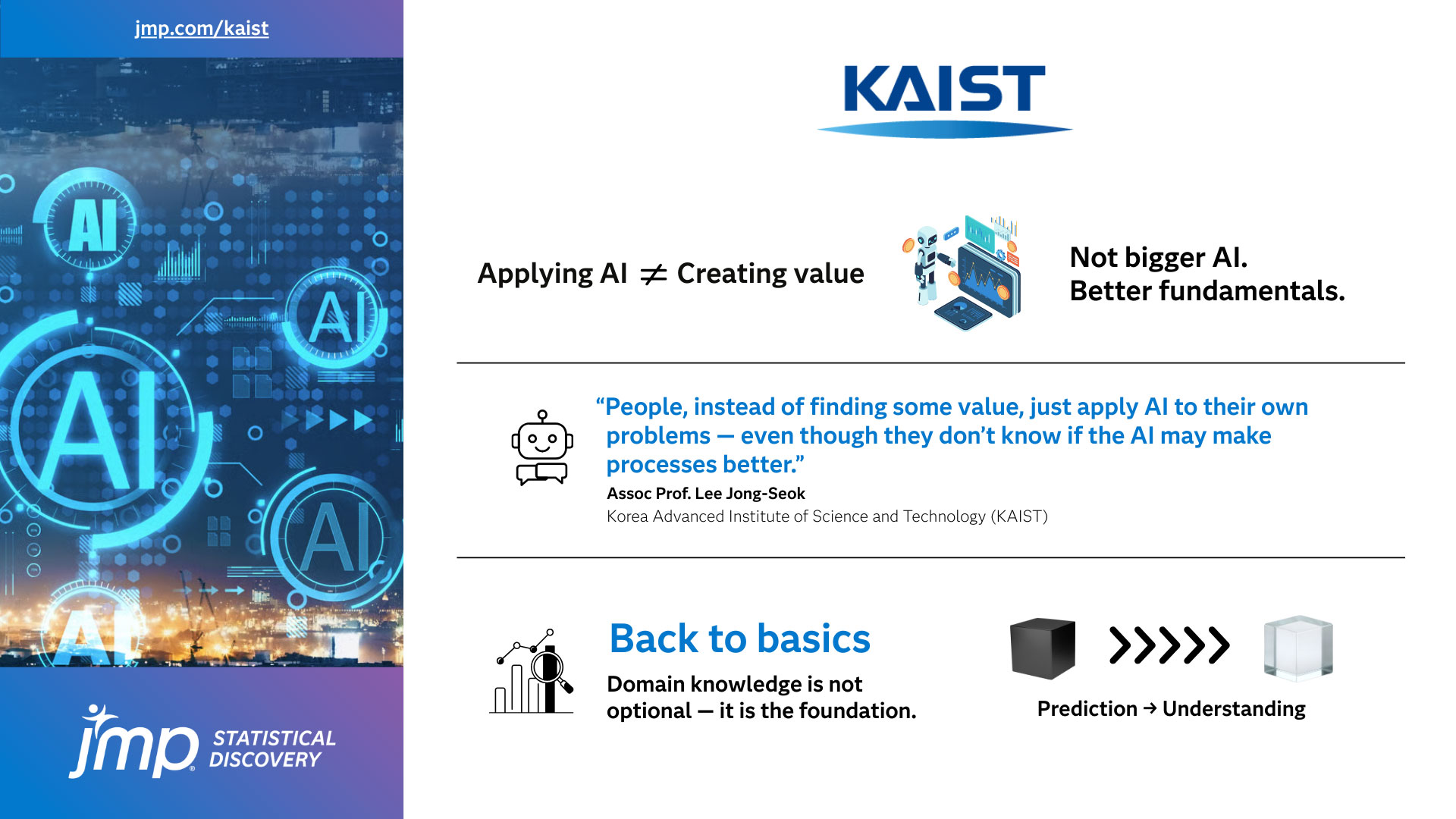
People instead of finding some value, they just apply AI into their own problems, even though they don't know if the AI may make processes better.
There are some challenges when applying AI to real problems because of the limited access to data. The AI learned from data that are publicly available, right? So, it doesn't know well about specific areas. If you go back to the basics, for example, basics for the manufacturing, then I think the human expert can do much better.
I am an associate professor at KAIST (Korea Advanced Institute of Science and Technology), and I believe that this school is the best one in South Korea. My research interest is in the intersection between machine learning and artificial intelligence and manufacturing applications. When I was a graduate student, I had an opportunity to work with a manufacturer in this country, and I got to know that the methodologies in research articles, they really are not directly applicable to the real problems.
So that's why I'm positioning myself in the bridging between academia and the industry.
A big trend of research is making a model as large as possible. It's getting more difficult to understand the model. But with my graduate students, we try to make as simple model as possible.
To apply to the manufacturing side, we should be able to interpret the models. Then the easiest way to do that is to make the model as simple as possible. But at the same time, what we are trying to do is as accurate as possible and as powerful as possible, even though with a very small structure, small size of model.
I worked with a steel maker in this country, and the problem that I have to solve is controlling the coating weight on the steel strip.
And there is a simple relationship between input and output. The input is gap; the output is the amount of zinc on the surface. So, I made a function using data obtained from this site.
To predict the coating weight, the gap was the one of the inputs in the model. Then we know that if X increases, Y must increase, and if X decreases, Y must decrease. There is a simple physics in this example, but the model trained from the data obtained from this site, that does not hold this simple physics.
There's a trend. Here's a gap, which is X, and here's a coating weight Y. Then there's a trend as gap increases coating weight increases, but sometimes at some point, even though gap increases, the coating weight decreases, the predicted coating weight decreases.
At this area, the physics is broken, so this model cannot be applied to the real side because I want to increase the coating weight.
But the model says that you have to decrease the gap, the opposite direction, right? It's the kind of accident like the autonomous driving. I have to turn right, but the AI turn left. So what I actually did to solve this problem is, I used the neural network, so there must be a positive relationship between the gap and the coating weight.
So when I train this predictive model, I gave a strong constraint on the coefficients of the gap. It must be a positive to be a positive relationship between that. So the solution that I came up with is basically from the statistics knowledge. If I don't have that kind of background, a statistical background and optimization background and in-depth knowledge about training model, then I was not able to solve this problem.