Accelerating cell and gene therapy with data-driven science
Meltenyi Biotec uses JMP to empower scientists and engineers with intuitive, visual analytics that bridge scientific intuition and statistical rigor. By enabling quality by design, faster analysis, and confident regulatory communication, JMP helps accelerate the delivery of life-changing therapies to patients.

Emmett George
Lead Bioprocess Engineer, Miltenyi Biotec
Below is the video transcript.
Miltenyi Biotec is a global life sciences company. We are committed to advancing biomedical research and cellular therapies to make a meaningful impact on human health. We start all the way from discovery through clinical and commercial production, and we really want to help bridge that gap between benchtop science to providing those real-world therapies and bringing those to market.
We focus on having a strong culture of data-driven decision making across functions – from R&D to manufacturing and then all the groups in between. There is that shared understanding that analytics isn't just a support function: it's quality, reproducibility, and regulatory compliance.
We use JMP specifically to empower the scientists and engineers at Miltenyi to use those statistical tools proactively instead of reactively, which strengthens our processes and helps us accelerate bringing those products to market.
JMP bridges the gap between scientific intuition and the statistical rigor that we bring forward with all our products and experimentation. It really allows quality professionals to explore data visually, model process behavior, and then to communicate the findings without needing to code.
I like looking at data and solving problems on the fly, showing up to work every day knowing that there's a long-term goal and a long-term strategy, and that's to help patients in need and to put themselves above you. Then also working with my colleagues who have similar goals and similar approaches to wanting to solve problems.
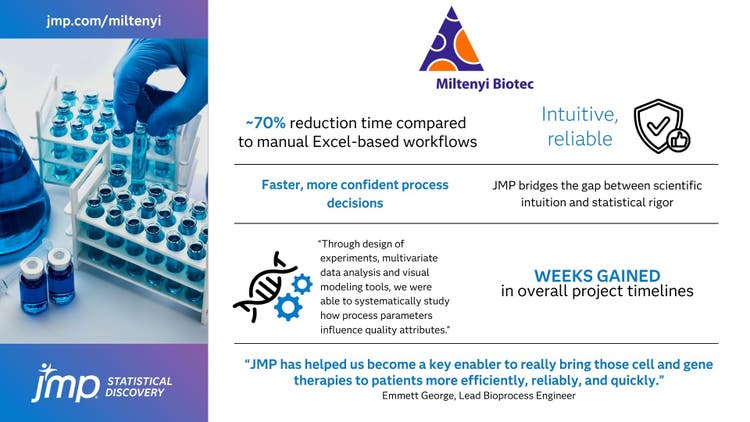
JMP made it easy to apply the quality by design approach, or QBD, in a very practical and data-driven way. Through design of experiments, multivariate data analysis, and visual modeling tools, we were able to really systematically study how process parameters influence quality attributes. And JMP really helped us move from that trial-and-error experimentation or the OFAC type of experimentation to using a much more structured, science-based, kind of risk-based approach to process development.
As the cell and gene therapy, or CNGT, industry continues to grow, I think seeing tools like JMP really evolving are going to become more essential to the scientists and engineers that are working on these therapies. JMP has a very intuitive, user-friendly interface, and that makes it possible for more teams to very quickly learn how to use JMP. You don't really have to have a strong statistical background, and you don't really need to know the coding behind it.
It empowers teams to visualize complex relationships and clearly communicate findings to those in the regulatory agencies where you have to prove what you're presenting if you want to see some of those therapies get approved. Within biotech, that documentation and strong documentation is very much needed for when you go up and present in front of the regulatory agencies.
Some of the other software I've used previously, it's really on the user to learn and there's not that STIPS that JMP offers, or the other training courses, or even the JMP Marketplace, the JMP Community, for you to go in with other users just like yourself to help you figure out what are your problems and then how to address those problems.
Not really having any exposure to the classical design of experiments and then seeing the power that it can bring (that Excel does not offer) that JMP offers extremely well. Again, using Easy DOE specifically, you don't have to have a strong background in the math behind the classical DOE or even the cubic design space. You don't really have to have that knowledge behind it. You just can't do that in Excel. It's much easier, and JMP is kind of that gold standard, if you will.
During process scale up, we consolidated data. Using JMP reduced the time to perform that statistical analysis and generate the control charts by probably roughly about 70%, compared to the manual Excel-based workflows that we were using in the Process Development team.
That time savings definitely translated into weeks gained in overall project timelines. I think more importantly, just the deeper confidence in our process decisions and really focused on leveraging that data.
JMP has helped us become a key enabler to really bring those cell and gene therapies to patients more efficiently, more reliably, and more quickly.