Reversing bacterial resistance with accelerated assay development
A new automated method for high-dimensional assay development is enabling researchers to rapidly identify drug candidates targeting bacterial resistance mechanisms. This advancement, made possible through a collaboration between the University of Oxford, JMP, and Synthace, focuses on the RecBCD enzyme and marks a significant step forward for drug discovery in the fight against antibiotic-resistant bacteria.

Adam Winnifrith
University of Oxford
Markus Gershater
CEO & Co-Founder, Synthace
To read more about the research discussed in this video, please see the RSC Chemical Biology paper.
Adam Winnifrith, Steven R. Brown, Piotr Jedryszek, C. Grant, Philip E. Kay, Adam M. Thomas, Jacob D. Bradbury and Thomas Lanyon-Hogg. Development of a fluorescence-based assay for RecBCD activity using functional data analysis and design of experiments. RSC Chemical Biology: DOI: 10.1039/d4cb00291a
Below is the video transcript.
Winnifrith: Drug-resistant bacteria are undermining modern medicine, and in the Lanyon-Hogg Group at the University of Oxford, we are developing new ways to combat that.
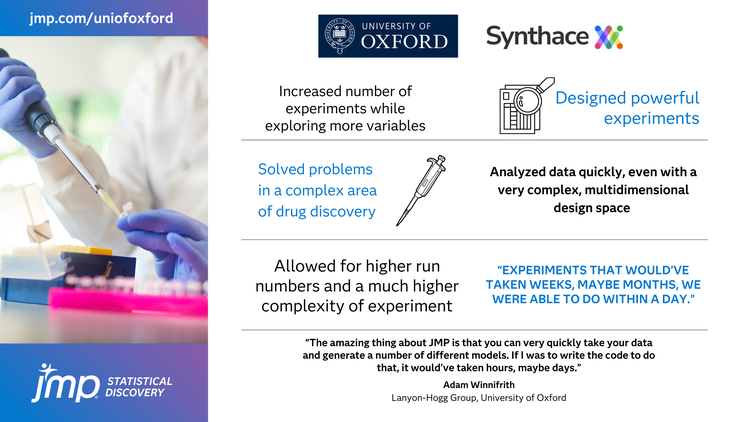
Bacteria become drug-resistant because they have evolved ways to resist the antibiotics that we use to treat them, and we were focused on trying to take a new approach to that, which was reversing bacterial resistance. And we had identified a particular enzyme, called RecBCD, which is a protein that controls that response, and we wanted to develop a drug against it. In order to do that, we needed to go through the whole drug discovery process, and an essential part of that is assay development. We started this bit of research by developing an assay that I was pipetting by hand. And the most experiments that I was doing with that was changing one variable at a time and getting 20, 24 data points after 10 minutes. With JMP and pipetting by hand, I was able to increase that to exploring four different variables and getting over about 128 different data points. And then when we combined Synthace and JMP together, I was getting about 728 different data points from one experiment.
Gershater: Fundamentally, biology is a really unique system that's emerged out of billions of years of evolution. So what you need are experiments that can unpick all of that complexity. We founded Synthace on the basis that multidimensional experiments are super powerful for investigating biological systems. And that's because for some biological problems, you actually run them at a really small scale.
Winnifrith: In our assay, there are 11 different variables that we thought were particularly important. We knew that developing the assay and making it robust and optimizing it for a particular signal-to-noise ratio was going to require exploring an incredibly high-dimensional design space. We needed to know which combination of those 11 variables are going to lead to the best assay for our purposes.
Gershater: So, in the case of Adam's work, then he used a combination of JMP that enables you to design a really powerful experiment and pretty much whatever experiment you need. But then you need a bit of software like Synthace, which is essentially like an experimental planning engine, and it writes the automation instructions that are needed for actually carrying out that experiment. So, you know, it was many, many hundreds of runs.
And then there is a piece of automation in the lab called the SPT Dragonfly, which is then super good at carrying out a really high complexity experiment at very low volumes. And then back into JMP for the analysis. So, it's using this combination of tools to solve this area of drug discovery, which previously has been really, really knotty.
Winnifrith: The amazing thing about JMP is that you can very, very quickly take your data and you can generate a number of different models to analyze the data. If I was to write the code to do that myself, that would've taken hours, maybe days. That for me, meant that within 20 minutes almost of getting my data, I was already able to get a really good feel for everything that had happened despite having a very complex, multidimensional design space.
Gershater: So I'm a big believer in automation for improving and enhancing the kind of power of experiments that can be run in the lab. So essentially the vision at Synthace is that we can make automation that's needed for carrying out super powerful experiments that are much easier to access and program and use, so that then it means that you can do much higher run numbers, much more higher-complexity experiment because you're just not doing that, you know, handheld pipetting.
Winnifrith: We were able to do those experiments within a day. Without JMP and Synthace, we just, we wouldn't even been able to do it at all, hand-pipetting those kinds of experiments. Even if I just did maybe one variable at a time, it would've taken weeks, maybe months. And this was just such a rewarding way to work and do science to iterate so rapidly.
Gershater: It just never gets old. Being able to look at those data sets, understand what this kind of methodology has unpicked for that particular system and how it's made it dramatically easier for people to be able to do that kind of work and kind of lifted the ceiling on the kind of biological experimentation that they're able to do. It's just really gratifying.
Winnifrith: Now that we've developed this new assay for targeting RecBCD, the Lanyon-Hogg Group at the University of Oxford will be taking it forward to screen new drug candidates against that enzyme, which will hopefully end up playing a part in saving patients' lives.
