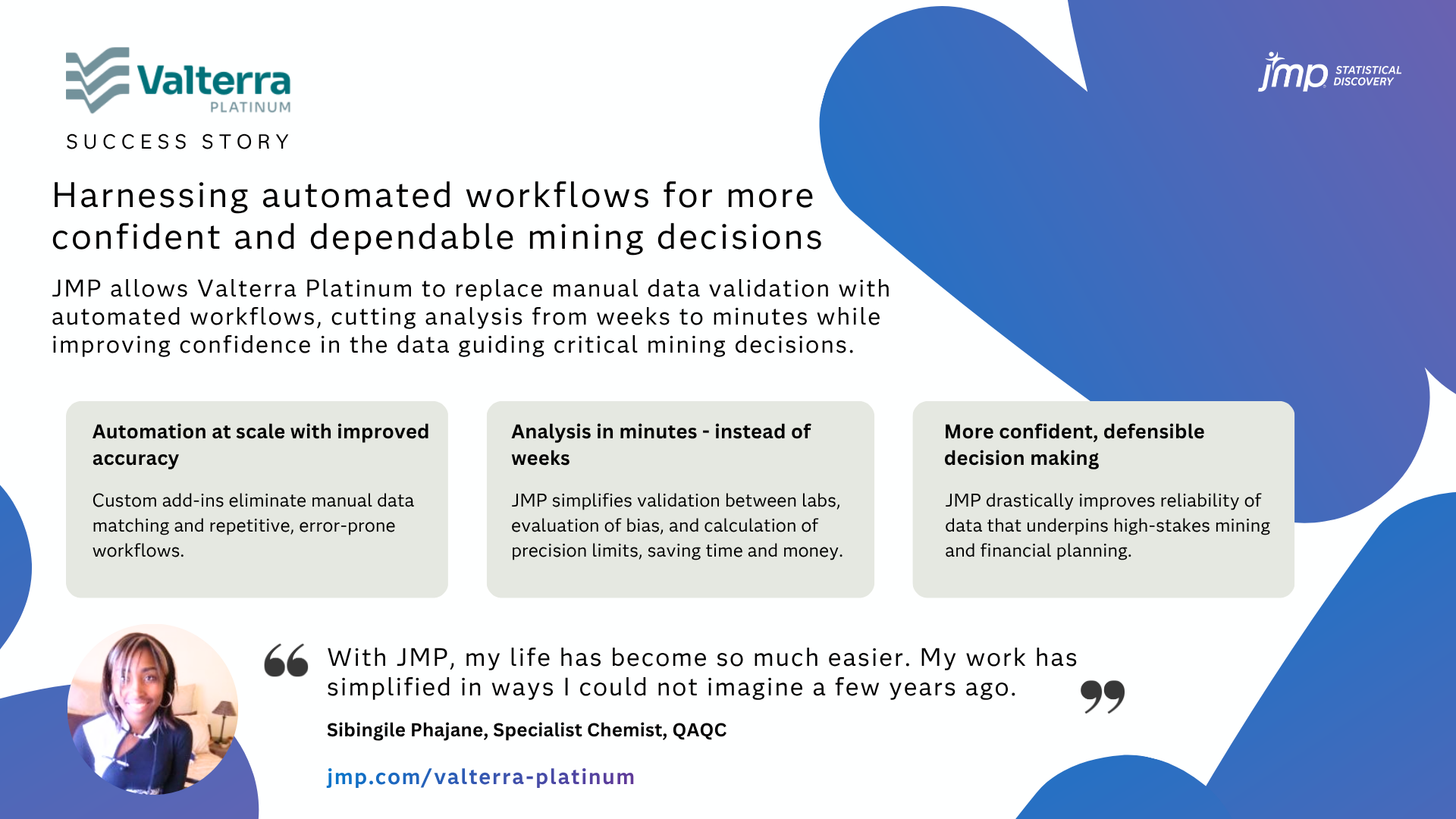
Harnessing automated workflows for more confident and dependable mining decisions
JMP enables Valterra Platinum to transform an otherwise slow, manual, and error-prone data validation process into a fast, automated workflow, drastically improving both efficiency and reliability. The result is not only faster decisions, but greater confidence in the data that underpins high-stakes mining and financial planning.

Sibongile Phajane
Specialist Chemist, Valterra Platinum
Platinum group metals (PGMs) reside at the heart of modern industry, required heavily in automotive manufacturing, a vast array of technology products, and even the development of pharmaceuticals, to name just a few. Meeting the global demand for these rare elements requires massive mining efforts, where success depends on the integrity of data as much as the richness of the ore. A minor analytical error, if missed, can ripple into costly miscalculations affecting what is mined where and how.
Ensuring that this data stands up to scrutiny is the work of specialists such as Sibongile Phajane, a chemist at Valterra Platinum. In an industry defined by scale and complexity, Phajane’s role is both precise and consequential: interrogating the quality of the numbers that ultimately shapes mining strategy for the company
Prior to joining the QAQC team, Phajane spent 12 years gaining laboratory experience in analytical chemistry. At Valterra Platinum, she uses that knowledge to ensure “the accuracy and precision of the data, and that the data is produced in a contamination-free environment,” she says. In an industry concerned with highly valuable metals, her work is crucial to ensuring that the highest levels of data quality are achieved.
Phajane explains that a large, constant stream of samples is sent to laboratories for analysis to support analytical requirements for Valterra Platinum’s five large and complex mining operations: laboratory submission of samples are analyzed with different techniques required for a complete sampling assay suite. Phajane must interrogate and assess all reported data and produce a QAQC evaluation per site. The importance of data quality and analytical accuracy can’t be overstated: “this data is used in mineral resource and ore reserve evaluations, which determines future mine planning.”
As Phajane warns, flawed analytical data “could lead to inaccurate estimation of grades and values that any mining company places financial value on,” opening the door to overestimated grades and unrealistic mine planning, or underestimated grades leading to “viable resources being discarded.”
Phajane suggests that JMP plays a critical role to assess the volume of analytical information, thus reducing system complexity. Validating mining data involves demonstrating both short- and long-term precision within individual laboratories, as well as consistency between these laboratories over time. Before JMP, Phajane says that she “used to do all of these evaluations manually,” which would require data alignment through manual processes. These workflows were slow, repetitive, and prone to human error.
However, the shift to JMP has substantially streamlined Valterra Platinum’s data validation procedures. With the use of custom-made add-ins and scripted JMP workflows, Phajane has reduced tasks that once took weeks to a matter of minutes. “JMP has simplified things in a way I could never imagine five years ago,” she says. Phajane has constructed scripts for validating precision between labs, evaluating bias, and calculating precision limits, among other validation tasks. As she describes, “I have an add-in for everything.”
The shift to JMP has provided not only an efficiency increase, but also a confidence boost in the data Phajane is evaluating. She explains that with JMP, she can easily “start investigations if a lab is drifting from reporting accurately [and] monitor whether labs take care to manage contamination,” insights that previously required long hours of manual checking. Phajane now has time to probe deeper and explore areas of improvement for Valterra Platinum, strengthening the reliability of the data that underpins critical mining decisions.