From footprints to data insights: transforming wildlife conservation with predictive analysis

WildTrack, a North Carolina-based nonprofit, uses JMP to transform non-invasive footprint tracking into powerful conservation science, helping monitor endangered species without harming them. What began as a response to the decline of rhinos has grown into a global ecosystem of researchers and students using JMP to analyze biodiversity through footprints.
Print

https://share.vidyard.com/watch/MYWyqPUHNgPhADFmmN5Zfv

Zoe Jewell

Co-Founder, WildTrack

Sky Alibhai

Co-Founder, WildTrack
Below is the video transcript.

WildTrack is a non-profit organization. We're based in North Carolina, and our slightly unique remit, I guess, is the monitoring of endangered species using completely non-invasive, cost-effective, and community-based technologies.

Going to Zimbabwe and seeing the state of one of the most charismatic species that we have today, seeing the demise, almost the virtual demise of that entire species was very evocative. I mean, literally, when we were there, we could hear shots being fired in the middle of the night, and we knew that another rhino had gone down. And I think in a way that drove us to make sure that in whatever way we could, we would continue the mission of WildTrack.

One of the things that we figured out early on was that the constant immobilization of these animals and putting collars on them and darting, and tagging them, really wasn't having a positive impact.

In fact, it's having a negative impact. That was really where we started to think there's got to be a better way of doing this. And JMP was quite central in showing us that there was something that could be done about that.

We were using this technology to put collars on the animals to try and monitor them. And we were working with local rangers, and they could read in the footprints, they could read information, they could garner information, which is absolutely astonishing. And we realized that here was a wealth of information that was not being utilized. And so, we started pursuing that to see how we could bring this art into the realm of science, and that's where JMP came in.

We started playing a bit with JMP and that was about the time we said, look, there must be something in these footprints. These trackers can identify the data, we should be able to do it too. There's got to be a way, and I think the data visualization features in JMP were such that that really made a difference, right? It really enabled us to play with that data and find out at what point we could distinguish individuals from their footprints. We can identify the species, individual, sex, all from one footprint. That is an incredible source of data.

And you wouldn't believe it that the technology we developed for tigers, lions, cheetahs, and rhinos is the exact technology we're using to monitor mice. You know, they leave footprints behind, which enables us to identify species diversity within small mammals; this is a great indicator of biodiversity.

I think for me the innate capabilities that JMP has with data visualization do facilitate, and it definitely speeds up the answer. So, from our point of view, it’s a unique setup that enables us to do all that we need within one piece of software.

We would go out to track rhinos in the morning before it got too hot and then come back in the afternoon to perform analytics using JMP.

JMP developers have been some of the most wonderful people that we've actually had to work with. Absolutely fantastic. You know, so many of them have contributed their time and explored avenues. And there's never a shortage of people who are willing to help. And that continues, that association continues to this day.

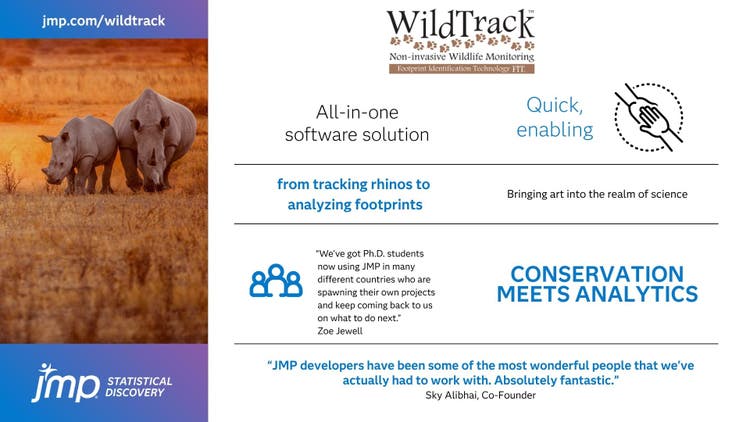
We've got Ph.D. students now using JMP in many different countries who are spawning their own projects and keep coming back to us on what to do next. So, it's really quite a big, I would say it's quite a big WildTrack JMP ecosystem at this stage.

Novonesis, DuPont, Johnson Matthey, IQE, Lonza Success Story Infographic - WildTrack

The results illustrated in this article are specific to the particular situations, business models, data input and computing environments described herein. Each JMP customer’s experience is unique, based on business and technical variables, and all statements must be considered nontypical. Actual savings, results and performance characteristics will vary depending on individual customer configurations and conditions. JMP does not guarantee or represent that every customer will achieve similar results. The only warranties for JMP products and services are those that are set forth in the express warranty statements in the written agreement for such products and services. Nothing herein should be construed as constituting an additional warranty. Customers have shared their successes with JMP as part of an agreed-upon contractual exchange or project success summarization following a successful implementation of JMP software.