BOOK CHAPTER
A better way to answer "why"
Move beyond correlation to understand cause and effect
By Ken Bollen

Ken Bollen
Professor, Department of Psychology and Neuroscience and Department of Sociology
University of North Carolina at Chapel Hill
We live in an era of abundant data and increasingly sophisticated analytical technologies. Yet many of the most important questions organizations face are not simply what happened, but why it happened.
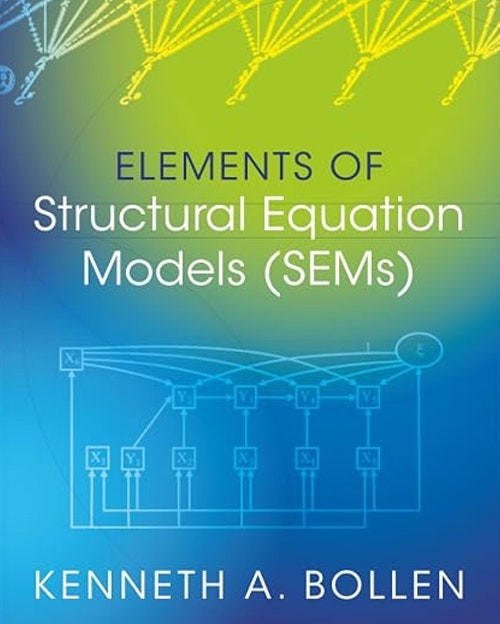
In this chapter from Elements of Structural Equation Models (SEMs), internationally recognized researcher Dr. Ken Bollen explores how structural equation modeling helps researchers and practitioners investigate complex relationships, account for measurement error, and test causal assumptions.
Why read this chapter?
You'll discover:
- Why causal thinking is essential for better decisions and innovation.
- How SEMs leverage expertise to help answer complex "why" questions.
- The risks of relying on poorly specified models and hidden measurement error.
- The strengths, limitations, and real-world applications of SEMs across disciplines.
A powerful framework for understanding complex systems
Structural equation modeling combines subject-matter expertise, causal assumptions, and empirical data to help researchers evaluate and refine their understanding of how variables relate to each other. Rather than focusing on prediction, SEMs provide a framework for investigating the mechanisms that drive outcomes.
Whether you're working in analytics, research, engineering, public health, social sciences, or business, SEMs offer practical tools for tackling the questions that matter most.
Download the book chapter
Complete the form to receive your complimentary chapter from Elements of Structural Equation Models (SEMs) and learn how leading researchers approach the challenge of answering "why."