Central Composite Design
What is a central composite design?
A central composite design (CCD) is a classic response surface design. It incorporates points from a fractional factorial design of at least resolution V, center points, and axial points (star points). In resolution V designs, the main effects and all two-factor interactions can be estimated. The points form a cube plus a star and are equidistant from the center.
When should I use a central composite design?
Central composite designs are used for response surface designs where prediction and optimization are your goal. They are especially useful for sequential experimentation since they contain design points from a two-level factorial or fractional factorial design. The initial design can be augmented with center points and axial points to obtain a CCD. Central composite designs only support continuous factors.
An introduction to central composite designs
Central composite designs are a type of classical RSM design and are known for their usefulness in sequential experimentation. They include only continuous factors, each tested at five levels: two axial, low, middle, and high, or –α, –1, 0, +1, +α.
Central composite designs include points from a fractional factorial design of at least resolution V, center points, and axial points. The three parts of the design allow you to estimate the main effects, interactions, and quadratic terms:
- Factorial points (coded as -1, +1): Enable you to estimate the main effects and second-order interactions.
- Center points (coded as 0): Enable you to detect curvature, increase precision, and test for lack of fit.
- Axial points (coded as –α, +α): Enable you to estimate quadratic terms.
In the figure below, factorial points are shown as black squares, center points as blue circles, and axial points as orange diamonds.
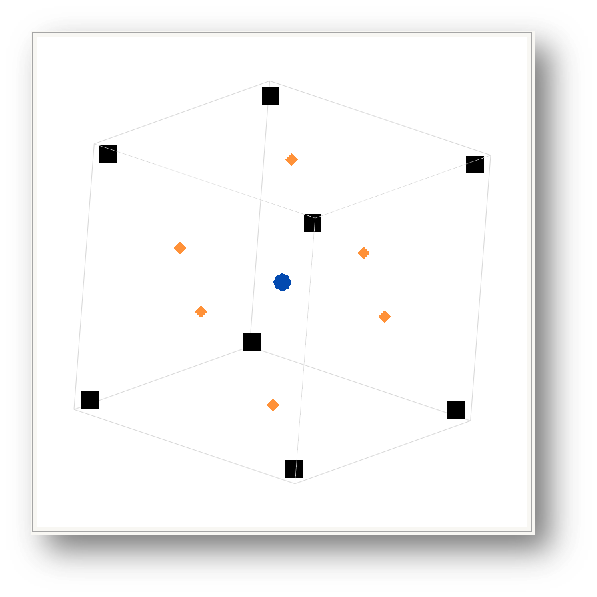
Center points represent when the factor values for all factors are set to the midrange values. They are used to understand if there is curvature (a quadratic effect), to increase precision, and to provide a test for lack of fit. If the lack of fit test indicates the first order model is not appropriate, you can augment the design with axial points to obtain a CCD.
Axial points (also known as star points) set properties of the design, such as rotatability and orthogonality, and are used to estimate the quadratic effects. They are situated at a distance of ±α from the center of the design. Each axial point is ±α for one factor and 0 for all other factors. Axial values can be placed in different positions within the design, so there are different types of central composite designs available:
- Faced: Axial values are on the centers of the face of the cube (factorial space). These CCDs are also known as on face or face-centered.
- Circumscribed: Axial values are outside the cube (factorial space).
- Inscribed: Axial values are within the cube (factorial space).
CCDs can be run sequentially by augmenting a design, which is one of their advantages. Augmenting a design means adding runs to an existing experimental design. First, collect data from a factorial or fractional factorial design. Next, add center points by augmenting the design to test for lack of fit. Finally, if you discover there is a lack of fit of the first-order model, you can augment the design with axial points to obtain a CCD.
Three- and five-factor I-optimal designs will generate the same unique trials as a CCD for the respective number of factors. When you have multiple factor types in addition to continuous – such as categorical, restrictions on the design space, nonstandard models or a custom run budget – consider algorithmic designs for their added flexibility.
An example of a central composite design
Suppose we want to find the optimal factor settings for maximizing Seal Strength of bread wrappers. From previous knowledge, we know that the three continuous factors % Polyethylene, Cooling Temperature, and Sealing Temperature are important. We decide to run a central composite design to understand the shape of the response surface with a second-order model. First, we define the response goals and the factor settings.
The response and factors are:
- Seal Strength: The response goal is maximize (higher is better).
- % Polyethylene: The factor range is 85-95 (mid-point is 90).
- Cooling Temperature: The factor range is 120°-140° (mid-point is 130°).
- Sealing Temperature: The factor range is 220°-240° (mid-point is 230°).
Each continuous factor is tested at a low, middle, and high value in a CCD to produce a second-order model with quadratic and interaction terms. As an example, % Polyethylene is tested at 85, 90, and 95. With three continuous factors, we choose a CCD with uniform precision of 20 runs. There are eight runs for the factorial points, six runs for the axial points on face, and six runs for the center points. Uniform precision means the number of center points is chosen so prediction variance is approximately the same at the center and at the corners of the design. Below is the randomized design table with a column that shows the pattern of the design points.
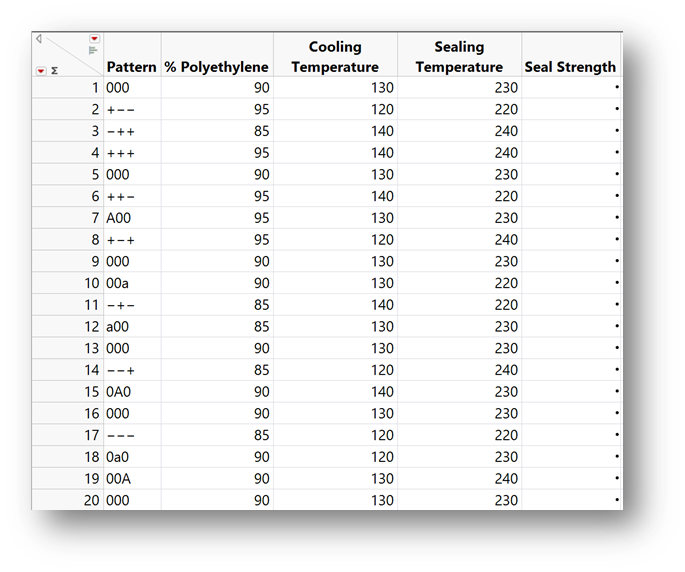
For educational purposes, the same table is shown below but in sorted order to see the three different design points. In addition, the design points are shown visually. In the table and figure, factorial points are shown as black squares, center points as blue circles, and axial points as orange diamonds.
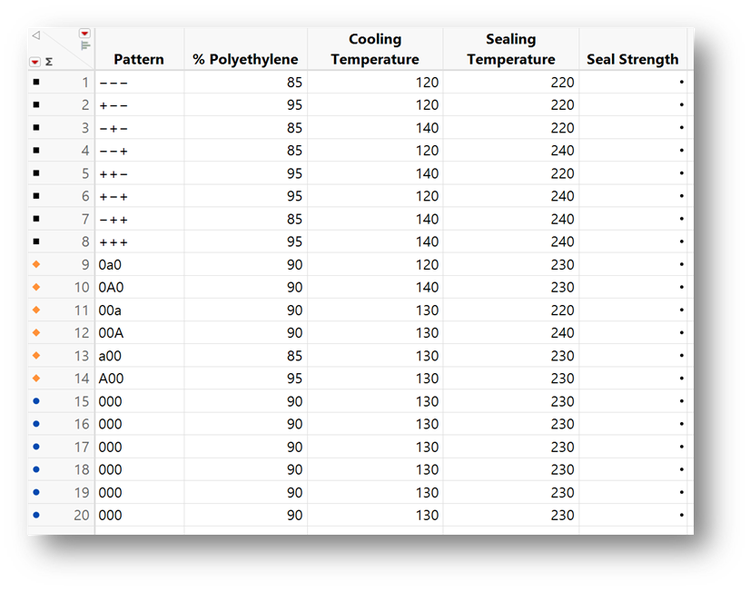
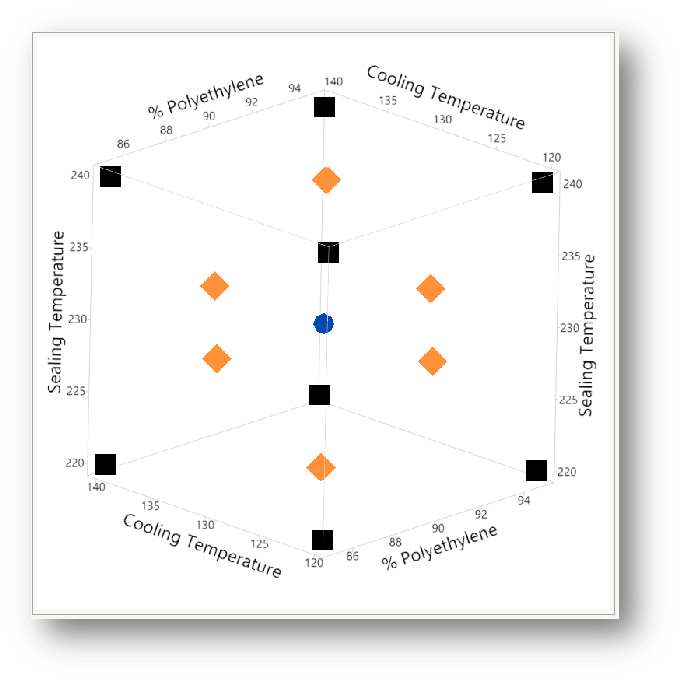
The values for Seal Strength are recorded in the data table after the experiment is executed, following the original randomized design run order to break correlation with any potentially unknown or lurking variables.

To analyze the experimental data, we use multiple linear regression to fit the initial “full” specified statistical model for Seal Strength. The terms for this second-order model include the following:
- Intercept.
- Three main effects (% Polyethylene, Cooling Temperature, and Sealing Temperature).
- Three two-factor interactions.
- Three quadratic effects.
Looking at the effect summary for the model with the active effects, we see that curvature is an active effect for Sealing Temperature with the quadratic term. We keep all the terms in the model for optimization and see if there is a maximum for Sealing Temperature, if one exists.
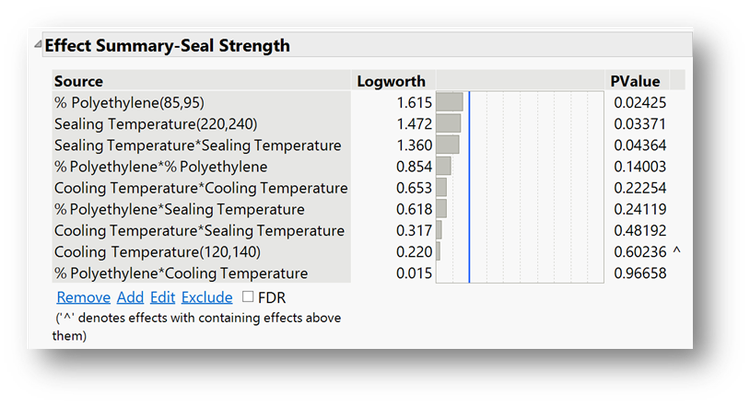
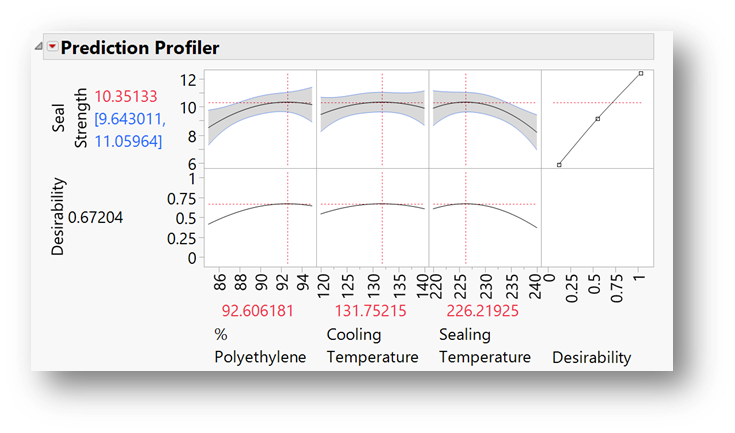
We can look at the model for Seal Strength with cross-sections of the surface, or profiles. Currently with the factors set at their respective midpoints, we predict a Seal Strength of 10.04. We want to optimize to find a combination of factor settings that produce the highest Seal Strength.
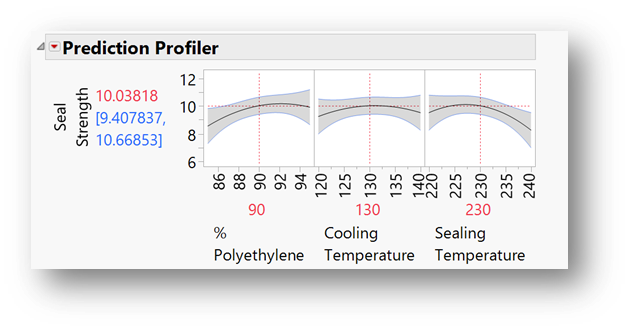
In this example, we see that setting % Polyethylene to 92.61, Cooling Temperature to 131.75, and Sealing Temperature to 226.22 is predicted to give a maximum value of 10.35 for Seal Strength. These settings give a desirability of 0.67, indicating we have reached approximately 67% of our goal to maximize Seal Strength. There might be other factor combinations that would produce similar results.