Plackett-Burman Designs
What is a Plackett-Burman design?
A Plackett-Burman design is a type of designed experiment used when you need to screen a large number of factors in a relatively small number of experimental runs. These designs are a class of fractional factorial designs that focus on identifying which factors are the most important, while assuming that interactions among the factors are negligible. Like other screening designs, they are especially useful in the early stages.
When should you use a Plackett-Burman design?
Plackett-Burman designs can be a good choice when you have a large number of factors and are most interested in estimating their main effects. They also offer more options in terms of the size of your experiment. The number of runs in a standard fractional factorial is a power of two (i.e., 4, 8, 16, 32, 64, …). In a Plackett-Burman design, the number of runs is a multiple of four (i.e., 4, 8, 12, 16, 20, 24, …), so these designs do not increase in size as quickly. However, modern screening methods, such as algorithmic designs or definitive screening designs, offer more flexibility in terms of the number of runs required and which effects you can estimate.
Why (and how) do you use a Plackett-Burman design?
When compared to a standard fractional factorial design, a Plackett-Burman design gives you more control over the size of your screening experiment. In a standard fractional factorial design, you might have an option for a 16-run design or a 32-run design, but nothing in between. In a Plackett-Burman design, there are three additional options between a 16-run design and a 32-run design: 20 runs, 24 runs, or 28 runs. There are some other key differences between Plackett-Burman designs and standard fractional factorial designs.
Resolution: The resolution of any fractional factorial design indicates how well you can separate main effects and interactions. In other words, it measures the degree of confounding in the design. Standard fractional factorial designs are resolution III, IV, or V designs. The higher the resolution, the less confounding there is. Plackett-Burman designs are almost always resolution III designs, meaning that you can estimate the main effects independently because they’re not confounded with one another. However, with these designs, the main effects are partially confounded with two-factor interactions. The results of a Plackett-Burman experiment are most useful in cases where you can assume the interaction effects are weak or negligible.
Learn how to construct a Plackett-Burman design in JMP
https://www.youtube.com/watch?v=y_r1eyVdc8Q
- To see more design of experiments JMP tutorials, visit JMP's Design of Experiments playlist on YouTube.
- To explore JMP's capabilities with your own data or sample data included with the software, download a free trial of JMP.
Confounding: As mentioned above, in a Plackett-Burman design the confounding of effects is partial, rather than complete (like it is in a standard fractional factorial). This partial confounding leads to an increase in the variance of the estimates, but it’s still possible to find large effects. Since one of the primary objectives in screening experiments is to identify the important factors from a large number of candidate factors, it’s common to find that many of the factors are not important. When you can remove unimportant factors from the model, these designs turn out to have good projection properties, often collapsing into full factorials with much – or in some cases, all – of the confounding eliminated.
In some cases, it's worth considering using a definitive screening design instead of a Plackett-Burman design. You can learn about how they compare here.
Example of a 10-factor Plackett-Burman design in 12 runs
Let’s imagine that an engineering team for a manufacturer of polymer materials wants to run an experiment to identify the factors that could influence the hardness of a new material formulation. Ten candidate factors are chosen with the factors to be studied at two levels.
| Factors | Low Level | High Level |
| Resin | 60 | 75 |
| Monomer | 50 | 70 |
| Plasticizer | 10 | 20 |
| Filler | 25 | 35 |
| Flash Temp | 250 | 280 |
| Flash Time | 3 | 7 |
| Cure Temp | 140 | 150 |
| Cure Time | 20 | 30 |
| Cure Humidity | 40 | 50 |
| Cooling Rate | 10 | 18 |
A full 2k factorial for 10 factors at two levels would require 210 or 1,024 runs – clearly not a realistic choice. Since the engineers believe that only a few factors will be the primary drivers of the hardness of the material, they decide a screening experiment would be the best choice. You could run a standard fractional factorial. Some possible design choices would be:
| Fraction | Runs | Resolution |
| 1/32 | 32 | IV |
| 1/64 | 16 | III |
| 1/128 | 8 | II |
The 1/128 fraction design in eight runs would not be a good choice because it’s only a resolution II design. That means it would not be possible to estimate all 10 of the main effects independently because some main effects would be fully confounded with other main effects. The 16-run 1/64 fraction is a resolution III design. Here, the 10 main effects can be estimated independently of other main effects. All the two-factor interactions are confounded with other two-factor interactions, so those can’t be estimated independently. A 32-run 1/32 fraction is a resolution IV design, meaning main effects can be estimated independently of each other and any two-factor interactions. There is, however, confounding among some of the two-factor interactions.
The 1/64 fraction resolution III design could be a good choice. However, because of the cost of the experiment, along with other constraints, the engineers prefer to design an experiment that could be performed with no more than 12 runs. The standard fractional factorial design would require 16 runs – four more than the experimenters are willing to do.
There is, however, a resolution III Placket-Burman design for 10 factors that only requires 12 runs. This experiment, along with the Hardness results, is shown in the table below.
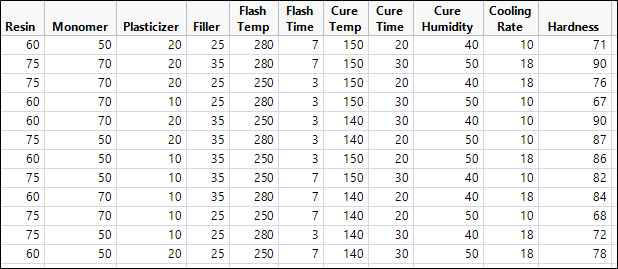
Before analyzing the data, let’s note a few properties of this experiment that are important to keep in mind.
As stated above, the 10 main effects in this Plackett-Burman experiment can be estimated independently of each other. That is, there is no confounding between them. Each of the main effects, however, are partially confounded with not just a few two-factor interactions, but many. And the two-factor interactions are also partially confounded with several other two-factor interactions. In the Plackett Burman design for the Hardness experiment, for example, the main effect of Resin is partially confounded with 36 different two-factor interactions, and the Resin*Monomer two-factor interaction is partially confounded with 28 other two-factor interactions!
Clearly this confounding would be very difficult to resolve without a relatively large number of additional experimental runs, even after applying subject matter expertise. As a result, when analyzing a Plackett-Burman design, you must assume that it’s only the main effects that are potentially important, and not the interactions.
With 10 factors and a model that contains only the main effects, a 12-run design has just enough runs to obtain an estimate of the experimental error, so you can get p-values to assess the statistical significance of the effects. The estimates for each of the main effects, along with their corresponding test statistics and p-values (denoted Prob>|t|), are shown below. Recall that each of the main effects are partially confounded with multiple two-factor interactions. If you conclude that a main effect is significant, you’re assuming that the impacts of those confounded interactions are negligible.
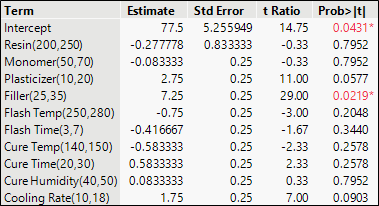
A common strategy in the screening stage is to use a higher significance level (alpha) when deciding which terms are important, to avoid potentially missing factors that truly do impact the response. For example, you might choose a significance level of 0.10 prior to analyzing your screening data. In subsequent experiments with the important factors you identified from your screening study, you would likely use a lower significance level (e.g., 0.05) to evaluate the significance of the model terms.
Using a significance level of 0.10, three factors appear to be important: Plasticizer, Filler, and Cooling Rate. Filler has the largest effect with a standardized estimate of 7.25, followed by Plasticizer (2.75) and Cooling Rate (1.75).
Conclusion
In screening experiments, the intent is not to build a model fully describing the relationship between the factors and the response. Instead, the goal is to find a subset of all the candidate factors to guide the next round of experimentation. Based on the results in our example above, a logical next step would be to design an experiment with just Filler, Plasticizer, and Cooling Rate to estimate the main effects and perhaps their interactions. In a situation where the results of the initial Plackett-Burman design are less clear, the original design can be augmented with additional runs to eliminate some or all of the confounding. Once you have identified the important factors and their potential interactions, you can take the next step of designing experiments to find the factor settings that optimize your response or responses.