Interquartile Range (IQR)
What is the interquartile range (IQR)?
The interquartile range is a statistic used to describe the variability or spread of a continuous variable. Although the IQR is a numerical statistic, it is commonly interpreted visually using a box plot, a graph that shows the distribution of values of the variable. Specifically, the IQR describes the spread of the middle 50% of the data and is represented by the width of the box on a box plot.

When should you use the IQR?
Since the width of the box on a box plot represents the middle 50% of the data, the IQR helps you visually compare variability by visually comparing the width (or height, depending on orientation!) of the box for different groups. In the figure below, two box plots for body fat percentage for men and women are displayed. You’ll notice that the IQR for men is higher than the IQR for women.

Because the interquartile range is calculated from the first and third quartiles, it is less influenced by extreme values than is the range or standard deviation of the data. The IQR measures variability in the middle of the data rather than across all the data.
The interquartile range is sometimes known as the innerquartile range or the middle 50%.
The IQR is also used in a simple calculation to detect potential outliers in the data. A value is a potential outlier if it is outside the range of (Q1 – 1.5 ´IQR, Q3 + 1.5 ´IQR). If there are data values outside this range, the outlier box plot uses the first data value inside this range for the length of the whiskers, then highlights data values outside this range. The figure below illustrates the outlier box plot showing potential outliers according to the IQR rule.

When the IQR is used to measure variability, the median is often used as the corresponding measure of central tendency.
How do you calculate the IQR?
The interquartile range is the difference between the 75th percentile (or third quartile, Q3) and the 25th percentile (or first quartile, Q1). For example, in the figure below, we can see the box plot and some statistics for the cereal calories data. Q3 is 197.5, Q1 is 110, and the IQR is 197.5 – 110 = 87.5.

Examples of interquartile range
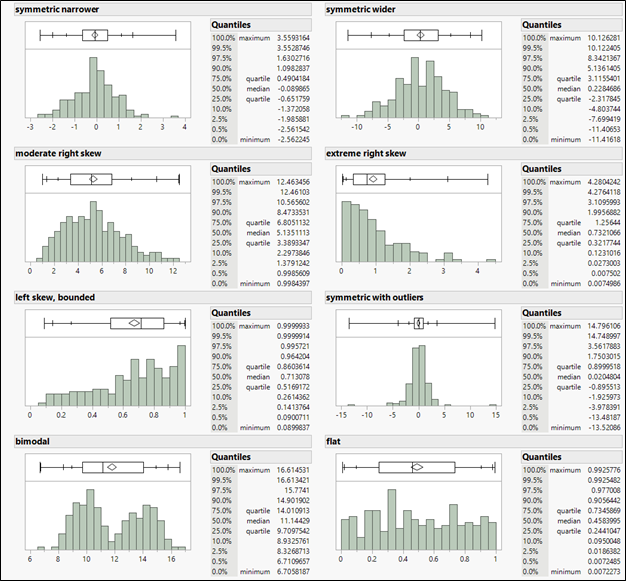
Examine the interquartile range for the data in the Univariate Statistics Data table. You can visualize the IQR using the box of the outlier box plot and see the value of IQR in the Summary Statistics report.
Is the IQR wide or narrow compared with the range of the data?