Bernoulli Distribution
What is the Bernoulli distribution?
The Bernoulli distribution is used to find probabilities for a single Bernoulli trial. A Bernoulli trial is a single experiment whose outcome is one of only two possible values, such as one or zero, success or failure, or non-defective or defective. The probability of the outcome of interest (e.g., success) is p, and the probability of the alternative outcome is 1 − p.
A classic example of a Bernoulli trial is a coin flip. The probability of heads is P(heads), and the probability of tails is 1 – P(heads). If the coin is fair, the probability of either outcome is 0.5. Other examples of Bernoulli trials include a pass/fail evaluation of a product, or whether a customer purchases an item after receiving a marketing offer.
When do you use a Bernoulli distribution?
The Bernoulli distribution is used to model the results of a Bernoulli trial. The trials must be independent and the probability, p, of the outcome of interest in each trial must remain constant. How might you estimate this probability? Let’s call the outcome of interest Success. You might collect data from multiple trials and use the ratio of the number of successes to the number of trials as an estimate of the probability of Success in any one trial. Or you might model the probability of Success as a function of independent variables. This model is often a logistic regression model.
What are the characteristics of a Bernoulli distribution?
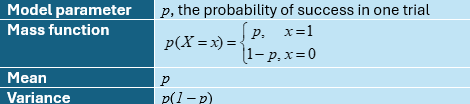
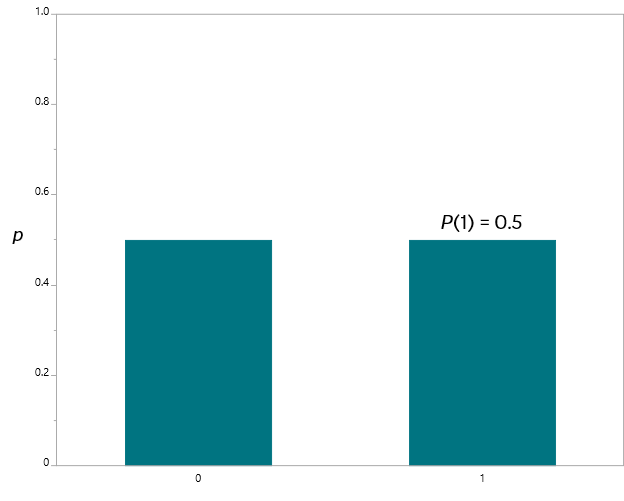
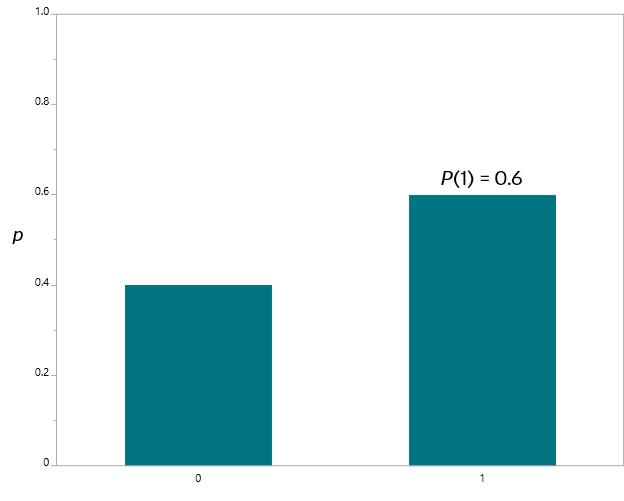
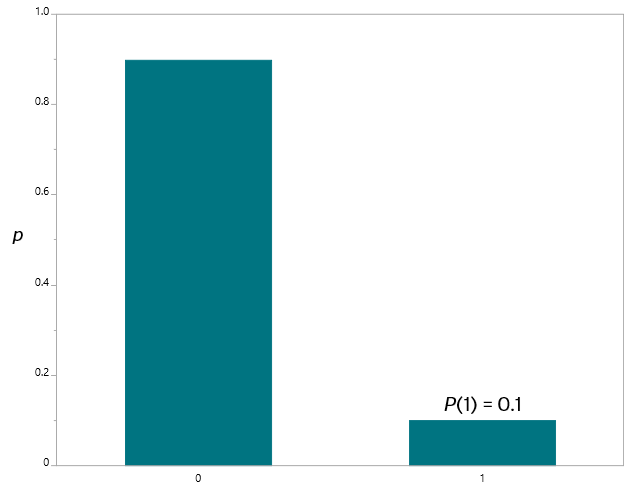
The graphs below illustrate Bernoulli outcomes where p = 0.5, p = 0.6, and p = 0.1.
Examples of Bernoulli random variables
In the coin flip example above, the Bernoulli random variable is the outcome of one coin flip: heads or tails. Other examples of Bernoulli random variables include whether an item from a manufacturing process is defective or not, or if a patient in a clinical trial shows improvement or not. More commonly, though, a sample of data does not consist of just one trial, but of multiple independent Bernoulli trials.
To find the probabilities associated with outcomes of multiple Bernoulli trials, you use the binomial distribution. In fact, the Bernoulli distribution is just the binomial distribution with a single trial. Other distributions that involve Bernoulli trials are the geometric and negative binomial distributions. The geometric distribution gives probabilities associated with the number of trials until the first success. The negative binomial distribution gives probabilities associated with the number of trials until the k-th success.