Discrete Uniform Distribution
What is the discrete uniform distribution?
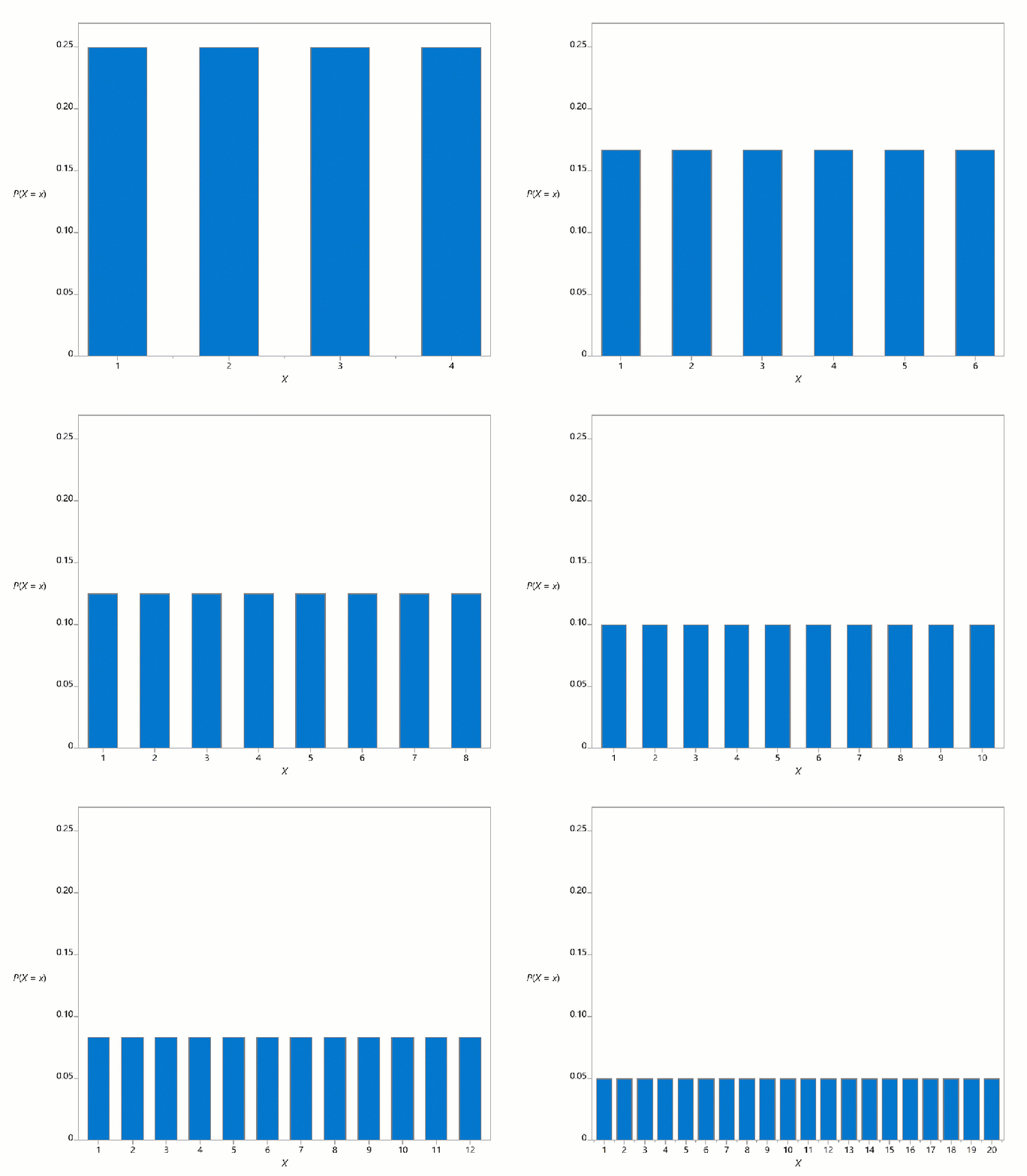
The discrete uniform distribution describes the probability of choosing a number at random from a set of integers between a and b, or choosing an item indexed by an integer value between a and b. There are a finite number of outcomes (n), and each of the possible outcomes has the same probability (1/n). The distribution is flat and symmetric.
What are some examples of the discrete uniform distribution?
Examples of scenarios that follow a discrete uniform distribution include:
- A raffle ticket selected randomly from a jar of 100 tickets.
- The number that comes up on the roll of a fair six-sided die.
- Selecting a unit to be tested from a group of 10 manufactured units.
When should I use a discrete uniform distribution?
The discrete uniform distribution is useful anytime you want to model a situation where there are a finite, countable number of outcomes and each outcome is equally likely. If the number of equally likely outcomes is theoretically infinite (e.g., it can be any value in the range [a, b], not just integers), use the continuous uniform distribution.
Characteristics of the discrete uniform distribution
| Model parameters | $a$, the lowest possible value $b$, the highest possible value |
| Mass function | $p(X = x) = \frac{1}{b - a},\ a < x < b$ |
| Mean | $\frac{(a + b)}{2}$ |
| Variance | $\frac{\left[(b - a)^2 + 2(b - a)\right]}{12}$ |
Example of probabilities for a discrete uniform random variable
The animation below illustrates the probabilities for each possible outcome of a die roll for dice with different numbers of sides. The number of bars in each graph corresponds to the number of sides of each die: four, six, eight, 10, 12, and 20. You can see how the individual probabilities change depending on the number of potential outcomes, but are the same for each outcome for a given die.