Weibull Analysis: Parametric Estimation of Reliability
What is parametric estimation?
Parametric estimation of reliability uses probability distributions appropriate for time-to-event data, such as the Weibull or lognormal distribution, to determine reliability. Instead of describing failures with many individual Kaplan-Meier estimates, parametric methods can describe failures completely with just a few parameters of a probability distribution. And unlike Kaplan-Meier estimates, which are available only for the specific time points at which observations were made, parametric methods can estimate failure probabilities at any time point, both interpolating and extrapolating from the observed time points. Because it is common to obtain a limited number of failures in the sample, often you must extrapolate the results (predict a value beyond any observation). Therefore, parametric models should be validated by theory or empirical testing
What is a probability plot? An example of parametric and non-parametric analysis.
A probability plot is an effective way to visualize data from a reliability analysis. A probability plot shows predicted probability of failure on the Y axis by lifetime on the X axis. The points on the graph represent the nonparametric midpoint Kaplan-Meier estimates. The nonparametric estimates are undefined outside of the range of the actual failure times and form a step function. Parametric probability estimates are displayed as curves and can be used to extrapolate beyond the range of data. Censored lifetimes can be displayed above the plot.

What information can you get from a parametric reliability analysis?
Information about probabilities and quantiles (failure times) that comes from parametric models can be presented both graphically and numerically.
The probability plot, an example of which appears in the figure below, shows the relationship between life and its probability based on a particular assumed distribution of the data. A linear arrangement of the markers results if the model is a good approximation. This plot is useful for assessing goodness of fit and the value of extrapolation.

The cumulative distribution function (CDF) of the failure times describes the increasing probability of a failure as time increases. It is known as the failure function. Its functional form depends on the particular distribution function you choose as a model for your lifetime data. The CDF answers the question “what proportion of parts are expected to fail by time t?”

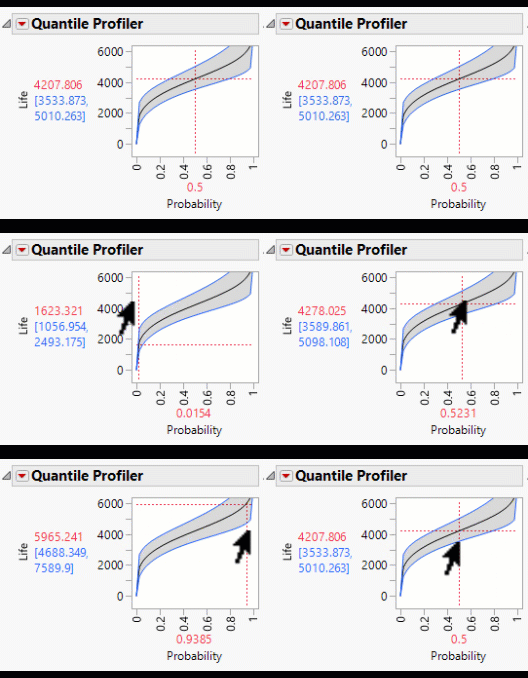
The quantile function is the inverse of the cumulative distribution function. It gives the failure time for a given proportion of the population. This function answers the question “what is the expected lifetime for p% of the parts?”
While the CDF gives the cumulative probability of failure up until time t, it does not describe the propensity of failure after surviving to a given time. The hazard function describes the instantaneous rate of failure for a unit, given that the unit has survived to this point in time. The hazard is not a probability; it is the failure rate of survivors to time t in the next instant following t and provides useful information for planning maintenance.
The hazard function might display some or all of the features of the bathtub curve: initially high, then decreasing (early failures), constant (random failure), or initially low, then increasing (wear out).


Common distributions for parametric reliability analysis
While many distributions can be used to model product reliability data, two distributions are used more often than others: the Weibull and lognormal distributions. Both distributions exhibit positive skew, often observed in reliability data.
What is the Weibull distribution?
The Weibull distribution is a flexible distribution that is good for modeling random failures. Its cumulative distribution function is $\displaystyle F(t; \alpha, \beta) = 1 - e^{ -\left( \frac{t}{\alpha} \right)^{\beta} }$. This parameterization is widely used in reliability analysis because the scale parameter a and shape parameter $\beta$ have physical interpretations. The scale parameter $\alpha$ is also called the characteristic life. When $t = \alpha,\; F = 1 - e^{-1} = 0.63$ so $\alpha$ represents the 63% quantile of the Weibull distribution. The shape parameter $\beta$ determines the shape of the hazard function. If $\beta$ < 1, the hazard decreases over time. If $\beta$ > 1, the hazard increases over time. If $\beta$ = 1, then the Weibull distribution simplifies to become the exponential distribution for which the hazard is constant over time.
What is the lognormal distribution?
The lognormal distribution is directly related to the normal distribution. If X has a lognormal distribution, then log(X) has a normal distribution. It is commonly used for failures due to cumulative effects, or growth, of the degradation process. If your product fails due to cracks, perforations, or fractures, consider modeling life with a lognormal distribution. Its distribution function is $F(t;\,\mu,\sigma) = \Phi\!\left(\frac{\log(t) - \mu}{\sigma}\right)$, where $\Phi(z) = \displaystyle \int_{-\infty}^{z} \frac{1}{\sqrt{2\pi}} e^{-w^2/2}\,dw$.
To help decide between models, examine the probability plot and model selection criteria, such as AICc or BIC.
