In this era of AI, with so much data and so many powerful large language models, we can readily get reasonable answers to many “why” questions. But for the more important why questions, we need to think carefully about how we can best attain deeper insight into often interconnected relationships that can influence outcomes of interest.
Understanding causal relationships is key to deriving meaning, making better decisions, and realizing useful innovations. Indeed, JMP provides many innovative methods for experimental design, considered the statistical gold standard to reveal definitive causal factors.
The causal revolution: From Judea Pearl to modern methods
However, designed experiments are not always an option. Thankfully, we have other methods to infer causality. Causal inference has been a topic of intense study in the past few decades. Renowned award-winning computer scientist and author Judea Pearl is among those who have examined the issue; his book, “The Book of Why: The New Science of Cause and Effect” is fascinating. In it, he writes, “…only a hundred years ago, the question of whether cigarette smoking causes a health hazard would have been considered unscientific.” Neither the vocabulary nor the methods existed to explore “the calculus of causation.” To think, we could’ve saved so many lives had we realized this “causal revolution” earlier!
Making structural equation models more accessible
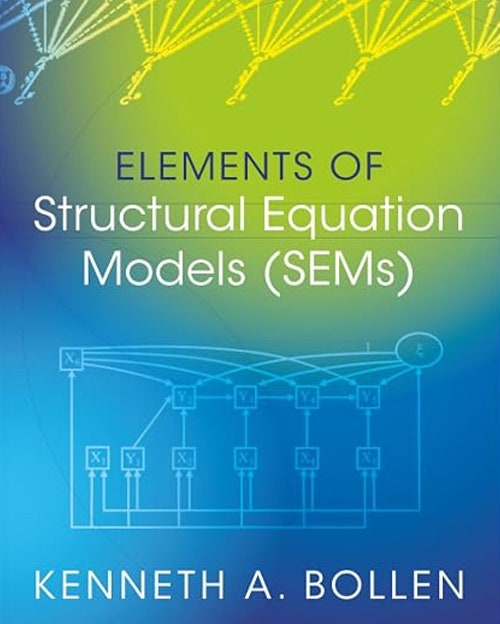
Several others have contributed to advances in understanding causal relationships, including noteworthy researchers from economics, psychology, sociology, medicine, and public health, to name a few. Still, many others could benefit from these powerful and flexible methods. Another world-renowned expert, Dr. Ken Bollen, has made a tremendous contribution to helping others answer more why questions with his recent book, “Elements of Structural Equation Models (SEMs).” The book makes these methods more accessible with clear explanations and examples. Bollen continued his research after publishing his earlier book, “Structural Equations with Latent Variables,” and has contributed significantly to the enhanced and extended methods in the evolution of SEM. His latest book showcases these contributions.
Bollen explores the origins of SEMs, the myths about them, as well as their strengths and vulnerabilities. The synergies of statistical thinking and subject matter expertise are important in building useful models of any kind, but when combined to build SEMs, they offer more options to better understand phenomena relevant to complex why questions. From the overview: “SEMs were not developed to discover nor prove causation, but instead to serve as a tool for combining qualitative causal assumptions and empirical data to yield quantitative causal conclusions and measures of fit to assess the plausibility of the assumptions.” (Bollen and Pearl, 2013)
While SEMs have been heavily used in psychology, neuroscience, the social sciences, public health, epidemiology, economics, and evolutionary biology, they have great potential in other disciplines, particularly disciplines that study complex, multifaceted relationships or unobservable phenomena (like fault detection and diagnostics in a mechanical process). They are especially useful in disciplines that need to separate measurement error from true score variance and test causal theories. Bollen concludes the book with this:
If a reader grasps these strengths and vulnerabilities of SEMs, they can become better model builders and testers. And I will have accomplished one of the goals of this book.
We think that is a worthy goal. If you're intrigued by the potential applications of these methods, in addition to Bollen’s latest book, you can learn more about SEMs from the Statistically Speaking webinar (featuring Bollen) linked below, as well as from the SEM page in our Statistics Knowledge Portal.
Looking for a better answer to your 'why' questions?