Happy Earth Day: How data is changing the future of conservation
This Earth Day, discover how WildTrack is transforming animal footprints into powerful data, helping protect endangered species without ever disturbing them. Each footprint becomes a data point, turning hidden patterns in nature into actionable insights for conservation.
Every footprint tells a story. We just need the right tools to understand it. From the rainforests in South America to the deserts of southern Africa, to the tracks left in sand, snow, and soil, our planet is constantly revealing clues about the life it holds. This Earth Day, organizations such as WildTrack are turning those clues into data, helping protect endangered species in ways that are both innovative and noninvasive.
We spoke with WildTrack’s co-founders Zoe Jewell and Sky Alibhai to learn how the organization is using analytics, community collaboration, and technology to help protect endangered species around the world. Because what if the key to protecting our planet isn’t just what we can see, but what we can measure?
A mission rooted in every step (or paw print)
What if you could protect a species without ever touching it? That’s the vision behind WildTrack.
WildTrack is a nonprofit organization that uses data from animal footprint tracking to help monitor endangered species without harming them. Using a unique synergy of noninvasive footprint tracking that combines advanced analytics and traditional ecological knowledge, it can decode animal tracks into rich biodiverse data. Each track it records is a data point that can help keep a species from sliding toward extinction.
The premise sounds almost impossible: no collars, no tranquilizers, and no disruption of any ecosystems. However, the science behind it is rigorous. WildTrack’s footprint identification technology (FIT) has been used to monitor such species as rhinos, lions, leopards, polar bears, and others – with more than 90% classification accuracy.
These outcomes weren't inevitable. When WildTrack first began, nearly all scientists were skeptical and reluctant to believe that traditional ecological knowledge could be translated into science and results. The data it collected changed that. Not through argument, but through results and data visualization tools that made it possible to see clearly and communicate convincingly.
In southern Africa, WildTrack’s data on cheetahs, lions, and leopards helped wildlife conservation managers understand how these endangered species use protected and unprotected areas so that conflict mitigation measures could be implemented. It has a multitude of success stories, ranging from tracking small mammal species like sengi to helping authorities in northeast China track the Amur tiger.
There is also a misconception worth addressing: that footprints are somehow “less scientific” than GPS collars. WildTrack’s analyses disproved that notion pretty soundly, showing higher accuracy and richer ecological detail. Instead of tracking a select few animals wearing collars, FIT creates a record of where all the animals in a population roam. No other wildlife monitoring tool can do this cost-effectively at landscape scale.
How does it actually work?
The process begins with a single photograph. A tracker captures an image of a footprint in the field, which is then fed into FIT, WildTrack's custom-built platform on JMP. FIT automatically extracts more than 120 measurements from the print. It extracts things like toe spacing, pad shape, and overall geometry and runs them through classification models built from a library of known species and individuals. What starts as a mark in the mud becomes a data point, and enough data points become a population.
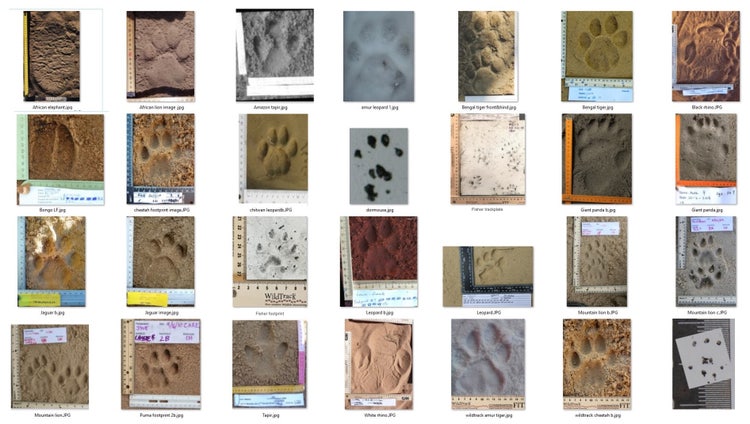
An example of the photographs they receive from trackers.
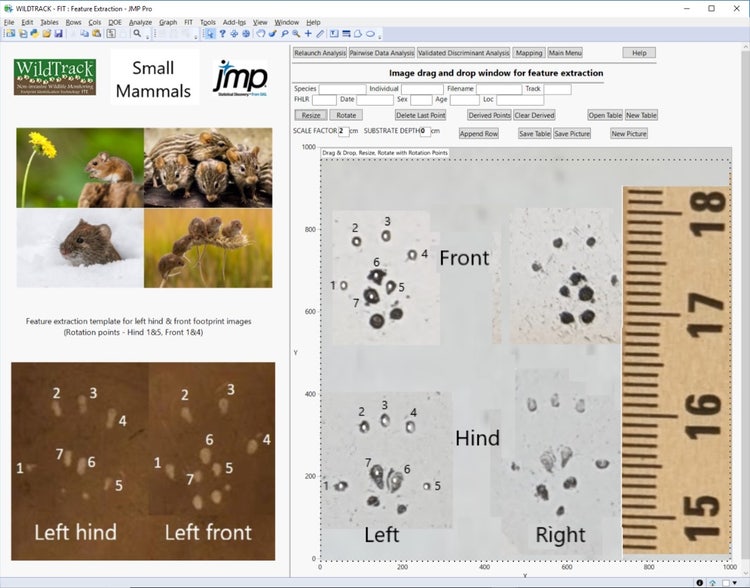
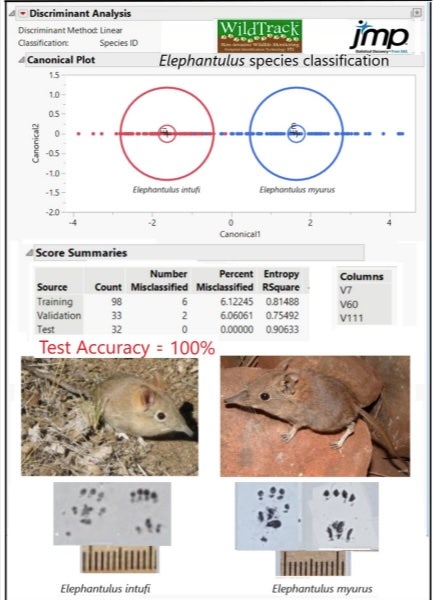
FIT is then able to place the photos in JMP’s feature extraction window and pick seven landmark points based on clarity and consistency. JMP then produces a data table of all the data points that have been collected, which allows JMP to run an analysis to match footprints to species based on previous data.
Using the footprint metrics, FIT can then identify the species with a remarkable accuracy.
A race against disappearance
But WildTrack is working against the clock. “Biodiversity loss is accelerating faster than our capacity to monitor it; many species are disappearing before we have basic data on their populations and ranges,” Alibhai said. Conventional monitoring tools like collars, GPS tags, and camera traps are expensive, physically disruptive, and difficult to deploy at scale across large landscapes and multiple species at once.
Making things harder, the data that does exist is rarely unified. Jewell said that “Conservation data are often fragmented across organizations, formats, and methods, making it difficult to see the big picture in time to act.” WildTrack's innovation of a cost-effective, community-focused, landscape scale application within JMP is a direct response to that problem, and it produces results that hold up under scrutiny.
Footprints, when analyzed with tools like JMP, can show not only that a species is present, but how individuals use landscapes, where they are under pressure, and where protection is working.
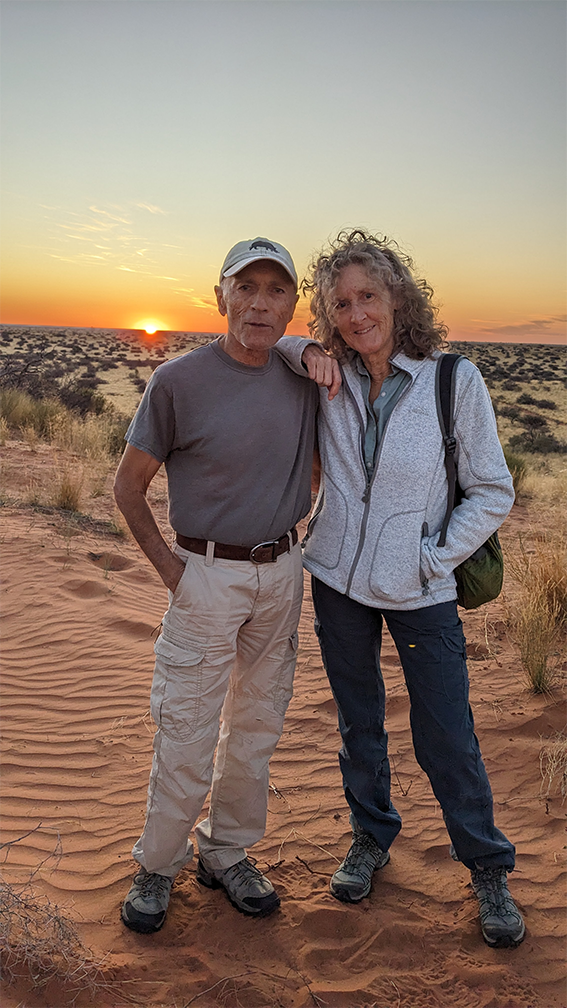
Zoe Jewell
The pattern recognition technology behind WildTrack’s footprint analysis has potential far beyond wildlife. In medicine, the same approach of reading subtle variations from a single source over time could flag early signs of arrhythmias or microvascular changes before symptoms even appear. In industry, it could detect the first microshifts in a turbine or pump that signal a failure, days or weeks before it happens. In computer science, behavioral biometrics, like how someone types or swipes on their phone, could be tracked the same way WildTrack tracks a paw print, keeping systems secure without invasive monitoring. Even in humanitarian settings, anonymous movement patterns along community routes could reveal when something has changed. Whether it’s a new conflict zone, a flooding path, a dangerous wildlife presence, we would know without ever recording a name or face.
What comes next
WildTrack sees conservation moving in a clear direction – toward real-time decision support, where data from footprints, sensors, and images feeds continuously into platforms that can guide action as conditions shift on the ground. WildTrack is already using AI in JMP that can identify species, individuals, sex, and age-class from a single footprint, opening new possibilities in noninvasive monitoring. Cloud infrastructure is making it feasible to scale footprint analytics globally while keeping the collection process as simple as taking a photograph.
Longer term, the team expects the field to move from single-species analysis toward something more ambitious like multispecies, landscape-level views that reveal how whole ecosystems are responding to pressure. WildTrack’s tools are already well suited to that shift, with predictive modeling and model comparison capabilities built to handle the kind of algorithmic complexity that future conservation science will routinely require.
When asked what they'd build with unlimited resources, WildTrack's answer was a 'real-time interactive atlas' of the planet, mapping the movements of multiple species across continents using nothing more than tracks in sand, snow, and soil. Beyond that, it would use footprints as early-warning indicators of how species respond to climate change and habitat shifts. It would also build the tools in partnership with Indigenous and local communities, so those communities can ask their own questions about their data.
A partnership built over the years
WildTrack's relationship with JMP goes back to the organization's earliest work and has deepened ever since. “Our collaboration with the JMP family, particularly the developers, has been the foundation of all our work over the years,” Alibhai says. Together, JMP and WildTrack built FIT, a JMP-based platform that automates feature extraction from footprint images and processes extraction data through a full analytical pipeline to give conservation teams a workflow they can use in both lab and field settings.
That partnership has allowed WildTrack to grow from its initial rhino monitoring projects into a global footprint AI initiative, while keeping the tools accessible enough for field biologists who may not have a data science background. Just recently, WildTrack hosted a workshop at JMP, gathering conservation biologists, architects, data engineers, and statisticians to push the work forward. The developers brought new ideas to the table, such as spherometrics for footprint classification, design of experiments approaches for interviewing traditional trackers, and new machine learning options for species identification.
WildTrack’s work is fascinating. If you want to learn more, please watch the video about WildTrack and its use of JMP here: jmp.com/en/customer-stories/wildtrack
Join WildTrack this Earth Day
One of WildTrack's core convictions is that conservation data only produces change if the people who need to act on it can understand it. “If rangers, local communities, policymakers, and students can't understand or trust the data, it won't drive change,” Jewell said. Letting nonspecialists explore data sets, spot patterns, and ask new questions without writing a line of code is central to making that happen.
This year's Earth Day theme, "Our Power, Our Planet," is a reminder that the most meaningful environmental progress is driven by the collective actions of communities and individuals. WildTrack has known this from the start, placing local communities, traditional trackers, and everyday citizen scientists at the center of work that reaches across continents.
Something that makes WildTrack so unique is its devotion to leaving the environment as it was found. While tracking footprints, it leaves none of its own behind. This Earth Day, we encourage you to make your mark without leaving one. Take a walk, look down, and see the world a little differently, because if WildTrack has taught us anything, it's that the ground beneath our feet still has a lot to say.
Curious to learn more about WildTrack and its conservation efforts? Visit wildtrack.org for more information.