The F Distribution
What is the F distribution?
The F distribution describes the ratio of variances from two samples when the samples are drawn independently from normally distributed populations.
What is the F distribution used for?
The F distribution is used almost exclusively in hypothesis testing as a distribution of a test statistic under a null hypothesis.
Common hypothesis tests using the F distribution include:
Suppose you are interested in testing whether the variance of two samples drawn from independent, normally distributed populations are equal. You calculate the sample variances s12 and s22 from samples of size n1 and n2, respectively. Your test statistic is the ratio of these sample variances and has an F distribution with numerator degrees of freedom n1-1 and denominator degrees of freedom n2-1. The F distribution is a smooth, continuous distribution characterized by these degrees of freedom.
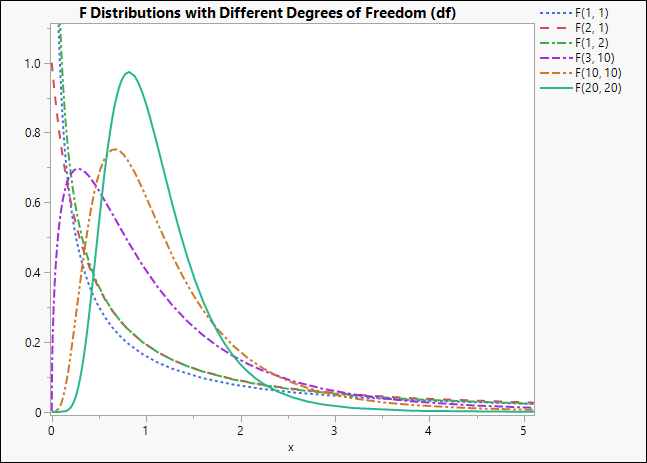
Several F distributions with different degrees of freedom are shown in the graph below.
How do you use published F distribution tables?
Most people use statistical software, like JMP, to do F tests. Still, many statistics books show F tables, so understanding how to use a table to evaluate your test statistic might be helpful. The steps below describe how to use a typical F table:
- Identify your alpha level. Typically, there exists a table for popular a values. If you set a = 0.05 for your test, then find the table for a = 0.05 or 1 – a = 0.95.
- Identify the degrees of freedom for your sample sizes. The rows and columns in an F table correspond to different numerator and denominator degrees of freedom.
- Find the cell in the table corresponding to your numerator and denominator degrees of freedom. This is the F distribution value.
- Compare your test statistic to the distribution value and make the appropriate conclusion.