 , the general form for the ARIMA model is as follows:
t is the time index
B is the backshift operator defined as 
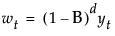 is the response series after differencing
μ is the intercept or mean term
 and
and  are the autoregressive operator and the moving average operator, respectively, and are written as follows:

 are the sequence of random shocks
 are assumed to be independent and normally distributed with mean zero and constant variance.
The constant estimate δ is given by the relation:

In the case of Seasonal ARIMA modeling, the differencing, autoregressive, and moving average operators are the product of seasonal and nonseasonal polynomials:



where s is the number of observations per period. The first index on the coefficients is the factor number (1 indicates nonseasonal, 2 indicates seasonal) and the second is the lag of the term.