The ultimate guide to functional data analysis (FDA) for scientists and engineers

Data is often dynamic, varying over time or space, forming curves, trends or spectra with the potential to reveal important patterns and relationships. Functional data analysis (FDA), is a statistical approach designed to help you interpret and extract meaning from this type of data.
In this guide, I’ll explain what FDA is, when to use it, and how to apply it effectively. Along the way, you'll discover why FDA has become one of my favorite approaches for extracting meaning from data that change over time or space. Let’s start by answering a few basic questions:
What is functional data analysis?
Functional data analysis (FDA) is a modern branch of statistics for analyzing dynamic data that vary continuously. Instead of viewing data as isolated points, FDA models entire curves or functions to capture the underlying patterns. This approach is useful for such data as temperature profiles, growth and decay curves, and spectral measurements where the shape and structure of the data are key to understanding it.
From workarounds to real insight: Modeling the full shape of your data
Throughout my career, some of the most challenging and fascinating problems have involved data that change continuously: temperature profiles, absorbance spectra, stress-strain curves, and more. These types of data are prevalent across scientific and engineering disciplines, offering rich insights, but they can be tricky to analyze due to the highly correlated nature of the data.
Early on, I developed workarounds. I’d reduce the functional data into single summary points, like picking a specific wavelength from a spectrum or isolating the peak temperature from a thermal profile. But each time, I knew I was leaving useful information behind.
That’s why discovering functional data analysis was a turning point. FDA is designed specifically for this kind of continuous, highly correlated data. Instead of reducing the data, FDA helps you model the full shape capturing more detail, more signal, and ultimately, better insight.
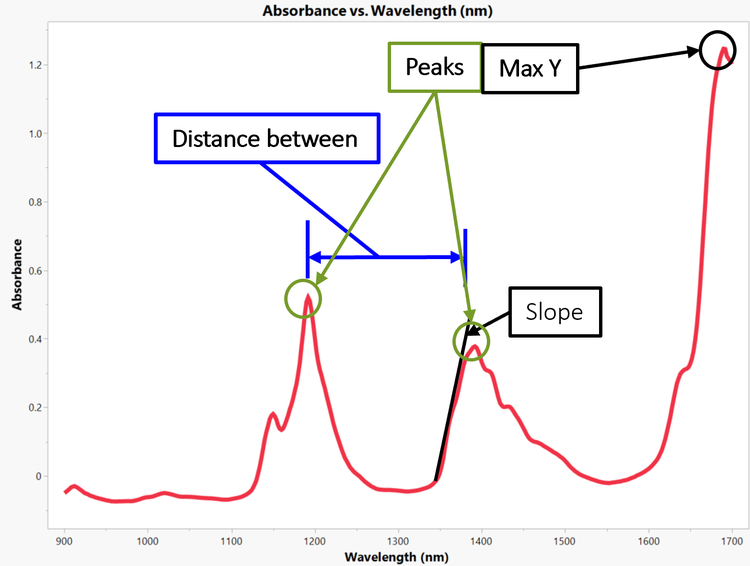
Workarounds to try to make sense out of curves.
Why use functional data analysis?
As I mentioned above, functional data analysis is a powerful approach when the shape of your data – not just individual data points – holds valuable insights. Instead of reducing your data to a few summary measures, FDA lets you leverage the full richness of your data curves to gain deeper understanding and build stronger models. FDA does this by converting raw data into functions that capture the shape of the data. These shape functions can be utilized as inputs, responses, or both for your modeling purposes.
Use FDA when:
- You have dynamic data: The data is a series of continuously varying points.
- The overall shape of your data matters: Patterns, trends, and changes over time provide additional insights beyond the isolated points.
- You are using design of experiments (DOE): To achieve ideal curves, pinpointing the right factor settings is crucial.
- You'd like to reduce noise to understand trends: Smoothing noisy data into a continuous function can reveal underlying trends and reduce variability.
- You want to find anomalies: Analyze the full curve to identify unusual shapes or deviations from expected patterns.
Examples of curved data ideal for functional data analysis:
Sensor Data
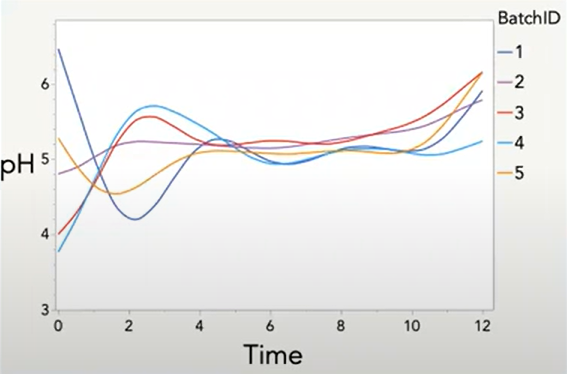
Fermentation process
Spectral Data
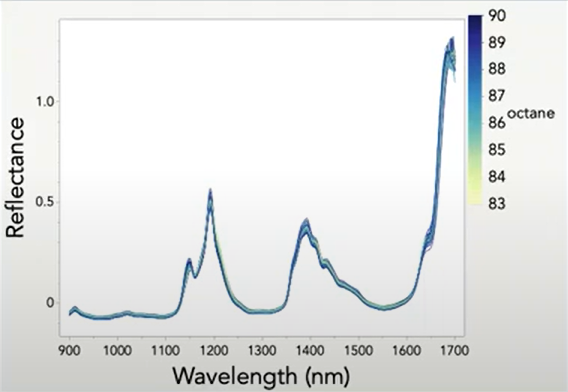
NIR Spectroscopy
Time Series
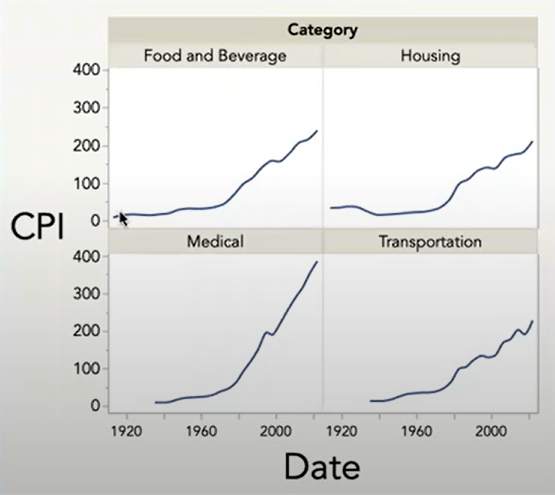
Consumer Price Index
Understanding functional data
Functional data can be broken up into two different categories: functional responses and functional factors.
Functional responses are the outputs you measure: things like a transparency spectrum across wavelengths or a temperature profile over time. You don't control these directly; they're what you're trying to understand or optimize.
Functional factors are the inputs you often can control: for example, a heating ramp rate, a dosing schedule, or a pressure profile. These are the curves you set to influence your response.
Real examples from the lab
Optimizing Solar Cells
While studying photovoltaics, I worked on a project to optimize the top layer of a thin-film solar cell called a transparent conductive oxide (TCO). The challenge was to maximize transparency while keeping sheet resistance low. Transparency was measured across a range of wavelengths, forming a spectrum. Reducing layer thickness improved transparency but increased resistance, so finding the right balance was key. This is a clear example of a functional response where using functional data analysis would be very useful.
Growing high-quality crystals
In grad school, I worked on a project to grow a crystal of copper tantalum sulfide, a material with unique electrical properties. The crystal growth furnace had multiple heating zones, each controllable with specific ramp rates and dwell times. The goal was to grow a large, high-quality crystal for electrical property measurements. This is an example of having several functional factors for each heating zone in the furnace.
Working with functional responses
FDA takes a different approach from traditional methods that summarize curves into single values like means or maxima. Instead, it treats the entire curve as the response, preserving the full shape of the data and enabling a more complete understanding of how it behaves.
Why analyze the full curve?
This approach has three main advantages:
- Retain important details: Instead of collapsing a spectrum or profile into one or two numbers, FDA retains the full shape. This allows you to identify patterns in timing, peak locations, rates of change, and other features that summary statistics overlook.
- Identify which factors affect shape: FDA helps you determine which experimental factors influence specific features of your response curve. One factor might shift the peak timing while another changes the overall amplitude. These insights would be lost if you only examined summary statistics.
- Optimize for a target shape: With FDA, you can define an entire target curve and find the factor settings that approximate it as closely as possible. This is particularly valuable for processes where the entire response profile matters, not just one summary metric.
Working with functional factors
Sometimes your experimental factors aren't single values at all—they're functions. Temperature profiles, force curves, and dosing schedules are all examples of functional factors.
What makes functional factors different?
- Curves as inputs: Rather than setting a single temperature value, you're designing an entire temperature profile over time, and that profile becomes your factor. FDA enables you to use these curves directly in your models.
- Understanding how shape affects outcomes: FDA helps you determine how the shape of your functional inputs affects your response. You can identify whether it's the steepness of the ramp, the dwell time at peak, or the cooling rate that drives your results.
- Using functional principal components: You can apply functional principal component analysis (FPCA) to your functional factors, reducing them to just a few components that capture the major sources of variation. These components can then be used in standard regression models, making the analysis more tractable.
Key benefits of functional data analysis
Functional data analysis helps you uncover patterns, improve models, and better understand continuous, dynamic data.
Preserve the richness of your data
FDA lets you model the entire data shape using a function, preserving valuable detail and context that is lost with summarization.
Simplify high-dimensional data
FDA reduces dimensionality and preserves the structure, making complex data sets easier to explore and model.
Build stronger predictive models
Additional information gained from the shape of the functional data can be used to improve model accuracy, leading to better predictions and greater understanding.
Understand process dynamics
By allowing you to model data that changes continuously, FDA helps you detect trends, patterns, and anomalies for deeper insight into process behavior.
Reveal patterns and reduce noise
By smoothing data and using FPCA as a dimension-reduction technique, FDA highlights subtle trends, filters out noise, and makes important features easier to detect.
What are some examples of how functional data analysis is used?
Functional data analysis is useful across industries where it’s important to understand how the shape of dynamic data changes. From improving processes to spotting issues early, FDA helps uncover deeper insights. Here are a few examples:
Chemical
- Analyze reaction profiles (e.g., temperature or concentration over time) to optimize process conditions.
- Monitor batch-to-batch consistency using process curves such as pH, pressure, or flow rates.
- Compare sensor curves (e.g., spectroscopic data) for quality control and early fault detection.
Semiconductor wafer fabrication
- Study wafer thickness, etch depth, or temperature curves during fabrication to improve yield and reduce defects.
- Analyze tool performance over time from sensor data to schedule predictive maintenance.
- Use photolithography or plasma process curves to tune parameters and reduce variability.
Pharmaceuticals
- Monitor assay performance across batches or sites by analyzing potency and stability curves.
- Compare dissolution profiles of different drug formulations to ensure consistent drug release.
- Track patient biomarker trends over time to evaluate treatment effectiveness or drug safety.
Consumer goods
- Evaluate product stability (e.g., color, texture, pH) over shelf life by analyzing change curves.
- Study sensor or testing curves from packaging or material performance tests (e.g., compression, elasticity).
- Analyze consumer usage patterns from smart devices or testing panels over time.
Biotechnology
- Analyze growth curves of cell cultures or microbes for yield optimization.
- Study gene expression or protein concentration trends during fermentation or bioproduction.
- Use time-series biomarker data from experiments or clinical trials to understand biological responses.
Aerospace
- Analyze flight trajectories of aircraft to decrease fuel consumption and minimize noise pollution.
- Utilize aircraft engine sensor data to enhance prognostics and health management (PHM) capabilities.
- Improve detection and identification processes using radar, sonar, and lidar data.
- Reduce "tool wear" through study of part degradation curves.
Put functional data analysis into practice
Now that you understand the foundations of functional data analysis, the next step is learning how to apply these ideas to real scientific and engineering problems. The pages below guide you through a practical FDA workflow, from preparing raw curves to building interpretable models and making decisions based on shape variation. Together, they show how FDA helps you move beyond point-based summaries to extract insight from entire functional profiles.
Preparing functional data for analysis
Learn how to clean, smooth, align, and transform functional data so it’s ready for shape-based analysis and interpretation.
Understanding functional principal component analysis (FPCA)
Discover how FPCA captures dominant modes of shape variation and reduces complex curves to a small set of interpretable components.
Applying functional data analysis
See how you can combine FDA with DOE, regression, and other modeling approaches to explain, predict, and optimize outcomes.
Get started with JMP Pro
Find out how JMP Pro supports the full functional data analysis workflow and whether it’s a good fit for your organization.
Frequently asked questions about functional data analysis
How can I use functional data analysis to tackle specific scientific and engineering problems?
Functional data analysis offers flexible tools for tackling complex problems in science and engineering. Once your data is ready, you can use FDA to:
- Design experiments: Analyze how factors affect entire response curves or use functional inputs in your design.
- Build predictive models: Model relationships where inputs, outputs, or both are functions.
- Detect anomalies: Identify unusual or faulty curves by modeling normal behavior.