The rise of sustainability analytics: Making smarter decisions for both the planet and the bottom line
Why sustainability analytics is becoming central to how organizations design experiments, manage variation, and make informed decisions.
Katie Stone
January 27, 2026
5 min. read
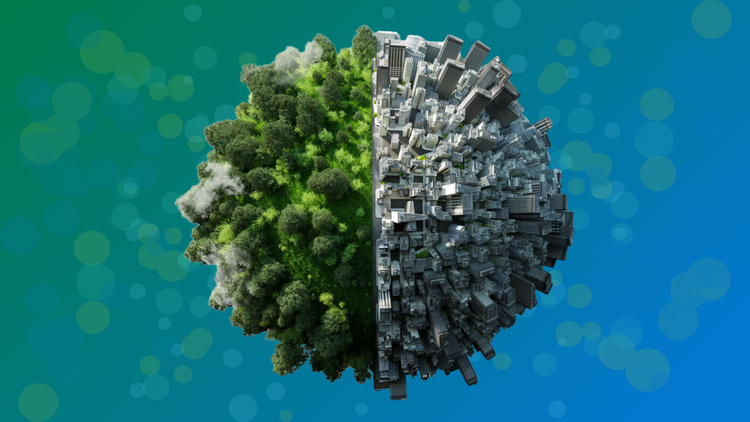
Sustainability has become a defining challenge for scientists and engineers across industries – from clean energy and manufacturing to environmental monitoring and conservation. It is often framed as a tradeoff: something organizations pursue in addition to performance, efficiency, or profitability.
But when you look closely at how progress toward sustainability actually happens inside R&D labs, manufacturing environments, and production systems, a different picture emerges. The teams making real gains aren’t choosing between sustainability and performance. They’re improving how they run experiments, understand variation, and make decisions.
This is where sustainability analytics comes in. By connecting experimental design, process optimization, and predictive modeling, organizations are uncovering sustainability improvements as a natural byproduct of smarter science. Across industries, measurable gains now come less from sustainability programs alone and more from how teams design experiments, analyze variation, and make operational decisions at scale.
In other words, sustainability analytics turns better experimentation into operational advantage, linking scientific rigor directly to resource efficiency, yield improvement, and long-term impact.
From compliance to competitive advantage
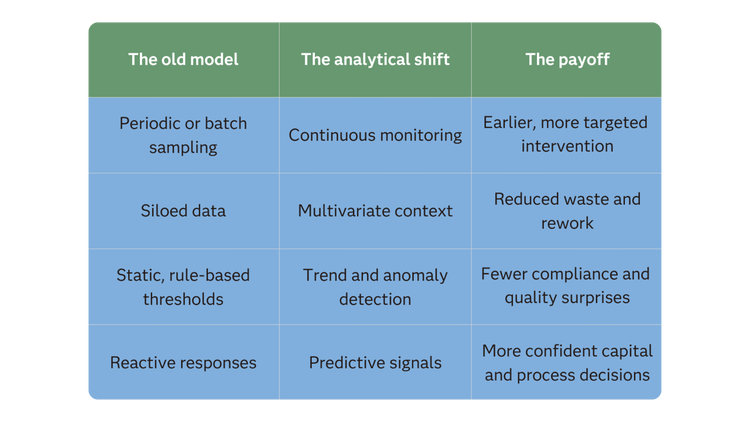
Each of the following examples illustrates this shift in a different context, showing how better analytical decisions translate directly into sustainability gains.
1. Turning waste into input: Closed-loop manufacturing and emissions reduction
Use case: Glass manufacturing
One of the most direct sustainability wins is eliminating waste altogether.
Culmium recently consulted with a glass manufacturer. By using predictive modeling to reliably forecast selenium emissions, the client could safely reintroduce selenium-rich dust back into the production process. By doing so, it created a closed-loop system where 100% of a previously discarded byproduct, once considered hazardous, could be reused without compromising product quality.
What this means for sustainability
When emissions and quality outcomes can be predicted with confidence, waste streams can become inputs rather than liabilities, thus reducing environmental impact while preserving operational performance.
2. Scaling sustainable innovation without scaling resource use
Use case: Biotechnology and sustainable chemistry
In R&D, sustainability is often constrained by time and cost. Faster learning with fewer experiments can determine whether promising ideas ever reach production.
At Amyris, sustainability is framed around accelerating the shift away from expensive or environmentally intensive production methods toward more efficient, lower-impact biotech-based production. A central theme in this story is the standardization of analytics workflows so teams can test more hypotheses, interpret results consistently, and make decisions based on signal rather than noise.
What this means for sustainability
Standardized experimentation and analysis generate more insight per experiment, reducing redundant work, material consumption, and time to impact.
3. Improving yield and reducing scrap in clean energy manufacturing
Use case: Solar technology
Clean energy technologies only deliver environmental benefit at scale and scale depends on yield.
At Heliatek, teams built a custom monitoring and alert dashboard to support a roll-to-roll solar film manufacturing process. Automated alerts helped operators detect deviations earlier and respond faster. Process experts estimated the dashboard improved yield by 1-5% in pilot production.
What this means for sustainability
Higher yield reduces scrap, lowers energy use per unit produced, and accelerates the deployment of clean energy technologies.
4. Reducing experimental waste in life sciences
Use case: Automated experimentation
In life sciences, sustainability often shows up as experimental efficiency.
Synthace highlights how combining automation with designed experiments allows teams to explore many factors in parallel rather than sequentially. Fewer experimental cycles reduce reagent use, time, and wasted effort, while structured data and visualization help teams identify issues earlier.
What this means for sustainability
Efficient experimental design minimizes wasted resources while improving confidence in results, benefiting both science and sustainability.
5. Conservation and biodiversity: Putting complex data into action
Use case: Ecological and conservation research
Sustainability also extends beyond industry into conservation science. Researchers working with wildlife and biodiversity data, such as Karlsruhe Institute of Technology, Coral Reef Diagnostics, and WildTrack, often face unstructured data sets, variability in observations, and limited resources.
JMP has been used in conservation research to analyze large biological data sets, apply statistical and machine learning techniques, and translate raw observations into true insight, helping researchers focus on understanding ecosystems, rather than wrestling with data complexity.
What this means for sustainability
When complex conservation data can be analyzed clearly and consistently, teams can move faster from observation to action, focusing effort where it has the greatest impact on ecosystems over time.
Same data, different outcomes
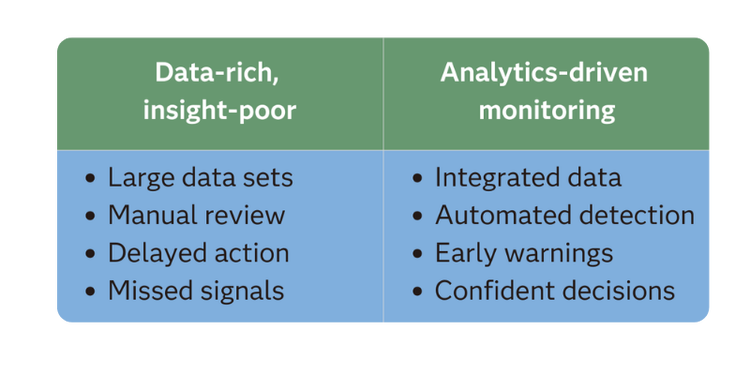
How sustainability analytics drives smarter decisions across industries
Many organizations still treat sustainability as something separate from core operations: a reporting requirement, a long-term aspiration, or a cost justified primarily by values or regulation.
But the examples above point to a different conclusion. Across industries, lasting sustainability gains emerge when teams improve how they experiment, monitor processes, and make decisions. The same changes that reduce waste and emissions also tend to improve yield, shorten development cycles, and lower operating costs.
This is the essence of sustainability analytics; using better data, smarter experimentation, and integrated monitoring to reveal the sustainability outcomes already embedded in efficient operations. When organizations embrace this mindset, sustainability stops being a tradeoff and becomes a signal that systems are working as intended.
These outcomes matter regardless of industry. They protect margins, reduce risk, and enable growth without scaling inefficiency, making sustainability analytics not just an environmental initiative, but a scientific and competitive advantage.
Discover how design of experiments (DOE) and sustainability analytics help teams reduce resource use, control costs, and maintain product performance. Learn how to turn your data into measurable environmental and operational results while reducing resource use, controlling costs, and maintaining product performance.
Watch our on-demand webinar.