CUSUM and EWMA Control Charts
What are CUSUM and EWMA control charts?
CUSUM and EWMA control charts are advanced control charts often used in automated process control to signal small shifts or drifts in a process. Shewhart charts use only the current data point to determine the control status of the process. Cumulative sum (CUSUM) and exponentially weighted moving average (EWMA) charts use both the current and past data. CUSUM charts weight the past data equally; EWMA charts use exponentially decreasing weights on past data.
When should you use a CUSUM or EWMA chart?
Shewhart control charts (individual and Xbar) are very good at detecting large changes in the mean quickly. Some processes might need different control schemes. For example, you might want to detect small shifts quicker or a linear trend in the mean rather than a shift in the mean.
Remember that the purpose of a control chart is to detect a change in the distribution of the process – to find special causes of variation. Many process changes are large, abrupt shifts in the average level due to external forces like sudden equipment failure, a change in raw materials, different incoming product, etc. Ordinary Shewhart charts are good at detecting these types of shifts. However, some process changes are small shifts or drifts in the average level due to smaller changes in the external forces acting on a process. These types of changes can take a long time to detect with a Shewhart chart.
Let’s look at an example. Suppose you use a colorimeter daily on a printed test page to assure quality in the color of printed covers for the books you publish. The data on the control chart in Figure 1 below are wavelengths from the orange color on the test page, simulated to have a constant average value through Subgroup 35. The control limits for the individual chart were calculated on the simulated in-control data.
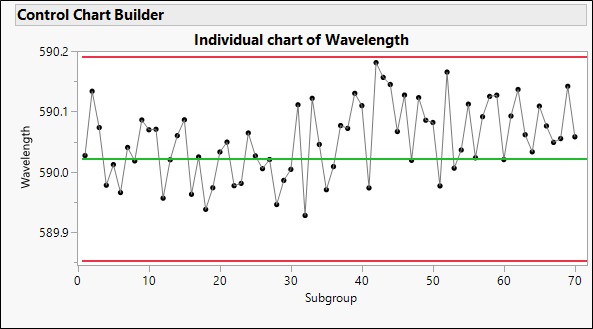
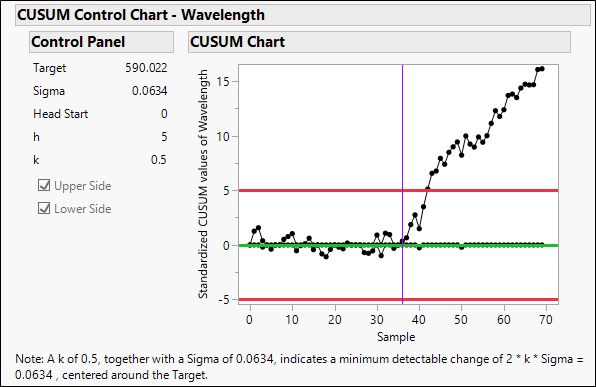
After Subgroup 35, a 1$\sigma$ mean shift was introduced in the process. The chart does not signal in the next 35 subgroups. In fact, it can be shown (see Lesson 4, Section 1 of Statistical Process Control Course - JMP User Community) that on average, it will take this chart 44 subgroups to signal after a small 1$\sigma$ mean shift. In contrast, a CUSUM chart or EWMA chart can detect a 1$\sigma$ mean shift in an average of 10 subgroups.
In the graph above, you might be able to detect a shift upward even though the chart has not signaled. You might be tempted to add additional tests to the control chart. Adding tests 1, 2, 5 and 6 (the zone rules) can also reduce the average time to signal the shift to 10 subgroups, but the false alarm rate is greatly increased.
Therefore, if detecting small shifts or drifts in your process is important to you, you should consider a CUSUM or EWMA chart.
CUSUM control chart
CUSUM charts can be used on either subgroup averages or on individual values. There are two halves to the chart: the upper and lower halves. There are two chart parameters: h and k. These parameters control the time it takes the chart to signal a shift in mean.
There are two plotting statistics. At time 0, both plotting statistics are zero. The CUSUM then accumulates the difference between the process observation and the process target, scaled by the process variation. Both statistics are plotted on the same chart. (Details on the chart calculations can be found in Lesson 4, Section 1 of Statistical Process Control Course - JMP User Community.)
Learn how to create a CUSUM control chart in JMP
https://www.youtube.com/watch?v=DZnC3bjk2u8
- To see more quality and reliability JMP tutorials, visit JMP's Quality and Reliability playlist on YouTube.
- To follow along using the sample data included with the software, download a free trial of JMP.
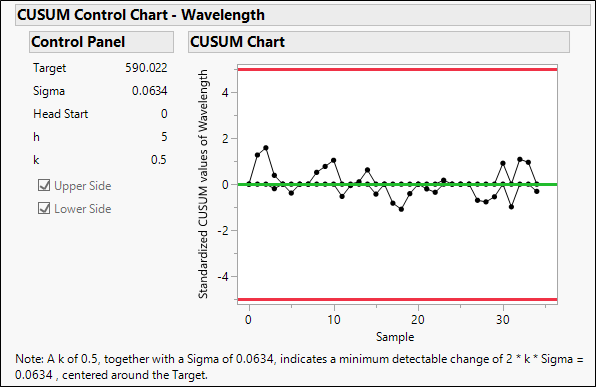
In the CUSUM chart, there are two plotting statistics for each subgroup. The upper CUSUM statistic C+ will detect upward shifts and drifts, and the lower CUSUM statistic C– will detect downward shifts and drifts in the process mean. The chart in Figure 2 shows no signals.
EWMA control chart
Exponentially weighted moving average control charts can also be used to detect small shifts. The plotting statistic for an EWMA chart is a portion λ of the most recent observation plus (1 – λ) times the previous EWMA statistic. In this way, the EWMA is a weighted average of all the data, with the weight decreasing exponentially as you go back in time. How much past data are included in the EWMA statistic is controlled by λ. Typically, the value of λ used in practice is about 0.2, or 20% of the most recent point, 80% of the history.
The control limits of the EWMA chart are based on the standard deviation of the EWMA statistic. Since the EWMA is a weighted average, the standard deviation depends on the subgroup number but soon reaches steady state. Thus, the control limits on an EWMA chart vary for the first few subgroups before reaching constant limits. (Details on the chart calculations can be found in Lesson 4, Section 1 of Statistical Process Control Course - JMP User Community.)

Learn how to create an EWMA control chart in JMP
https://www.youtube.com/watch?v=L5WCDo9QzE8
- To see more quality and reliability JMP tutorials, visit JMP's Quality and Reliability playlist on YouTube.
- To follow along using the sample data included with the software, download a free trial of JMP.
The EWMA can be used as a forecasting tool. The EWMA statistic for the last time period is used as a forecast for the next time period. The last value in the control chart in Figure 4 (Subgroup 71) is the forecast of the process for the next subgroup.